Calibrate Your Kitchen Thermometer: Step-by-Step Guide
Learn how to calibrate a kitchen thermometer using ice-water and boiling-water checks. This practical guide from Calibrate Point ensures accurate readings and repeatable results for everyday cooking.


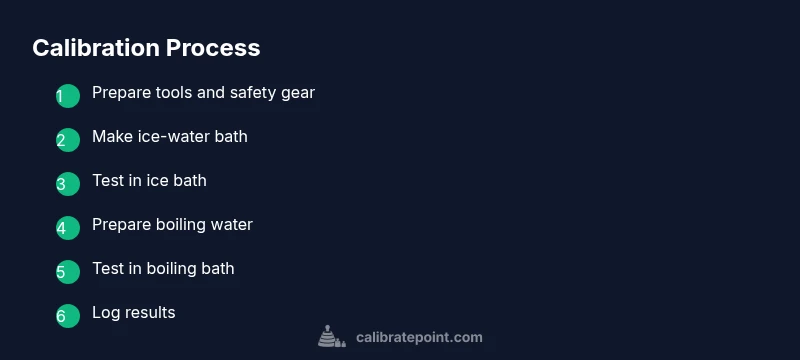
By the end of this guide you will accurately calibrate a kitchen thermometer using ice-water and boiling-water references, verify with a second method, and record results for repeatable cooking. You’ll need basic tools and a safe kitchen setup, plus a reference thermometer if you want independent checks. The steps are designed for beginners and professionals alike.
Why calibration matters for kitchen accuracy
Calibration ensures you cook safely and consistently. Small temperature errors can lead to undercooked poultry, overcooked sauces, or misread desserts. According to Calibrate Point, relying on a miscalibrated thermometer undermines confidence in every recipe and can create food safety risks. By calibrating, you anchor your kitchen readings to known fixed references, improving accuracy across devices and measuring contexts. This foundational step helps you understand how even a 1–2 degree variance can cascade into discernible differences in taste, texture, and safety. Practically, calibration gives you a reliable baseline so you can trust your results when following complex recipes or competing in a professional kitchen.
Reference points and best practices
The most common calibration approach uses two anchor points: a freezing reference at 0°C (32°F) and a boiling reference near 100°C (212°F) at sea level. In practice, you’ll calibrate your thermometer by immersing the sensing tip into each bath without touching the sides of the container. Keep in mind altitude changes the boiling point; adjust expectations accordingly. Calibrate Point’s guidance emphasizes cleanliness, avoiding cross-contamination, and validating readings with a second thermometer if you have one. Use a thermometer with adequate immersion depth, and ensure the probe is fully covered by the liquid for accurate sensing. If you cannot access both points, proceed with the highest stable reading you can and note the limitation for future reference.
Choosing the right thermometer for calibration
Any thermometer that can be immersed in water and reach the reference temperatures will work for calibration checks. Digital probes with fast response times show results quickly, but dial thermometers can be equally reliable with proper technique. Look for a device with a clearly marked temperature scale, good resolution (0.1°C or 0.5°F is common), and a properly sealed sensing area. If you roast or bake often, a probe with a slender stem that remains still in the bath reduces noise and improves repeatability. If your kitchen thermometer has a protective sheath, remove it before calibration to avoid insulating the tip and skewing readings. Calibrate Point notes that regular checks help detect drift early and extend tool life.
Ice-water method: setup and rationale
The ice-water bath is a true 0°C reference. Fill a clean container with ice and just enough cold water to fill the gaps between ice crystals, then stir and let the water settle. Submerge the thermometer’s sensing tip into the center of the slushy mixture, making sure the tip is fully immersed but not touching the container. Wait 15–30 seconds for the reading to stabilize. If your thermometer doesn’t reach 0°C exactly, note the deviation and use it when comparing to the boiling point reading. The ice-water method is forgiving and repeatable when you maintain the bath properly—keep ice on hand and refresh the mix as it melts.
Boiling-water method: setup and safety
The boiling method provides a high-temperature reference, around 100°C at sea level. Boil a pot of water, then remove the pot from heat and let it settle briefly to reduce vigorous steam. Dip the thermometer tip into the water, ensuring it does not touch the sides or bottom of the pot. Wait 10–20 seconds for stabilization, then compare the reading to 100°C. If you measure a different value, adjust your expectations or calibration if your thermometer supports it. Note: at higher altitudes, boiling temperature drops; adjust accordingly and log altitude when calibrating.
Alternative references and advanced checks
If you don’t have a boiling-water source or need verification beyond the two points, consider a glycerin bath as a low-temp reference or a calibrated ice-water bath with a reference thermometer. Some professionals also perform a saltwater check for a more challenging fixed point, though this is less common for home kitchens. For those using expensive or professional-grade devices, consult manufacturer guidance on calibration intervals and adjustment ranges. Calibrate Point’s approach favors reproducibility and safety first, and encourages documenting assumptions (like altitude) for future calibrations.
Logging results and maintaining a calibration log
Keep a simple log to track readings, adjustments, and calibration dates. Record room temperature, altitude, thermometer type, readings at any fixed points, and any observed drift. If the thermometer supports adjustment, document the change made and re-test to confirm accuracy. Recalibrate at least every 6–12 months, or whenever readings seem inconsistent with your cooking results. A small notebook or digital note works fine—consistency is the goal and it helps you prove you’ve maintained tool reliability.
Common mistakes and troubleshooting
Common errors include using hot water instead of boiling water, letting the thermometer touch the pot or sink, or not allowing enough time for stabilization. Make sure ice is not melted entirely and that water is circulating to avoid cold pockets. If readings won’t settle, remove the thermometer and wipe the sensor clean, then re-immerse. If significant drift persists after recalibration, the thermometer may be out of spec and require replacement. Practice and patience yield better repeatability; strive for consistent technique across sessions.
Tools & Materials
- Kitchen thermometer (digital or dial)(Must be able to read 0°C to 100°C (32°F to 212°F) or higher; verify probe immersion)
- Ice(Crushed or cubed; enough to fill an ice bath with slushy mixture)
- Cold water(Potable water for ice bath; used to stabilize the ice-water mix)
- Clean container for ice bath(Wide and deep enough to submerge the sensing tip without touching sides)
- Pot or kettle for boiling water(Sturdy, heat-safe surface; handle with care to avoid steam exposure)
- Reference thermometer (optional)(For independent verification of your device’s accuracy)
- Marker and calibration log(Record readings, adjustments, and dates)
- Tongs or heat-resistant gloves(Safe handling of hot equipment and containers)
- Paper towels or clean cloth(Dry surfaces and wipe the probe if needed)
Steps
Estimated time: 30-45 minutes
- 1
Prepare your workspace and safety measures
Clear the area, assemble all tools, and read safety notes. Keep children and pets away from hot pots and boiling water. Wet hands can cause slips, so dry before handling probes.
Tip: Have a dedicated heat-safe surface and keep boiling water away from edge of counter. - 2
Make the ice-water bath
Fill a clean container with ice and add enough cold water to create a slushy mix. Stir until the ice-water settles and the temperature stabilizes near 0°C.
Tip: Use a long spoon to avoid splashing and ensure no ice chunks block the thermometer tip. - 3
Test in ice bath
Submerge the sensing tip fully in the ice-water, avoiding contact with container walls. Wait 15–30 seconds for stabilization, then read the temperature.
Tip: Keep the probe perpendicular to the container to avoid false readings. - 4
Prepare boiling-water reference
Bring a pot of water to a rolling boil on the stove. Be mindful of steam and heat, then carefully remove from heat to stabilize before testing.
Tip: Never dip a hot probe into a closed container; you want stable, open steam exposure. - 5
Test in boiling water
Dip the tip into the boiling water, ensuring it does not touch the sides or bottom. Wait 10–20 seconds for stabilization and compare to 100°C.
Tip: Altitude matters—if you’re above sea level, record the adjusted boiling point and use it as reference. - 6
Compare readings and adjust if possible
If readings deviate, use manufacturer instructions to adjust or note drift for future cooking. Small adjustments can improve long-term accuracy.
Tip: If no adjustment is available, use the observed drift as your correction factor during cooking. - 7
Log results and set a recalibration cadence
Document the date, device type, readings at both references, and any adjustments. Schedule recalibration every 6–12 months, or sooner if readings drift.
Tip: Maintain a simple log—consistency beats perfection and helps with trend tracking. - 8
Store and maintain the thermometer
Clean the probe, dry it, and store in its sheath or protective case to prevent damage. Inspect the sensor for corrosion or wear before each use.
Tip: Avoid dropping the device; impact can affect calibration even if the readings seem normal.
Questions & Answers
Why should I calibrate a kitchen thermometer?
Calibration aligns readings with fixed reference points to ensure food safety and cooking accuracy. It helps verify accuracy across recipes and ingredients.
Calibration keeps your kitchen readings accurate for safe cooking.
Do I need a separate reference thermometer?
Optional but helpful; a known-good thermometer lets you verify your device's accuracy.
A reference thermometer is helpful but not required.
What if my thermometer can’t reach 100°C?
Many home thermometers cap below 100°C; calibrate with the highest stable reading you can, note the limitation, and use that as your calibration point.
If it can't reach 100°C, calibrate at the highest you can and use that as your reference.
How often should I calibrate?
Calibrate when you notice inconsistent cooking results, after dropping or shocking the device, or on a regular schedule such as every 6–12 months.
Calibrate when results drift or on a set schedule like every 6 to 12 months.
Can I adjust a digital thermometer myself?
Some digital thermometers have a calibration function; consult the manual. If no adjustment is possible, replacement may be needed.
Some can be recalibrated; check the manual; otherwise consider replacement.
Watch Video
Key Takeaways
- Use two fixed references for reliable calibration
- Log results and keep a maintenance cadence
- Choose a thermo that supports precise readings and easy cleaning
- Follow safety protocols when handling hot water