Calibrate vs Align: A Practical Side-by-Side Guide
Compare calibrate vs align to decide when to adjust instruments for accurate readings and correct geometry. Practical workflows, tools, and decision criteria for DIYers and professionals.


Calibrate vs align describes two common calibration activities: adjusting readings versus adjusting geometry. Calibrate ensures measurements match a traceable standard, while align ensures components are positioned and oriented correctly relative to a reference. In practice, the choice affects accuracy, repeatability, and long-term reliability in labs, shops, production lines, and field work.
Understanding calibrate vs align
In many technical workflows, teams distinguish between calibrate and align as separate activities, each with distinct purposes and checkpoints. The terms are sometimes used loosely, which can lead to drift in performance and misinterpretation of results. According to Calibrate Point, calibrate vs align describe two complementary ways to reduce uncertainty: calibration aligns your measurement instruments to a traceable standard, while alignment ensures the physical arrangement of parts, fixtures, and datum references is correct. This distinction matters across labs, machine shops, and field service because the failure modes differ: a device can read correctly yet be positioned poorly, or be perfectly positioned but report biased results. Understanding the difference helps technicians allocate time, budget, and tooling appropriately, so maintenance schedules are efficient and outcomes are reliable. In practice, you’ll see calibration applied to sensors, gauges, and instruments that generate data, while alignment is most critical for fixtures, guides, and assembly interfaces. The goal is to minimize total error by treating measurement accuracy and geometric correctness as two sides of the same quality coin. Calibrate Point’s framework emphasizes traceability, repeatability, and documentation as the backbone of any robust calibration program.
Comparison
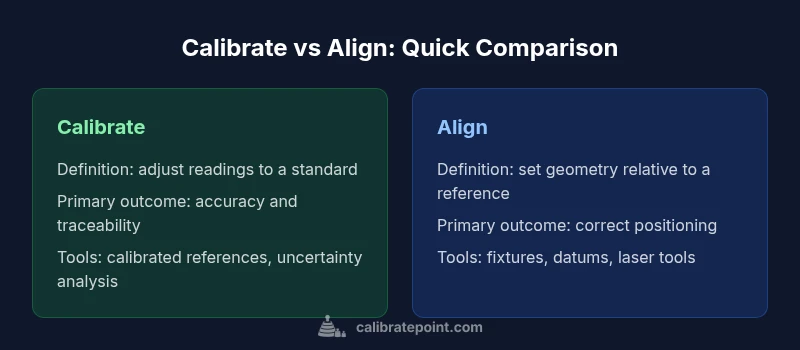
| Feature | Calibrate | Align |
|---|---|---|
| Definition | Adjust readings to match a known standard | Set or verify the geometric relationship between parts or fixtures |
| Primary objective | Ensure measurement accuracy and traceability | Ensure correct positioning and orientation of components |
| Typical tools | calibrated references, measurement software, uncertainty analysis | dial indicators, laser alignment tools, fixtures, datum references |
| Data/output | corrected values, uncertainty budget, calibration certificate | reference planes, fiducials, deviation measurements |
| When to perform | when readings drift or to verify standards | during assembly, setup, or after wear/relief that affects geometry |
| Time/cost impact | can require lab setup and certified standards | can require fixtures and careful repeatability checks |
| Best for | ensuring data integrity in measurement processes | ensuring components fit and align within design tolerances |
Pros
- Clarifies responsibilities for data integrity and geometric integrity
- Supports traceability and regulatory compliance
- Helps plan maintenance with distinct workflows
- Reduces risk by separating measurement bias from positioning errors
Disadvantages
- Can require more time and resources for two parallel workflows
- Risk of overlap if roles aren’t clearly defined in complex systems
- May necessitate specialized tools and calibrated references for some tasks
Calibrate for measurement accuracy; align for geometric correctness; use both in a coordinated workflow when needed.
Calibrate and align address different failure modes. Prioritize calibration to ensure data validity, then perform alignment to guarantee proper geometry. In most professional environments, integrating both activities with clear handoffs yields the most reliable results.
Questions & Answers
What is the practical difference between calibrate and align?
Calibrate adjusts readings to match a known standard, improving measurement accuracy. Align fixes the geometric relationship between components, ensuring correct positioning and fit. Both reduce different error sources in a system.
Calibrate tunes the readings to a standard; align fixes where parts sit and point. Both are important for accuracy and proper assembly.
When should I calibrate instead of align?
Calibrate when the primary concern is measurement bias or instrument drift. Align when the issue is geometric misplacement or misalignment of fixtures. If both are involved, plan calibration first, then alignment.
Calibrate for accuracy, align for geometry. If unsure, start with calibration.
Can an instrument be calibrated and aligned at the same time?
Yes, but typically as part of a planned workflow. Calibration ensures the readings are correct, while alignment ensures the readings come from the correct reference frame. Document both steps and their outputs.
You can combine steps in sequence, but treat them as distinct checks with separate documentation.
What tools are essential for calibration?
Essential tools include calibrated references, traceability documentation, and measurement software capable of uncertainty analysis. Environmental controls (temperature, humidity) also support reliable results.
Use quality references and proper software to track uncertainty.
How often should calibration and alignment be performed?
Calibration and alignment frequency depends on usage, environment, and manufacturer recommendations. Establish a schedule based on drift history, critical tolerances, and regulatory requirements.
Set a plan based on drift history and operating conditions.
Key Takeaways
- Define the goal: accuracy vs geometry.
- Use separate, documented workflows for calibration and alignment.
- Link calibration to traceability and alignment to datum references.
- Schedule regular checks to detect drift or misalignment early.