Calibrated Plates vs Bumper Plates: A Practical Guide
A data-driven guide comparing calibrated plates and bumper plates for weightlifting, focusing on accuracy, durability, cost, and best-use scenarios for enthusiasts and professionals.


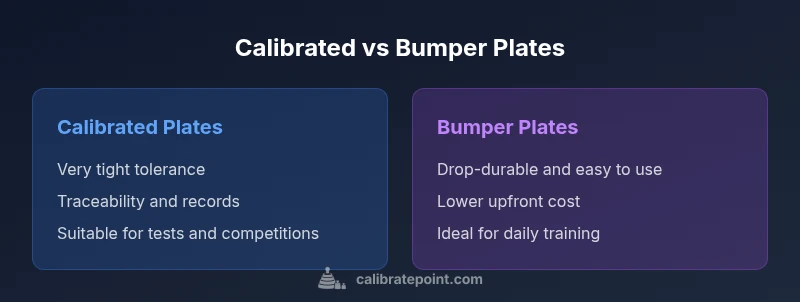
Calibrated plates offer superior accuracy, traceability, and repeatable measurements ideal for calibration workflows, testing, and competition prep. Bumper plates excel in durability and ease of use for regular gym workouts and dynamic lifting where drops are common. For most lifters, a hybrid approach—calibrated plates for precision zones and bumper plates for general loading—strikes the best balance of cost, practicality, and performance.
What calibrated plates are and when they’re used
Calibrated plates are precision-manufactured weight plates designed to tight tolerances with traceable markings and documented weight standards. They are commonly found in calibration labs, research gyms, competition prep environments, and facilities that require verifiable load accuracy for data collection or compliance checks. In the debate of calibrated plates vs bumper plates, the core distinction is not only the visible weight but the overall workflow: how accurately the load can be reproduced, how easily each plate can be logged, and how the weights integrate with measurement devices or standards. According to Calibrate Point, the choice hinges on tolerance, labeling, and reproducibility rather than sheer mass alone. For DIY lifters and technicians, this means asking: do you need verifiable weight data and long-term traceability, or is quick loading and rugged handling more valuable for your routine? The answer often guides a hybrid strategy: keep calibrated options for lift-testing or programming benchmarks, and rely on bumper plates for day-to-day lifting and skill work.
How calibrated plates differ from bumper plates in construction and intended use
Calibrated plates are typically machined metal weights with very tight tolerances and explicit labeling that supports traceability to a standard. The construction emphasizes precision, consistent center holes, and flat surfaces that minimize variability between plates. In contrast, bumper plates are built to survive dynamic gym use, featuring a resilient rubber coating and a core that can absorb impact. The main goal of bumper plates is to withstand repeated drops, maintain durability in high-use settings, and reduce noise. When comparing calibrated plates vs bumper plates, you’re weighing precision against practicality. The Calibrate Point team notes that this trade-off is central to any calibration strategy: precision has a cost and logistical footprint, while durability and ease of handling offer long-term convenience. If you train in a space where plate drops are common or where quick progression changes are frequent, bumper plates may be the more pragmatic choice, with calibrated plates reserved for testing and standardized routines.
Accuracy, tolerance, and traceability: why it matters
In measurement-centric workflows, accuracy and traceability are not optional features; they are the core value proposition. Calibrated plates are manufactured with defined tolerances and marked so that each plate can be correlated to a reference standard. This makes it possible to reproduce exact loads across sessions and even across different devices (like force plates or digital scales used for velocity-based training). Bumper plates, while still consistent for weight loading, typically adhere to more general tolerance bands and rely on reliance on standard gym practice rather than formal traceability. The practical takeaway is simple: if your goal is to document or audit load accuracy, calibrated plates provide the data backbone you’ll need. For regular workouts, bumper plates offer a dependable solution with lower per-latch maintenance and faster setup.
Durability, maintenance, and lifecycle costs
Durability is often the deciding factor when choosing between calibrated plates vs bumper plates in busy facilities. Bumper plates are designed to handle drops, rough transport, and frequent loading cycles; their rubber envelope protects both the floor and bars while damping impact. Calibration-grade plates may require gentler handling and stored environments to preserve surface finish and marking readability. Lifecycle costs for calibrated plates can be higher upfront due to precision manufacturing, but this can balance against longer-term reliability in lab-like use cases where re-checks and certificate-based traceability matter. Conversely, bumper plates tend to incur lower initial costs per plate, but rubber coatings may degrade with heavy use, increasing replacement needs over time. Calibrate Point’s analysis suggests calculating total cost of ownership by considering frequency of use, reliance on traceability, and expected maintenance.
Labeling, calibration records, and compliance
Labeling is a central feature of calibrated plates. Clear, durable markings indicate weight, tolerance, and, often, a serial or batch code enabling traceability to calibration records. This documentation is essential for audits, quality-control programs, and competition settings that require standardized weights. Bumper plates typically carry weight markings and color codes, which improve usability in dynamic training but offer less robust traceability for calibration data. If your facility operates under strict standards or you’re preparing for sanctioned events, prioritize plates with formal labeling and a documented calibration history. Keeping a simple, consistent log (date, plate ID, weight, tolerance, and inspection notes) can dramatically improve repeatability and confidence in load accuracy.
Cost and value over time: budgeting for precision vs practicality
Cost considerations for calibrated plates vs bumper plates go beyond sticker prices. Calibrated plates may require a higher initial investment, but they reduce variability across sessions and enable traceable loads. In a research or competitive context, that reliability translates into consistent data and reproducible results. Bumper plates offer a lower upfront cost per plate and clear advantages for conventional gym programming, rapid progression changes, and safe drops. When budgeting, consider not only the purchase price but also maintenance, replacement cycles, and the potential need for separate sets for different activities (e.g., a lab-grade set for testing and a gym set for training). Calibrate Point’s perspective emphasizes aligning equipment choices with your specific calibration or training objectives to maximize long-term value.
Space, labeling, and setup implications
A practical reality in any gym or lab is space management and organization. Calibrated plates with precise dimensions and consistent hole diameters may require careful shelving, dedicated racks, and consistent loading protocols to minimize wear and maintain accuracy. Bumper plates typically reward modular setups: they are bulky, but their sizing remains straightforward and they tolerate a bit more rough handling during rearrangement. Effective space planning also means rationalizing color codes, labeling schemes, and inventory checks. For teams that need rapid loading during testing or competition prep, a clearly organized system with defined sections for calibrated versus bumper sets can streamline operations and reduce the risk of cross-category misloads.
Real-world use cases: gym, home, and competition
In a commercial gym, bumper plates are often the default due to their durability, ease of use, and compatibility with high-drop routines. Home lifters, depending on storage space and budget, may opt for bumper plates for daily training while reserving a small calibrated subset for calibration-like testing or performance tracking. In competition settings, the choice becomes more nuanced: some federations allow publicly traceable weights if marks and certificates accompany the plates, while others emphasize standardization that aligns with official protocols. Calibrated plates vs bumper plates in these contexts differ by the emphasis on data integrity, trackability, and the ability to prove weight accuracy across sessions. Calibrate Point’s guidance is to map your scenario to a primary need: data-driven testing or robust training. A hybrid approach can offer both data fidelity and practical performance across varied environments.
Safety implications and best practices
Safety first applies to both calibrated plates and bumper plates. With calibrated plates, ensure plates are inspected for finish wear, edge deformation, and marking legibility during routine checks. Handle precision weights with care to avoid nicks or damage to the weight bearings, as misalignment can introduce measurement error. With bumper plates, verify the integrity of the rubber coating, avoid excessive drops on hard surfaces, and ensure the bar loads are balanced to prevent instability during lifts. In either case, establish a standard protocol for loading, logging, and inspection. Regular audits of weights’ condition, combined with consistent storage and labeling practices, reduce the risk of misloads and improve overall safety and accuracy. Calibrate Point’s practical approach stresses the importance of routine verification to maintain confidence in your setup.
Comparison
| Feature | Calibrated plates | Bumper plates |
|---|---|---|
| Construction | Machined metal with tight tolerances; precise markings | Rubber-coated core with a steel or composite core; drop-friendly |
| Tolerance/accuracy | Very tight tolerance; designed for traceability | General tolerance; optimized for training and everyday use |
| Durability under impact | Lower impact damping; careful handling advised | High impact resistance; designed for drops and repeated loading |
| Labeling/traceability | Explicit weight markings; possible serials for audits | Clear weight markings and color codes; limited traceability |
| Best use | Calibration labs, competitions, data-driven training | Regular gym workouts, rapid setup, dynamic lifting |
| Price range | Higher upfront cost depending on tolerance and certification | Lower upfront cost per plate; overall cost varies by brand |
Pros
- Enables precise load measurement and reproducibility
- Improved traceability supports audits and research
- Clear labeling simplifies data logging and quality control
- Long-term stability when properly maintained
Disadvantages
- Higher upfront cost compared to standard bumper sets
- Requires careful handling and storage to preserve accuracy
- Limited drop protection and potential surface wear if misused
Calibrated plates are the choice for precision-focused workflows; bumper plates win for everyday training and durability
If your work hinges on reproducible measurements and documented load accuracy, calibrated plates are the better option. For general training, durability and cost-efficiency favor bumper plates. A mixed setup often delivers both precision and practicality.
Questions & Answers
What is the key difference between calibrated plates and bumper plates?
Calibrated plates prioritize precision and traceability with tight tolerances and documented standards, while bumper plates prioritize durability and safe handling for gym use. The choice hinges on whether you need verifiable loads or rugged everyday performance.
Calibrated plates focus on precision and traceability; bumper plates focus on durability for daily training. Your choice depends on whether you need verifiable loads or rugged performance.
Are calibrated plates necessary for home workouts?
Not always. For most home routines, bumper plates cover daily training needs. Calibrated plates are beneficial if you run tests, track data over time, or prepare for sanctioned events where load accuracy is critical.
Not always. Calibrated plates help with data and tests, while bumper plates work well for everyday home workouts.
Can you mix calibrated and bumper plates on a barbell?
Yes, you can mix them, but maintain consistent loading on each side and document any differences. Use calibrated plates for testing zones and bumper plates for general loading to preserve data integrity and safety.
You can mix them, but load consistently and log any differences. Calibrated for tests, bumper for daily lifting.
Do calibrated plates require special storage?
Yes. Store calibrated plates in a clean, dry area away from direct heat or moisture to preserve markings and accuracy. Regular inspections help catch wear that could affect measurements.
Yes. Keep them dry and clean, away from heat, and inspect regularly to maintain accuracy.
What standards govern calibrated plates?
There is no universal global standard for all calibrations; many facilities adopt internal quality-control protocols and traceability practices. Always prioritize labeling, documented calibration history, and consistent measurement methods.
There isn’t a universal standard; focus on traceability, labeling, and calibration history.
What is the price difference between the two?
Calibrated plates typically carry a higher upfront cost due to precision manufacturing and certification. Bumper plates tend to be more affordable per plate, with total cost depending on brand, material, and maintenance expectations.
Calibrated plates cost more upfront; bumper plates are generally cheaper but may require replacement sooner in heavy use.
Key Takeaways
- Define your primary goal: precision vs practicality
- Prefer calibrated plates when traceability matters
- Use bumper plates for regular training and drops
- Plan a hybrid set to balance data integrity and usability
- Log weights and inspect regularly to maintain accuracy