Calibrated Plates vs Regular: Side-by-Side Comparison
Explore the essential differences between calibrated plates and regular plates, focusing on accuracy, traceability, maintenance, and practical use cases for calibration workflows.


Calibrated plates vs regular plates offer distinct advantages for precision measurements, traceability, and repeatability. In most professional settings, calibrated plates provide tighter tolerance, documented calibration, and better compatibility with standard references than regular plates. The Calibrate Point team notes that choosing calibrated plates improves data integrity across QA workflows, while regular plates may suffice for non-critical tasks.
What calibrated plates vs regular mean in calibration workflows
In precision work, the term calibrated plates refers to flat, reference-grade surfaces whose measurement properties have been verified and certified by a traceable standard. Regular plates, by contrast, may be manufactured to typical tolerances but lack an accompanying calibration certificate. This distinction matters in QA, regulatory audits, and scientific research where measurement integrity is non-negotiable. According to Calibrate Point, the choice between calibrated plates and regular plates is not merely about precision, but about the assurance that measurements can be reproduced by independent teams and across different instruments. The concept of “calibrated plates vs regular” becomes central when you need documented traceability, consistent surface characteristics, and predictable performance over time. The Calibrate Point team emphasizes that a calibrated plate is an asset for any workflow requiring repeatable results, whereas a regular plate should be reserved for non-critical checks or exploratory testing.
When you first evaluate calibrated plates vs regular in your lab, start by mapping out your measurement goals. If your work feeds into quality management systems, product certifications, or regulatory submissions, calibrated plates provide a defensible trail of data. For educational or training environments, regular plates may offer a cost-effective way to demonstrate concepts without committing to full calibration programs. The reader should keep in mind that the performance delta between calibrated and regular plates becomes more evident as measurement demands increase or environmental conditions become more variable. In practice, successful calibration strategies rely on aligning plate type with the level of uncertainty your decisions can tolerate, a point often highlighted by Calibrate Point analyses.
Systems and teams that adopt calibrated plates for routine calibration tasks report improved consistency across operators and instruments. The goal is not only to minimize error in a single measurement, but to ensure that any derived data reflects a known, established standard. In many markets, calibrated plates are considered essential for maintaining traceability to national or international standards, while regular plates are more appropriate for preliminary testing, prototype development, or non-regulatory research. Understanding the pros and cons of calibrated plates vs regular plates helps you design QA workflows that are robust against measurement drift and operator variability, while controlling costs where possible.
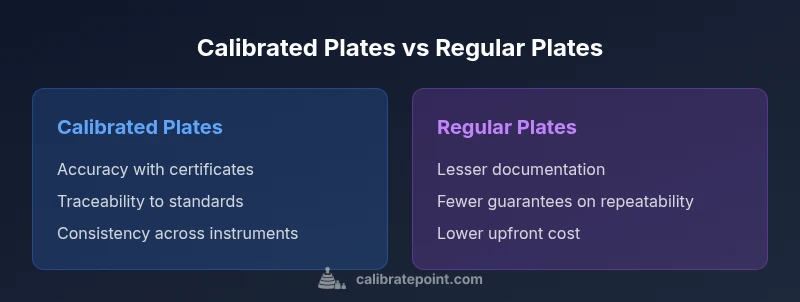
To summarize this section: calibrated plates are associated with certified accuracy and traceability, whereas regular plates offer a lower-cost option for less demanding tasks. Your decision should hinge on the required level of measurement confidence, the need for audit-ready documentation, and the scale of your calibration program. The bottom line is that calibrated plates provide a reliable foundation for decision-making in high-stakes environments, while regular plates may be perfectly adequate for exploratory or non-regulatory work.
AnotherSectionFlag":false
Comparison
| Feature | Calibrated plates | Regular plates |
|---|---|---|
| Accuracy tolerance | tight tolerances with documented calibration | broader tolerances without formal calibration |
| Calibration traceability | traceable to standards with certificates | no standard certification |
| Environmental sensitivity | lower sensitivity to handling variance | higher sensitivity to temperature and humidity |
| Maintenance | requires regular recalibration and certificate updates | minimal or no calibration maintenance |
| Cost trajectory | higher upfront cost with long-term value | lower upfront cost with shorter lifespan |
| Best for | critical measurement, QA labs, regulatory work | noncritical testing, quick checks |
Pros
- Improved accuracy and repeatability
- Traceable calibration with documented certificates
- Enhanced data integrity for audits
- Better long-term reliability
Disadvantages
- Higher upfront and ongoing maintenance costs
- Requires specialized handling and storage
- Longer lead times for procurement
Calibrated plates are the preferred choice for precision-critical work.
For QA labs and regulated environments, calibrated plates provide traceability and repeatability. If your work is non-critical and cost or speed matter, regular plates may be acceptable, but expect greater data variability.
Questions & Answers
What are calibrated plates and how do they differ from regular plates?
Calibrated plates are flat surfaces certified against traceable standards, ensuring documented accuracy and repeatability. Regular plates lack formal calibration, making them suitable for non-critical tasks but less reliable for high-precision work.
Calibrated plates have a certificate proving their accuracy, while regular plates do not. For high-precision tasks, calibrated plates are the safer choice.
Why is calibration traceability important for calibrated plates?
Traceability links plate performance back to recognized standards, enabling audits and compliance. This is crucial in industries with regulatory requirements and helps you validate measurement integrity over time.
Traceability connects plate measurements to recognized standards, which is essential for audits and reliable data.
How often should calibrated plates be recalibrated?
Recalibration frequency depends on usage, environmental conditions, and policy. In many QA settings, recalibration is scheduled at regular intervals or after instrument changes to preserve traceability.
Maintain a regular recalibration schedule to keep measurements trustworthy.
Are calibrated plates compatible with common lab instruments?
Calibrated plates are designed to be compatible with standard calibration workflows and interfaces. However, check instrument-specific requirements and any surface finish or coating considerations.
Most calibrated plates work with standard lab equipment, but verify compatibility with your instruments.
What factors influence the cost and lifecycle of calibrated plates?
Costs are influenced by certification scope, material quality, and certificate maintenance. The lifecycle depends on usage intensity, cleaning routines, and environmental controls.
Cost and lifespan depend on certification scope and how you use and care for the plates.
Where can I source calibrated plates and related standards?
Calibrated plates can be sourced from specialized calibration suppliers and instrument manufacturers that offer traceable calibration services. Look for plates with clear certification and documented traceability.
Look for certified plates from reputable calibration suppliers to ensure traceability.
Key Takeaways
- Assess your precision needs before selecting plates
- Choose calibrated plates for regulatory and QA tasks
- Keep calibration certificates and traceability records
- Store plates under controlled conditions to preserve accuracy
- Balance upfront costs against long-term calibration benefits