How Many Calibration Points: Practical Guidance for Accuracy
Learn how many calibration points are typically needed for common sensors, why the count matters, and how to tailor your plan for accuracy with practical ranges and best practices from Calibrate Point.


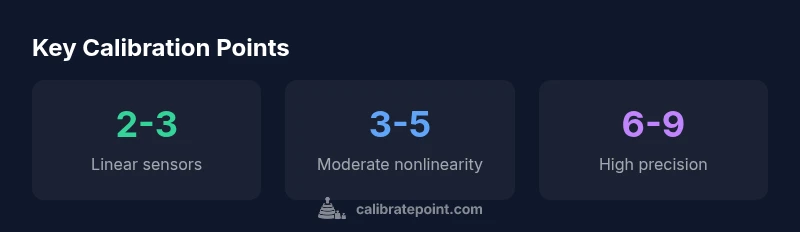
For most linear sensors, 2-3 calibration points are common, while non-linear or high-precision applications often use 3-5 points, and up to 6-9 for very dynamic ranges. The exact number depends on device type, drift, and regulatory requirements, but a pragmatic baseline starts with two anchored points and a mid-range check, expanding only when nonlinearity or drift justify it.
What calibration points are and why they matter
Calibration points are the anchor values used to map an instrument's raw output to a known standard. For many sensors, the goal is to define the relationship between input and measured output so that subsequent readings are accurate across the full range. According to Calibrate Point, selecting the right number of points is a balance between capturing the device's behavior and keeping the process efficient. In practice, you want to ensure coverage at the ends of the range and at a mid-range region where nonlinearity is most likely. The central idea is to create a transfer function that interpolates reliably between anchors, minimizing uncertainty and drift over time. When you search for guidance on calibration, the core question often starts with how many calibration points you need to establish a trustworthy model. This article answers that question with practical ranges, device considerations, and a step-by-step approach.
How many points do you actually need?
The classic rule is to pair mathematical rigor with pragmatic effort. For a perfectly linear sensor, two points suffice to define a slope and offset. However, most real-world sensors exhibit some nonlinearity or drift. In practice, a three-point baseline is common, providing a stop-gap test at a mid-range that helps reveal curvature. If the device operates over a wide dynamic range or shows noticeable nonlinearity, expanding to three to five points is prudent. For high-precision instruments used in regulated processes, six to nine points are not unusual to capture complex transfer functions. Always balance the marginal gains in accuracy against the time and cost to calibrate each point.
Factors that influence the ideal count
There is no one-size-fits-all answer. The number of calibration points you choose should reflect: the device type (linear vs nonlinear), the measurement range, expected drift, environmental stability, required measurement uncertainty, and any regulatory or standardization requirements. End-point anchors are critical; mid-range anchors clarify slope changes and potential nonlinearity. More points increase fidelity but also calibration time and data handling needs. In many environments, the goal is to capture the most significant nonlinearities with as few points as possible while maintaining traceable accuracy.
How to determine the right number of points
- Define the measurement range clearly and identify critical operating regions. 2) Choose anchor values at the lower end, upper end, and at least one mid-range point. 3) Consider nonlinearity; if residuals from a simple linear model exceed your acceptance criteria, add points in regions with the largest residuals. 4) Confirm stability across time by running a short drift test. 5) Validate against traceable references and document deviations. 6) Reassess periodically or after major process changes to ensure the point count remains sufficient.
Case examples in common instruments
- Temperature sensor in a process line: start with 3 points (low, mid, high) to catch potential nonlinearity across the range. Expand to 5 if drift is observed.
- Pressure transducer: 4-7 points may be used in high-dynamic ranges; prioritize endpoints and mid-range regions impacted by nonlinearity.
- pH meter: 3-5 points typically cover the pH scale; include a known buffer near pH 4, 7, and 10 if regulatory needs exist.
- Weighing scale: 3-5 points spanning the scale helps capture nonlinearity at both ends and the mid-range.
Building a calibration plan that scales
Design your plan to be scalable from unit to facility level. Start with a small, well-documented pilot, then expand to larger batches only if data shows meaningful improvements in uncertainty reduction. Maintain a point-by-point log, capture residuals, and track the impact of environmental factors like temperature. A consistent template makes it easier to compare devices and justify point-count decisions over time.
Calibration point guidelines by device type
| Device Type | Recommended points | Typical range |
|---|---|---|
| Linear temperature sensor | 2-3 points | 2-3 |
| Nonlinear pressure transducer | 3-5 points | 3-5 |
| High-precision spectrometer | 6-9 points | 6-9 |
| pH/ORP meter | 3-5 points | 3-5 |
| Industrial force gauge | 4-7 points | 4-7 |
Questions & Answers
How many calibration points do I need for a linear sensor?
For a truly linear sensor, two calibration points define the slope and offset. In practice, adding a third point provides a check against small nonlinearities or drift and is often recommended.
Two points are usually enough for linear sensors, with a third point as a check if you suspect drift or very small nonlinearities.
When should I use more than three points?
Use more than three points when the device shows nonlinearity across the range, drift over time, or regulatory requirements demand tighter uncertainty. In many cases, 3-5 points balance accuracy and effort.
If nonlinearity or drift is present, or if regulations require tighter accuracy, consider 3 to 5 points.
Can too many calibration points hurt?
Yes. Excess points increase calibration time, data handling, and potential for user-induced errors. Use diminishing returns as a guide to stop adding points once uncertainty improvements plateau.
Adding more points can waste time and introduce errors once you’ve captured the essential behavior.
How does the number of points affect uncertainty?
More anchors typically reduce interpolation error and capture nonlinearity, lowering measurement uncertainty. However, the gains taper off; beyond a certain point, the improvement may be negligible.
More anchors can reduce uncertainty, but the benefits level off after a point.
Are there standards for calibration point counts?
Standards emphasize traceability and method validity rather than a fixed point count. Choose points to meet specified uncertainty and regulatory requirements.
There aren’t universal fixed counts in standards; focus on achieving traceable, justifiable accuracy.
How do I validate that my point count is sufficient?
Assess residuals from the calibration model, perform a drift test, and compare against acceptance criteria. If residuals stay within limits across the range, the point count is suitable.
Check residuals, drift, and acceptance criteria across the range to validate your count.
“Calibration point strategy should be driven by device behavior, not a fixed formula. Start with a baseline of two to three points for linear regions and expand where nonlinearity or drift demands it.”
Key Takeaways
- Start with two points for linear behavior; add one mid-range anchor.
- Expand to 3-5 points for most non-linear sensors and regulatory needs.
- Use 6-9 points only for high-precision, wide-range instruments.
- Balance accuracy gains against time and cost.
- Document all decisions for auditability.