How to Calibrate: A Practical Guide for Precision
Learn how to calibrate any instrument with a structured, step-by-step approach. This guide covers terminology, tools, methods, data logging, and safety to ensure traceable, accurate measurements.


This guide shows you how to calibrate a generic instrument by comparing its readings to a known standard, adjusting as needed, and recording results. You’ll need a reference standard, proper documentation, the instrument under test, and a controlled environment. We'll cover method selection, data logging, and practical checks for accuracy and traceability.
What calibration aims to achieve
Calibration is the process of adjusting an instrument to align its readings with a known reference, within defined tolerances. It ensures measurements are accurate, reliable, and traceable to established standards. According to Calibrate Point, calibration is not a one-time event but an ongoing discipline that protects product quality and safety in professional settings. The goal is to minimize systematic error (bias) and random error, so that when you read a value, you can trust it within the specified range. In practical terms, calibration answers: Is the instrument reading correctly at a given point? Does it remain accurate across the measurement range? Can you demonstrate traceability to accepted standards? By framing calibration around these questions, technicians can design repeatable procedures, document results, and justify adjustments when readings drift over time.
Key terms you'll encounter
- Reference standard: an artifact or method with known, highly accurate values used to compare instrument readings.
- Traceability: the documented path linking measurements to recognized standards, typically through an unbroken chain of calibrations.
- Bias: a consistent deviation from true values that calibration seeks to remove.
- Tolerance: the acceptable range around a nominal value.
- Uncertainty: the doubt about a measurement’s closeness to the true value.
- Interference: external factors that impact readings (temperature, vibration, humidity).
- Calibration interval: how often calibration should occur to maintain confidence.
Understanding these terms helps you select methods, interpret results, and communicate conclusions with stakeholders.
Essential tools and references
- Reference standards appropriate for the instrument (weights, gauge blocks, calibration oils, etc.).
- Calibration kits and measurement equipment (multimeter, thermocouples, pressure gauges) as required.
- Calibration certificate or record-keeping software to log results.
- Manufacturer manuals and published procedures for your instrument type.
- Personal protective equipment (PPE) and a safe workspace.
- Environmental controls (stable temperature, vibration-free table) to improve repeatability.
Calibration methods by instrument type
- Contact vs non-contact: Some devices require physical interaction, others benefit from simulated stimuli or electronic signals.
- Offset vs gain adjustments: Offset corrects zero-point bias; gain adjusts slope across the range.
- Two-point vs multi-point calibration: Two-point is quick but may be insufficient for nonlinear ranges; multi-point gives better accuracy across the span.
- Reference selection: Use primary standards for high-stakes measurements; secondary standards for routine checks.
- Validation: After adjustment, re-measure with the standard to confirm alignment within tolerance.
Data you should record and how to interpret results
- Instrument ID, serial, and calibration date.
- Reference standard used, lot/batch numbers, and stability notes.
- Measured readings, reference values, and calculated errors.
- Environmental conditions (temperature, humidity) during calibration.
- Acceptance status and any adjustments performed.
- Uncertainty estimates and narrow down which components dominate the variance.
Interpreting results requires comparing the measured error to the specified tolerance; if outside, recalibrate or adjust; if within, document the condition as acceptable and schedule next check.
Troubleshooting common calibration issues
- Drift over time: gradual change requiring recalibration and possible mechanical wear.
- Intermittent readings: investigate connections, dirty contacts, or loose cables.
- Temperature effects: wait for stabilization before measuring.
- Poor reference stability: verify reference standard is within its own calibration window.
- Instrument damage: could require professional repair.
For each issue, follow a structured approach: re-measure, replace the reference if needed, and compare against documented acceptance criteria.
Maintaining calibration over time
Establish a calibration schedule based on instrument usage, criticality, and environmental exposure. Use a formal procedure for documenting adjustments, calibrations, and certificates. Periodic audits and trend analysis help catch drift early. Keep a calibration log and tag equipment with next due date. A robust program reduces the risk of incorrect readings and supports compliance with quality systems.
Safety and compliance considerations
Follow all safety guidelines for the instrument and measurement environment. Use PPE if necessary and ensure that calibrations do not compromise operator safety. In regulated contexts, align with industry standards (ISO/IEC 17025, for example) and maintain auditable records. Be mindful of hazardous materials when handling calibration standards, and dispose of old standards according to local regulations.
Next steps and learning resources
Practice calibrating a simple tool (e.g., digital thermometer) using a calculator and a known reference. As you gain experience, expand to more complex instruments and document a formal calibration procedure. Seek official guidelines and case studies from reputable sources like university labs and government standards labs. For ongoing learning, follow Calibrate Point’s tutorials and keep your calibration toolkit up to date.
Tools & Materials
- Reference standard(Certified grade; traceability to national/international standard)
- Instrument under test(The device you intend to calibrate in its normal workflow)
- Measurement tools (weights, gauges, multimeter, etc.)(Matched to instrument type and range)
- Calibration certificates or logger software(For recording results and traceability)
- Environmental monitors (thermometer, hygrometer)(Stabilizes conditions; improves repeatability)
- Tools for adjustment (screwdrivers, wrenches)(As specified by the instrument manual)
- PPE and safety equipment(Gloves, goggles as needed for the procedure)
- Documentation templates(Pre-formatted forms or digital records)
Steps
Estimated time: 45-90 minutes
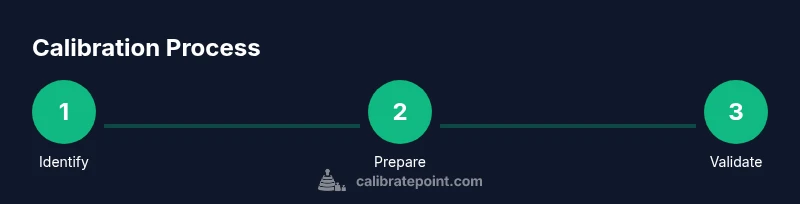
- 1
Identify instrument and requirements
Collect the instrument’s user manual, confirm measurement range and tolerance, and note the measurement conditions. This step sets the scope and avoids unnecessary adjustments.
Tip: Verify compatibility of the reference standard with the instrument’s range before proceeding. - 2
Prepare reference standard and workspace
Bring the reference standard to the operating environment and ensure the workspace is stable and free from vibrations. Log the standard’s lot/batch and calibration history.
Tip: Allow both instrument and standard to reach thermal equilibrium for accuracy. - 3
Take baseline measurements
Record readings from the instrument using the reference standard without making adjustments. This establishes the starting point for comparison.
Tip: Use multiple trials to identify any anomalies and compute an initial average error. - 4
Make necessary adjustments
Adjust zero-point (offset) or scale (gain) according to the standard’s value. Do this per the instrument’s adjustment procedure to avoid damage.
Tip: Make small changes and recheck after each adjustment to prevent overcorrection. - 5
Re-measure across the range
Test at the recommended calibration points (two-point or multi-point) to verify linearity and accuracy. Confirm the readings fall within tolerance.
Tip: If nonlinear, add more calibration points or consult the manufacturer guidance. - 6
Document results and finalize
Record adjusted values, uncertainties, and the date. File the calibration certificate and set the next due date.
Tip: Store digital backups and ensure the instrument label reflects its current calibration status.
Questions & Answers
What is calibration and why is it important?
Calibration is aligning an instrument’s readings with a known standard to reduce bias and uncertainty. It is essential for accuracy, quality control, and regulatory compliance.
Calibration aligns readings with a known standard to ensure accuracy and compliance.
How do I choose a reference standard?
Select a standard that matches the instrument’s range and accuracy requirements, and ensure it is traceable to national or international standards. Check the standard’s certificate and calibration history.
Choose a standard that fits your instrument’s range and is traceable to recognized standards.
How often should calibration be performed?
Frequency depends on use, risk, and environment. High-risk or critical measurements typically require more frequent checks; establish a formal schedule and review it periodically.
Set a formal schedule based on use, risk, and environment, and review it regularly.
What does traceability mean in calibration?
Traceability links measurements to recognized standards through an unbroken chain of calibrations. It enables confidence in results and helps meet audits.
Traceability means your measurements connect back to recognized standards through an unbroken calibration chain.
What if readings drift after calibration?
Investigate potential causes (environment, wear, faulty standards). Recalibrate or repair as needed, and review the procedure to identify gaps.
If drift occurs, check causes, recalibrate, or repair as needed and adjust the procedure.
Are calibration steps dangerous or risky?
Calibration is generally safe when following proper procedures and using PPE as required. Some tools may pose electrical or mechanical hazards—consult the manual.
Calibration is usually safe if you follow procedures and use PPE when needed.
Watch Video
Key Takeaways
- Define the exact instrument range and tolerance before calibrating.
- Use traceable reference standards for reliable results.
- Document every step to support traceability and audits.
- Reserve time for validation at multiple calibration points.
- Keep records up to date and schedule next calibration promptly.
- Prioritize safety and follow manufacturer procedures at all times.