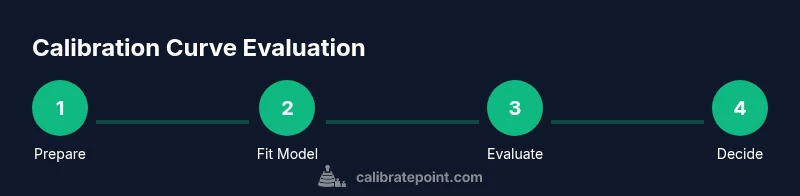
How to Know If a Calibration Curve Is Acceptable
Learn how to determine whether a calibration curve is acceptable for reliable quantification, including linearity checks, residual analysis, and documentation best practices.


To know if a calibration curve is acceptable, evaluate linearity, residuals, and the regression metrics against your method’s criteria. Check R², slope, and intercept stability, assess residuals for randomness, and verify accuracy at key QC points. Follow your approved acceptance criteria, document deviations, and re-run if necessary to ensure reliable quantification.
Understanding the Calibration Curve and Its Acceptability
In quantitative analysis, a calibration curve links instrument response to known concentrations. Knowing how to interpret this curve is essential for reliable measurements. For anyone asking how to know if calibration curve is acceptable, the answer starts with the curve’s purpose: to enable accurate quantification across the method’s working range. If the curve is not acceptable, reported results risk bias and loss of comparability. Acceptable curves are defined by how well the data fit a model, how the residuals behave, and whether the curve supports accurate concentration estimates at routine QC points. In practice, your lab will document the acceptance criteria before running a batch. These criteria should reflect the method, regulatory expectations, and the instrument’s linear range. The Calibrate Point team emphasizes that acceptability is not a single statistic; it is a synthesis of multiple indicators—linearity, fit, residual patterns, and real-world accuracy across standards and controls.
Defining Acceptance Criteria
Acceptance criteria translate the abstract idea of a “good fit” into measurable, repeatable rules. Start by agreeing on the curve model (typically linear, but the method may justify quadratic or higher-order terms). Document the minimum data points, the concentration range, and the required accuracy at select concentrations. Your criteria should cover: the goodness of fit (how well the model explains variability), the intercept’s plausibility, and the predictability at QC levels. In regulated environments, criteria may come from statutory guidelines, internal validation protocols, or instrument manufacturer recommendations. The key is consistency: apply the same criteria to every run, every lot, and every analyst. If a curve breaches any criterion, you should investigate potential causes—calibration range extension, sample preparation issues, instrument drift, or matrix effects. Calibrate Point recommends preserving a clear decision tree: pass, revise, or re-run—depending on which criterion fails and how severely.
Linearity and Model Fit
Linearity assessment begins with plotting the instrument response against concentration and fitting the chosen model. A good fit shows proportional increases in signal across the curve and minimal curvature within the working range. Look for uniform spread of residuals around zero; nonlinearity may appear as systematic patterns in the residual plot. Statistical tests for linearity, lack-of-fit, or polynomial terms help quantify the concern, but they should be interpreted in the context of your method validation. Remember that a strong fit is not the same as clinical or regulatory acceptability; you must ensure the curve serves accurate quantification at the specific QC points used for your method. If nonlinearity is detected, consider restricting the calibration range, applying data transformation, or using a weighted model to compensate for change in variance.
Residual Analysis and Randomness
Residuals are the difference between observed responses and model-predicted responses. The hallmark of an acceptable calibration curve is randomness: residuals scattered evenly with no obvious pattern across concentrations. Look for funnel shapes, systematic increasing or decreasing residuals, or clustering at the ends of the range. A formal residual analysis may include residual vs. predicted plots, normal probability plots, and tests for heteroscedasticity. When residuals show structure, the curve’s predictive ability may be compromised, especially at the extremes of the range. In such cases, re-evaluate the model choice, consider data transformation, or collect additional points to stabilize variance and improve fit.
Goodness-of-Fit and Parameter Stability
Beyond visuals, quantify the curve with goodness-of-fit metrics. The regression R-squared value should reflect how much variability in response is explained by the model, while the slope indicates sensitivity to concentration. Intercept plausibility matters: a large offset could indicate bias, missed blank corrections, or matrix effects. In practice, acceptance should consider the combination of fit quality, parameter stability across runs, and agreement with independent control measurements. If repeated calibrations produce materially different slopes or intercepts, you may have drift or a systematic error requiring instrument maintenance, re-validation, or revised calibration strategy. The bottom line is: a curve is acceptable when the model is stable, the predictions lie within the method's tolerance bands, and QC checks confirm accuracy within the working range.
Weighted Regression and Heteroscedasticity
When variance changes with concentration, ordinary least squares may underperform at high or low concentrations. Weighted regression can stabilize variance and improve predictions in those regions. Select weights based on an understanding of error structure: common choices down-weight high-variance points or use a variance function tied to concentration. Refit the curve with weights and compare performance to the unweighted model, focusing on the residuals pattern and the predictive accuracy at QC concentrations. Documentation should justify the weighting scheme and show how it affects results. In many labs, weighted fits are reserved for data sets with clear heteroscedasticity and demonstrated improvement, not as a default method.
Practical QC Points and Replication
QC samples at low, mid, and high ends of the curve are essential anchors for acceptance decisions. Run replicate standards and blanks to monitor drift, carryover, and contamination. Compare predicted values to known concentrations within the lab's predefined tolerances, and examine any trend across runs. A robust acceptance strategy includes routine checks of instrument performance, environmental conditions, and reagent integrity that could influence curve quality. Remember: the curve is only as good as the data you feed it, so ongoing training and strict adherence to SOPs matter as much as the math.
Outliers and Data Curation
Identifying and handling outliers requires balance between statistical rigor and domain judgment. Before removing points, verify data quality, instrument logs, and sample handling. If an outlier results from an identifiable error, justify its exclusion and document the rationale. If the point reflects real variation, consider robust regression or re-collection of data. Do not discard points simply to improve R-squared; the curve must reflect true performance across the intended range. Finally, use influence metrics to pinpoint points that disproportionately affect the fit and assess whether they should be retained or excluded with documented justification.
Documentation and Traceability
Transparent documentation is essential for audits and method validation. Record the complete calibration protocol, data sets, regression results, chosen model, and the acceptance criteria used for decision making. Include the rationale for any deviations, the versions of software, instrument settings, and QC outcomes that influenced the pass/fail status. A well-documented evaluation enables others to reproduce the assessment and ensures continuity across teams and over time. Calibrate Point emphasizes starting with a clear, pre-approved SOP and updating it as methods evolve.
Common Pitfalls and How to Avoid Them
Some of the most frequent mistakes involve ignoring residual patterns, over-referencing R-squared without context, and applying fixed thresholds without considering the method. Beware of a narrow calibration range that fails to capture nonlinearity outside the mid-range. Do not assume that a high R-squared guarantees accuracy at QC points if those points lie near the curve’s ends or outside the linear region. Avoid poor data quality—unmixed standards, carryover, or instrument drift can all masquerade as a good fit. Regular calibration maintenance and cross-checks with independent controls help catch these issues before they escalate.
Real-World Scenarios: Examples
Scenario A: A spectrophotometric assay shows a slight curvature near the upper end of the range. You test linearity, apply a weighted model, and verify that QC estimates remain within tolerance. If predictions at critical QC levels align with known values, the curve can be deemed acceptable for routine use with the caveat that the upper range is treated with care. Scenario B: An LC-MS method displays poor intercept plausibility after multiple injections. Investigate blank corrections, calibrator preparation, and matrix effects; if the slope shifts significantly between runs, recalibrate and revalidate before continuing.
Quick Validation Checklist
Before reporting results, run through a concise checklist: confirm model choice matches the method, inspect residuals, verify R² and parameter stability, review QC performance, and document decisions with traceable evidence. Maintain traceability for regulatory review and internal audits.
Tools & Materials
- Calibration standards(Cover the full working range with multiple concentration points)
- Blanks(Instrument baseline checks)
- Quality control (QC) samples(Low, mid, and high controls within range)
- Pipettes and tips(Consistent volumes across standards)
- Volumetric flasks or calibrated diluters(Accurate dilutions for standards)
- Data analysis software(Software capable of regression and residual plots)
- Laboratory notebook or electronic log(Record decisions and results)
- Instrument calibration and maintenance logs(Context for drift or instrument health)
- Calculation worksheet(Document regression metrics and acceptance criteria)
Steps
Estimated time: 1-2 hours
- 1
Prepare data and fit the model
Assemble responses and known concentrations for all calibration points. Import the data into your analysis tool and fit the appropriate regression model (linear or otherwise) for the working range.
Tip: Ensure units and concentrations are consistent across all points to avoid systematic errors. - 2
Assess linearity visually and statistically
Plot observed vs. predicted responses and evaluate the curve for straight-line behavior within the intended range. Perform regression diagnostics to check for lack-of-fit or curvature.
Tip: Use multiple diagnostic plots to corroborate the linearity assessment rather than relying on a single metric. - 3
Evaluate residuals for randomness
Generate residual plots and look for random scatter around zero. Identify patterns such as funneling or systematic trends that suggest heteroscedasticity or model misspecification.
Tip: If residuals show structure, consider data transformation or alternative weighting. - 4
Check goodness-of-fit and parameter stability
Review R² (or alternative fit metrics) and verify that slope and intercept remain stable across runs and batches. Document any deviations clearly.
Tip: A high fit statistic is not sufficient; stability across measurements is essential for acceptance. - 5
Address heteroscedasticity if present
If variance changes with concentration, apply an appropriate weighting scheme and re-evaluate the curve’s performance at QC points.
Tip: Justify weighting choices with data-driven rationale and show improved predictive accuracy. - 6
Make a go/no-go decision and document
If criteria are satisfied, approve the curve for quantification within the working range. If not, investigate causes, recalibrate, or adjust the curve and revalidate.
Tip: Record the rationale, data, and decisions to support audits and future comparisons.
Questions & Answers
What makes a calibration curve acceptable?
An acceptable curve shows linear response over the working range, residuals that are random, and stable regression parameters that meet the method’s predefined acceptance criteria. It should also demonstrate accurate predictions at QC concentrations.
An acceptable curve shows linear response, random residuals, stable parameters, and accuracy at QC points.
How many calibration points should I use?
Use enough calibration points to cover the working range and fit a reliable model. Include blanks and QC points to test accuracy and bias across the range.
Include enough points to cover the range and test accuracy at QC levels.
How should I handle curvature or nonlinearity?
If nonlinearity is detected, consider restricting the calibration range, applying data transformation, or using a weighted model. Validate the modified curve with QC checks.
When nonlinear, restrict range or apply weighting, then re-validate.
Is weighting allowed in calibration curves?
Weighting is allowed when variance changes with concentration and improves predictive accuracy. Justify the scheme and show improved residual behavior.
Yes, weighting can help if variance varies with concentration.
What if the intercept is far from expected?
A large intercept may indicate bias or matrix effects. Investigate blank corrections, calibrator prep, and potential interferences before deciding.
A large intercept suggests bias; investigate potential sources before deciding.
What steps if the curve fails acceptance?
Reassess data quality, perform instrument checks, recalibrate if necessary, and document the entire revalidation process. Do not release results until criteria are satisfied.
If it fails, recheck data, recalibrate, and revalidate before proceeding.
Watch Video
Key Takeaways
- Define criteria before data collection.
- Test linearity and residual randomness.
- Use weighting when variance changes with concentration.
- Document decisions for traceability.