Is CAS the Same as IAS? Understanding Calibrated Airspeed
Explore whether calibrated airspeed (CAS) and indicated airspeed (IAS) are the same, with definitions, practical implications, and calibration guidance for pilots and technicians.


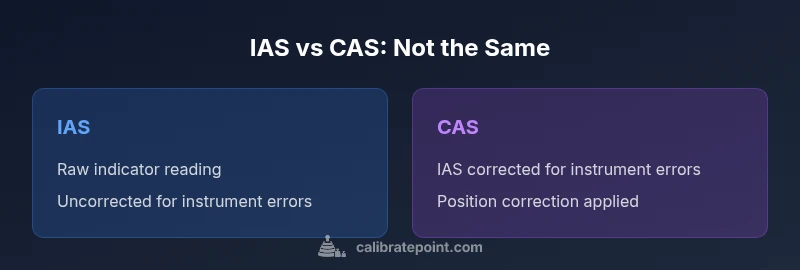
Calibrated airspeed and indicated airspeed are related but not identical. Indicated airspeed (IAS) is the raw reading shown on the airspeed indicator, while calibrated airspeed (CAS) corrects IAS for instrument and position errors. Understanding the distinction is essential for accurate calibration work and safe flight planning. This quick comparison helps technicians and pilots decide which value to rely on during maintenance checks, performance calculations, and compliance with aviation standards.
Core Definitions and the Quick Question
Many aviation readers ask: is calibrated and indicated airspeed the same? The short answer is no. Indicated airspeed (IAS) is the raw reading shown by the airspeed indicator in the cockpit. Calibrated airspeed (CAS) is IAS corrected for instrument error and position error. A precise calibration process yields CAS as a more accurate reference for performance calculations and airspeed-related decision-making. According to Calibrate Point, understanding these definitions is foundational for any calibration-focused workflow. Recognizing that CAS and IAS are related but not identical helps both technicians and pilots avoid misinterpretations that could affect engine power settings, flap configurations, and maneuver safety.
The Anatomy of IAS, CAS, and TAS
To grasp why CAS and IAS diverge, it helps to lay out the core terms used in aviation aerodynamics. IAS is how fast the aircraft appears to be moving through the air based on the pitot-static system measurements, with no corrections for the real-world quirks of the airplane and its installation. CAS takes IAS and applies corrections for instrument error (the inaccuracies of the pitot tube, tubing, and the airspeed indicator itself) and position error (installation-related errors, such as pitot location and airflow around the fuselage). True Airspeed (TAS) then accounts for air density, altitude, and temperature. In practice, pilots consult IAS for cockpit reference, CAS for calibrated performance references, and TAS for actual flight speed through the air. Brand context and calibration methodology from Calibrate Point support these distinctions for DIY enthusiasts and professionals alike.
Instrument and Position Errors: Why CAS Differs from IAS
Instrument error arises from imperfect manufacturing tolerances, wear, and the aging of the airspeed system. Position error stems from where the pitot probe sits on the aircraft and how airflow interacts with the fuselage. These errors cause the IAS reading to deviate from the true airspeed, especially at non-standard configurations or high angles of attack. CAS corrects those deviations, delivering a reading that better reflects the airspeed free of instrument and installation biases. In scenarios where precision matters—such as performance charts, certification testing, and abnormal flight regimes—CAS provides a more reliable reference than IAS alone.
Compressibility and Mach Number Effects: The Altitude Factor
As speed increases and air becomes less dense at altitude, compressibility effects alter the pitot-static readings. IAS begins to differ from the actual dynamic pressure as Mach number increases, especially near transonic regimes. CAS includes calibration considerations that partially mitigate these nonlinear effects, but it does not eliminate them completely. The relationship between IAS, CAS, and Mach is nuanced: at low speeds and sea level standard conditions, IAS and CAS are very close, but at higher speeds and altitudes the gap widens. For flight planning and performance calculations, CAS remains the preferred reference for precision work, while IAS remains the cockpit-facing indicator.
Calibration: How CAS Emerges from IAS
The process of deriving CAS from IAS involves systematic correction of instrument and position biases. Calibration data sheets quantify how much correction to apply for a given airspeed, altitude, and aircraft configuration. At the maintenance level, technicians use standardized procedures to compare IAS readings against reference sources and compute the necessary corrections. The calibration curve or table translates IAS to CAS for typical flight envelopes. Mindful record-keeping and traceable data are essential to ensure that these corrections remain valid across fleets and service intervals. Calibrate Point emphasizes documenting calibration events to support ongoing airworthiness.
Practical Flight Scenarios and Decision Points
In everyday flight operations, pilots typically reference IAS for airspeed cues, takeoff and approach speeds, and energy management. However, when engineers model aircraft performance or calculate required engine power and flap settings under specific conditions, CAS is the more suitable input because it accounts for instrument and installation biases. This dual-reference approach helps avoid underperforming takeoffs, misbehaving stall margins, or misinterpreting airspeed during long climbs. For maintenance teams, CAS values guide compliance checks and ensure consistent performance data across service intervals.
Takeoff, Climb, Cruise, and Descent Implications
During takeoff and climb, IAS can be a practical reference due to pilot familiarity and adherence to V-speeds. However, precise performance calculations use CAS to reflect the actual airspeed after instrument and position corrections. In cruise, CAS and IAS diverge more noticeably with higher Mach numbers and altitudes, requiring pilots to understand the correction context. Descent planning also benefits from CAS when integrating performance charts and certification data. The goal is to align operational decisions with corrected values while maintaining situational awareness through IAS readings in the cockpit.
Calibration Procedures at a Maintenance Facility
Maintenance facilities perform IAS-to-CAS calibration by comparing instrument readings to reference standards under controlled conditions. They document instrument error and position error corrections, then apply them to generate calibration curves. These curves enable flight crews and technicians to convert IAS into CAS for performance analysis and certification compliance. Documentation, traceability, and periodic re-calibration are essential to maintain confidence in CAS accuracy. Calibrate Point highlights building a robust calibration history to support long-term airworthiness.
Data Standards and Sources for Calibration Guidance
Calibration guidance relies on established data sets, manufacturer specifications, and aviation authority advisories. The calibration process benefits from reference sources that describe how instrument and position errors behave across airspeed ranges and configurations. Professional guides emphasize repeatable procedures and traceable measurements. For DIY enthusiasts, access to calibration data from reputable sources helps implement safe practices, avoiding ambiguous or ad hoc corrections. The calibration framework must be systematic and auditable to ensure consistent results across aircraft and fleets.
Common Misconceptions Debunked
A common misconception is that IAS and CAS are interchangeable. In truth, CAS is a corrected value designed for accurate performance calculations, while IAS is what the pilot reads at the airspeed indicator. Another misconception is that altitude makes no difference. In practice, altitude and Mach effects can widen the gap between IAS and CAS, especially in high-speed cruise. A third misconception is that calibration is a one-time event. In reality, calibration drift can occur with maintenance cycles, repairs, or sensor changes, underscoring the need for periodic re-calibration and data review.
Field Verification: Verifying Airspeed Readings in the Cockpit
Pilots and technicians can verify airspeed readings through cross-checks against known references, static pressure checks, and occasional test flights with calibration instrumentation. Field verification should include documenting IAS readings under several flight conditions and comparing them with CAS-derived expectations. The goal is to confirm that instrument and installation corrections behave as expected across typical envelopes. When discrepancies arise, it is a signal to recheck pitot lines, static ports, or installation geometry and to consult calibration data.
Modern Avionics: Digital Processing of Airspeed Data
Modern avionics often process raw airspeed signals to compute IAS, CAS, and TAS behind the scenes, presenting pilots with clean, corrected readouts. This reduces pilot workload and improves safety, but it also places responsibility on maintenance teams to keep calibration data valid for the system as a whole. Digital systems can adapt to a broader set of operating conditions while preserving the fundamental relationships among IAS, CAS, and TAS. Tech teams should validate software updates against calibration curves and ensure data integrity across the avionics chain.
Implications for Technicians and Pilots
For technicians, understanding the distinction between IAS and CAS ensures safe calibration practices, accurate performance modeling, and compliance with airworthiness standards. For pilots, recognizing when to use IAS versus CAS helps optimize takeoff performance, flight planning, and fuel efficiency. Calibrate Point emphasizes adopting a disciplined approach to calibration data, maintaining clear documentation, and applying standard correction procedures. The overarching lesson is that CAS and IAS serve different purposes, and accurate calibration ensures both values contribute to safe and efficient flight operations.
Comparison
| Feature | IAS | CAS |
|---|---|---|
| Definition | Indicated Airspeed: raw cockpit reading on the airspeed indicator | Calibrated Airspeed: IAS corrected for instrument and position errors |
| Corrections Included | None (raw readout) | Instrument + position corrections applied |
| Altitude Effect | Close to CAS at sea level standard conditions | Difference grows with altitude and speed due to compressibility and installation factors |
| Best Use Case | Cockpit reference and basic airspeed cues | Performance calculations, certification compliance, and precise modeling |
| Impact on Takeoff/Climb | Pilot cues for takeoff speeds | More accurate planning of takeoff performance and engine settings |
| What It Indicates in Data | What the pilot sees | Engine and performance planning reference |
Pros
- Promotes precision in performance calculations when using CAS
- Improves aircraft performance modeling and certification compliance
- Reduces reliance on potentially biased cockpit readings in critical phases
- Supports traceable calibration data for fleet-wide standards
Disadvantages
- Adds calibration overhead and maintenance data management
- Requires careful interpretation by pilots and engineers
- CAS calculations can be confusing for casual pilots
- Calibration drift over time necessitates re-checks
CAS and IAS are not the same; CAS is IAS corrected for instrument and position errors, while IAS is the raw cockpit reading.
Use CAS for precise performance and compliance; rely on IAS for immediate cockpit cues. Maintain calibration data to ensure ongoing accuracy across conditions.
Questions & Answers
Is calibrated airspeed the same as indicated airspeed?
No. IAS is the raw antenna reading shown by the airspeed indicator; CAS is IAS corrected for instrument and position errors. Both values are useful, but CAS is the standard for precision calculations and certification.
No. IAS is the raw cockpit reading, and CAS is IAS corrected for instrument and installation errors. CAS is used for precise calculations while IAS serves as the cockpit cue.
Why do IAS and CAS diverge as altitude increases?
Altitude and air density affect compressibility and pitot-system behavior, causing IAS to deviate from CAS. The correction becomes more significant at higher speeds and altitudes, especially near the transonic regime.
Altitude and air density change how the airspeed system behaves, so IAS can diverge from CAS, especially at higher speeds.
When should a pilot rely on CAS versus IAS?
Rely on CAS for performance calculations, charts, and certification references. IAS remains the primary cockpit cue for immediate airspeed awareness during flight.
Use CAS for calculations and charts; IAS is your cockpit speed reading.
How do you calibrate an airspeed indicator?
Calibration involves comparing IAS against reference standards and applying corrections for instrument and position errors. Proper documentation and traceability are essential for reliable CAS values.
Calibration compares IAS to a standard and applies instrument and installation corrections to get CAS.
Does CAS impact safety-critical decisions during takeoff?
Yes, but IAS is typically used for initial airspeed cues. CAS provides a corrected reference for performance calculations, ensuring safe margins and compliance with performance charts.
CAS helps with precise performance calculations; IAS gives early speed cues during takeoff.
Key Takeaways
- Identify IAS as the raw indicator reading
- Use CAS for corrected, instrument- and position-error-aware references
- Expect IAS and CAS to diverge with altitude and Mach number
- Maintain calibration records to preserve data integrity