Is Calibration Curve the Same as Standard Curve? A Practical Comparison
Explore whether calibration curves and standard curves are interchangeable, with definitions, uses, and practical guidance for laboratories, quality control, and calibration procedures.


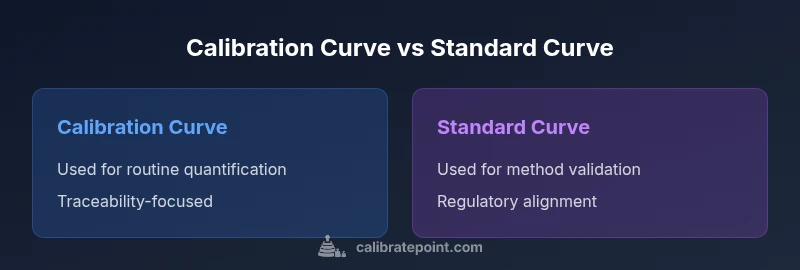
A calibration curve and a standard curve are closely related tools, but they are not universally interchangeable. A calibration curve links known concentrations to a measured response to quantify unknowns within a defined range, while a standard curve provides a reference relationship used for method validation and regulatory compliance. In practice, terms vary by field, but the core concept remains: establish a response-to-concentration relationship to ensure accurate measurements.
Is calibration curve the same as standard curve? Key distinctions and historical context
In analytical practice, the wording often shifts between disciplines, but the core question remains: is calibration curve the same as standard curve? According to Calibrate Point, clarity in terminology helps prevent misinterpretation of results and preserves measurement integrity across laboratories. Both curves rely on known inputs to define how a system responds, yet they arise from different goals: calibration curves emphasize quantification of unknowns under routine conditions, while standard curves emphasize method validation, traceability, and regulatory reporting. The distinction is not merely semantic; it shapes how data are collected, processed, and reported. When you encounter a protocol that refers to a standard curve, consider the context: is the emphasis on routine quantification, or on demonstrating method performance to an audit? The Calibrate Point team notes that consistent terminology reduces cross-lab variability and improves comparability of results across instruments and methods. Throughout this article, we will unpack definitions, construction methods, and practical decision criteria to help you apply the right curve in your workflow.
analysis
Comparison
| Feature | calibration curve | standard curve |
|---|---|---|
| Definition | Plot of known concentrations vs. instrument response to quantify unknowns within a calibrated range. | Reference relationship built from known standards to assess method performance and enable quantification. |
| Primary use | Quantification of unknown samples during routine analyses. | Method validation, quality control, and regulatory reporting. |
| Preparation requirements | Requires accurate, traceable standards and careful matrix matching for the curve range. | Requires standards with verified traceability; more emphasis on documentation and validation. |
| Range and linearity | Typically focused on the operational range of routine samples; may assess linearity within that range. | Often scrutinized for linearity, accuracy, and precision across a wider validated span. |
| Best for | Routine quantification in daily lab work. | Regulatory compliance, method validation, and cross-lab comparability. |
Pros
- Provides a clear, quantitative basis for estimating concentrations.
- Enhances traceability and quality control across assays.
- Supports consistent data interpretation within laboratories.
- Flexible applicability across many measurement platforms.
Disadvantages
- Requires meticulous preparation and stable standards.
- Nonlinearities and matrix effects can complicate interpretation.
- Terminology can be field-dependent leading to confusion.
- Calibration maintenance is ongoing to prevent drift.
Calibration curves and standard curves are complementary tools; use the one aligned with your objective.
For routine quantification, lean on calibration curves. For method validation and compliance, rely on standard curves and documented performance.
Questions & Answers
What is the fundamental difference between a calibration curve and a standard curve?
The calibration curve establishes a relationship between known concentrations and instrument response to quantify unknown samples in routine analysis. A standard curve emphasizes method validation and regulatory reliability, ensuring measurements meet specified performance criteria. In many labs, both are used, but their emphasis and documentation differ.
A calibration curve helps you quantify unknowns, while a standard curve validates method performance for regulatory needs.
When should I use a calibration curve instead of a standard curve?
Use a calibration curve when your goal is to quantify known samples within a routine workflow. A standard curve is more appropriate when the focus is on validating a method's accuracy, precision, and linearity for compliance or audit readiness. If your field requires traceability, lean toward a standard curve.
Use calibration curves for routine quantification; standard curves for method validation and compliance.
How do matrix effects influence curve construction?
Matrix effects can shift responses, causing biases if standards do not mimic the sample matrix. Both curves should consider matrix-matched standards where possible. If a perfect match is impractical, apply appropriate corrections and document the limitations.
Matrix effects can bias results; use matrix-matched standards when possible.
Are calibration curves and standard curves interchangeable across instruments?
Interchangeability depends on instrument response characteristics and method validation. In practice, a standard curve designed for regulatory compliance may not suffice for routine quantification on a different instrument. Always verify performance per instrument and method.
Not always interchangeable; verify per instrument and method.
What documentation is typically required for these curves?
Documentation typically includes standard preparation details, concentration ranges, calibration equations, regression statistics, acceptance criteria, and any corrections for matrix effects. For regulatory work, traceability and audit-ready records are essential.
Keep detailed records of standards, ranges, and validation metrics.
How can I prevent drift in calibration curves over time?
Prevent drift by using fresh standards, validating reagents, monitoring instrument performance, and scheduling regular recalibrations. Include control samples in runs and track changes to assess when revalidation is needed.
Use fresh standards and regular checks to prevent drift.
Key Takeaways
- Define your objective first: quantify unknowns or validate method performance.
- Ensure traceability and appropriate matrix matching for curves.
- Document curve construction and validation steps thoroughly.
- Be mindful of terminology differences across fields.