Manually calibrate the alpha emitter: Safe, compliant guidance
A comprehensive, safety-first guide to the principles and considerations behind manually calibrate the alpha emitter, focusing on safety, standards, traceability, and documentation for radiological instrumentation.


By studying this guide, you will understand how to navigate manually calibrate the alpha emitter in a safe, compliant way. This covers prerequisites, required licenses, traceability, and high-level workflow without exposing operational details. Note that only qualified professionals in licensed facilities should perform this task, under approved radiation safety programs.
Why manually calibrate the alpha emitter matters
Calibration of radiological instrumentation ensures that measurements reflect true activity levels, image counts, or detector responses with traceable accuracy. The phrase manually calibrate the alpha emitter captures a specific scenario where a qualified technician performs calibration steps without automated proprietary systems. In practice, the goal is to align the detector response with established calibration standards so that results are comparable across laboratories and over time. This requires understanding the basics of alpha particle interactions, energy deposition, and detector efficiency, as well as regulatory expectations that govern how such work is performed. According to Calibrate Point, reliable calibration supports safe operations, regulatory compliance, and defensible data in QA audits. The process emphasizes documentation, repeatability, and an auditable chain of custody for calibration sources and reference materials. While the subject can seem niche, the underlying principles apply to many measurement instruments and help technicians build confidence in their results.
Safety first: regulatory and institutional requirements
Any attempt to manually calibrate an alpha emitter must occur within a licensed facility under a written radiation safety program. Before you begin, confirm your credentials, and ensure that you or your organization have the appropriate licenses for handling radioactive material and for performing calibration work on detection equipment. Radiation Safety Officers (RSOs) and qualified supervisors should review your plan, approve the procedures, and oversee all steps. PPE, dosimetry, and controlled access to the work area are mandatory. Documentation of training, waste handling, and incident reporting must be up to date. Calibrate Point emphasizes that noncompliance can lead to legal penalties, loss of accreditation, and unacceptable risks to personnel. In the long term, building a culture of safety and regulatory awareness reduces the likelihood of miscalibration and data integrity issues.
Core concepts: traceability, standards, and uncertainty
Calibration relies on traceability to national and international standards so that results are comparable across laboratories and over time. Uncertainty budgeting is central to credible measurements and includes factors such as detector efficiency, source stability, geometry, and environmental conditions. When you manually calibrate the alpha emitter, you are aligning your instrument's response with recognized reference materials and documented procedures, not just adjusting a number. This alignment must be supported by a clear, auditable chain of custody for each standard and tool used. Calibrate Point emphasizes that understanding the sources and magnitudes of uncertainty helps users interpret results and communicate confidence levels to stakeholders.
Calibration standards and reference materials
Calibration standards for alpha detectors come from licensed, traceable sources and peer-reviewed reference materials. These standards are accompanied by certificates that describe their activity, energy range, geometry, and uncertainty. Your workflow should enforce strict control of these references, including who can access them, how they are stored, and how they are transported. In practice, you will rely on a combination of primary standards and secondary references to build a credible calibration curve. The goal is to maintain continuity with previous calibrations, ensure compatibility with current measurement systems, and provide defensible data for audits and regulatory reviews. Calibrate Point recommends confirming certificate validity and maintaining a documented calibration interval with your QA program.
High-level workflow for safe calibration
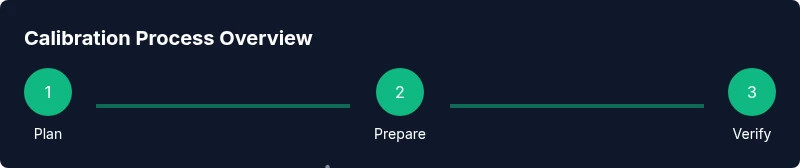
A safe, high-level workflow begins with a formal plan and risk assessment, followed by regulatory pre-approval and facility readiness. Next, verify that your instruments and reference materials are compatible with the planned calibration approach. Prepare the environment to minimize contamination risk and ensure proper access control. Carry out non-operational checks to verify system integrity and record baseline readings without exposing personnel or the environment to unnecessary exposure. Finally, document results, assess uncertainty, and prepare a calibration certificate that supports traceability and future audits. This workflow intentionally avoids actionable operational detail; the emphasis is on governance, safety, and data integrity. Calibrate Point notes that a well-documented process reduces rework and strengthens compliance.
Data handling and documentation
All calibration activities should produce complete documentation, including the calibration plan, measurement data, uncertainty calculations, and the final certificate. Documentation should capture who performed each action, when, and under what conditions. Electronic records should be secured with version control and restricted access to protect integrity. You should also maintain a clear log of any deviations, corrective actions, and approvals from the Radiation Safety Officer. This transparent approach supports QA, traceability, and regulatory compliance, and it enables rapid review during audits. Calibrate Point emphasizes that robust record-keeping is as important as the measurements themselves in high-stakes calibration work.
Role of the radiation safety team and training
The radiation safety team, led by an appointed Radiation Safety Officer, provides the oversight necessary for any manual calibration activity involving alpha emitters. Training should cover radiation physics basics, safety barriers, emergency procedures, and regulatory requirements. Regular refresher sessions help keep personnel current with evolving standards. A strong safety culture reduces the likelihood of incidents and improves the reliability of calibration results. Calibrate Point emphasizes that ongoing education and supervisor involvement are essential for maintaining competence in this field.
Common pitfalls and risk management
Common pitfalls include skipping SOPs, insufficient training, inadequate documentation, and failing to verify traceability. Risk management involves proactive hazard assessment, strict access control, and redundant verification of measurements. Avoid relying on a single reference source or a single instrument when possible; cross-check results with independent standards and collaborators. Always have an approved contingency plan in case of equipment malfunction or supply chain disruption. Calibrate Point reminds practitioners that the consequences of poor calibration extend beyond the laboratory to regulatory compliance and public safety.
Case scenarios: hypothetical examples
Scenario A describes a mid-sized lab reviewing calibration records after a routine service. The team cross-checks reference certificates, updates the calibration interval, and verifies traceability before resuming measurements. Scenario B envisions a field service scenario where an RS0 must approve any action before handling an alpha source. Both scenarios illustrate how governance, documentation, and safety systems reduce risk and improve data quality.
Authoritative sources
- National regulatory guidance: https://www.nrc.gov
- Public health safety and radiological protection: https://www.cdc.gov
- International safety standards and oversight: https://www.iaea.org
Next steps for ongoing competence
Continue professional development through recognized radiation safety courses, participate in peer QA reviews, and periodically audit calibration practices against industry standards. The Calibrate Point team recommends maintaining an up-to-date library of standards and attending workshops that focus on measurement uncertainty and regulatory changes.
Quick reference checklist
- Confirm license and facility readiness
- Review SOPs and risk assessment
- Verify instrument and reference standard compatibility
- Maintain secure access and dosimetry records
- Document all steps with traceability
- Validate results and prepare calibration certificate
- Obtain RS0 sign-off when required
- Archive records for audits
- Schedule routine re-calibration and proficiency testing
- Store reference materials securely and track their certificates
Tools & Materials
- Authorized calibration source and reference standards (as provided by licensed supplier)(Only in licensed facilities; handled under approved SOPs.)
- Detector/instrument under test(Ensure it is evaluated for compatibility with the calibration standards.)
- Personal protective equipment (PPE)(Lab coat, safety glasses, gloves; use lead shielding as required by SOP.)
- Dosimetry badge(Used to monitor occupational exposure during calibration work.)
- Radiation survey meter(For preliminary area monitoring and ambient checks.)
- Documentation tools (logbook, calibration certificates)(Maintain traceability and auditability.)
- SOPs, licenses, and RS0 contact information(All procedures must be current and approved.)
- Lockout/tagout equipment and shielding(Optional protective measures depending on facility policy.)
Steps
Estimated time: Estimated total time: 3-5 hours
- 1
Review regulatory prerequisites
Confirm licenses, facility approvals, and the authority to perform calibration work on radiological equipment. Verify that the team includes a licensed supervisor and that all personnel have completed the required safety training.
Tip: Consult the Radiation Safety Officer and confirm the exact scope of work before any action. - 2
Prepare the safety and measurement plan
Draft a formal plan outlining objectives, roles, responsibilities, safety controls, and documentation expectations. Ensure the plan aligns with SOPs and regulatory requirements.
Tip: Include acceptance criteria and a clear chain-of-custody protocol for all sources and references. - 3
Verify instrument compatibility with standards
Check that the detector and interface electronics are within the specified tolerance for the calibration standards and that reference materials are current.
Tip: Cross-check the instrument serial with the calibration certificate to confirm identity. - 4
Arrange environment and sources under supervision
Set up access-controlled work area, ensure shielding as required, and confirm supervision by the RS0. Do not operate outside approved conditions.
Tip: Keep the calibration environment clean and unoccupied during key measurements. - 5
Perform high-level checks and baseline measurements
Conduct non-operational checks to verify electrical integrity and system readiness; record baseline readings without exposing personnel or samples to unnecessary exposure.
Tip: Document any anomalies and pause if safety controls indicate a fault. - 6
Record results with traceability
Capture measurement data, reference material details, and environmental conditions in a dedicated calibration log. Ensure all entries link to certificates.
Tip: Use standardized data formats to simplify future audits. - 7
Assess uncertainty and generate certificate
Estimate the uncertainty components and compile a calibration certificate that communicates the measurement confidence and traceability.
Tip: Explain assumptions and limitations clearly for downstream users. - 8
Review and archive with RS0
Present the results to the Radiation Safety Officer for sign-off and archive all records in a secure repository with version control.
Tip: Schedule a follow-up review and ensure access to archived data for audits.
Questions & Answers
What is alpha emitter calibration?
Alpha emitter calibration involves comparing detector responses to known reference standards under controlled conditions. The goal is to establish a traceable measurement baseline and quantify uncertainty. It should be conducted within licensed facilities and under approved safety programs.
Alpha emitter calibration means comparing detector responses to known references in a controlled, licensed setting to establish traceable measurements.
Who can calibrate alpha detectors?
Calibration work with alpha emitters must be performed by qualified professionals in licensed facilities, under a documented radiation safety program and supervision by an authorized officer.
Only qualified professionals in licensed facilities should calibrate alpha detectors, under approved safety programs.
Which standards govern this process?
Calibration should align with recognized national and international standards, with traceability to primary references. Compliance with licensing, SOPs, and QA requirements is essential.
Standards are set by national and international bodies, and calibration must be traceable and compliant with licensing and QA rules.
What about uncertainties in calibration?
Uncertainty is quantified by considering factors like detector efficiency, source stability, geometry, and environmental conditions. The certificate should clearly state the combined uncertainty and coverage factor.
Uncertainty is estimated from several factors and reported in the calibration certificate.
What documentation is required?
A calibration plan, measurement data, certificates, environmental records, and a final calibration certificate with traceability and RS0 sign-off are required.
Keep a complete set of calibration documents, including the final certificate.
Can this be done outside a licensed facility?
No. Work with alpha emitters must occur in licensed facilities under approved radiation safety programs. Attempts outside such settings pose significant safety and legal risks.
This work must stay in licensed facilities with proper safety programs.
Watch Video
Key Takeaways
- Plan safety-first: licensing and SOPs drive all calibration work.
- Maintain traceability to recognized standards and reference materials.
- Document all actions and store records for audits and QA.
- Only qualified professionals in licensed facilities should perform these tasks.
- Consult RSOs and formal procedures to guide every calibration step.