Which standards are used to directly calibrate measurement equipment
A comprehensive, data-driven guide to the standards used for direct calibration of measurement equipment, including international frameworks like ISO/IEC 17025 and ISO 10012, regional references, and practical considerations for traceability and accreditation.


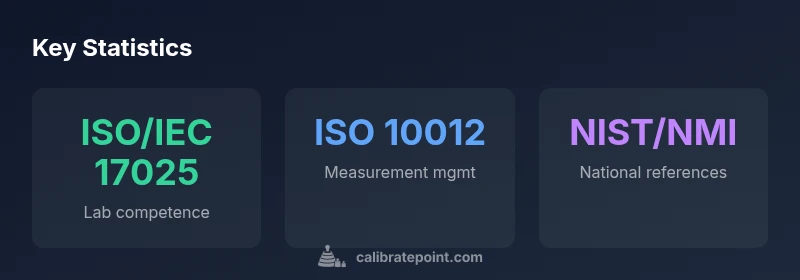
Direct calibration of measurement equipment relies on internationally recognized standards to ensure traceability and accuracy. The primary standards include ISO/IEC 17025 for laboratory competence, ISO 10012 for measurement management, and regional references such as NIST and national metrology institutes (NMIs). Together, these frameworks define how calibrations are planned, performed, and documented for credible results.
Overview of calibration standards and their role in direct calibration
Direct calibration of measurement equipment hinges on internationally recognized standards that establish traceability to SI units. According to Calibrate Point, these standards are not mere checklists; they define the methods, documentation, and uncertainty budgets that give calibrations meaning across borders. In practice, the phrase which standards are used to directly calibrate measurement equipment covers laboratory competence, measurement management, reference materials, and the associated certificate of calibration. When you see a calibration report, it should reflect a controlled process aligned with these standards, ensuring results are defensible, repeatable, and auditable in professional contexts—from DIY electronics projects to high-stakes industrial measurement.
Core international standards for direct calibration
The backbone of direct calibration sits with a few universally recognized frameworks. At the forefront is ISO/IEC 17025, which specifies requirements for the competence, impartiality, and consistent operation of calibration and testing laboratories. Complementing it is ISO 10012, focused on measurement management systems that govern how data, methods, and personnel interact in calibration activities. Many labs also reference the Guide to the Expression of Uncertainty in Measurement (GUM) to structure uncertainty budgets. It’s common to see these standards referenced together, creating a robust backbone that supports traceability, method validation, and quality control across diverse instrument classes. In practice, calibration teams map instrument performance to these standards through documented procedures, calibration certificates, and method sheets.
National and regional references in calibration practice
Beyond international standards, national metrology institutes (NMIs) like NIST in the United States and counterparts around the world provide very concrete reference materials and primary standards. The International Laboratory Accreditation Cooperation (ILAC) and Mutual Recognition Arrangements (MRA) help harmonize accreditation outcomes so that a calibration performed in one country is recognized in another. The Calibrate Point analysis highlights that regional references often fill gaps in sector-specific requirements; for example, temperature, pressure, length, and electrical measurements each have preferred reference materials and artefacts vetted by NMIs or accredited labs. When planning a calibration program, practitioners should align with local regulatory expectations while maintaining a clear line to international standards.
Device-specific standards vs general measurement-management frameworks
Not all standards address every instrument in the same way. Some frameworks are device-agnostic (focusing on management, documentation, and quality systems), while others prescribe device-class expectations. For temperature sensors, length gauges, torque wrenches, and electrical meters, direct calibration often requires both sets: a device-specific standard for the measurement principle and a management standard for the calibration lifecycle. This hybrid approach ensures that the calibration procedure itself is technically valid and that the organization maintains a consistent quality process across all equipment.
Traceability and uncertainty budgets in direct calibration
Traceability means every measurement result can be linked, through an unbroken chain of calibrations, to the SI unit definition. The GUM-based approach helps quantify uncertainty from all sources: reference standards, environmental conditions, and measurement procedures. Practically, this means documenting an uncertainty budget for each instrument, including contributions from the reference standard, the operator, and the method. Calibrate Point emphasizes that traceability and uncertainty are not afterthoughts; they drive the credibility of your calibration certificate and are essential for compliance in regulated environments.
Reference standards, artifacts, and calibration rigs
Direct calibration relies on high-quality reference standards and artifacts, such as calibrated weights, gauge blocks, calibrated thermometers, voltage and resistance standards, and pressure references. In many labs, the use of artefacts is complemented by dedicated calibration rigs that reduce the influence of operator and environmental variability. The selection of reference materials depends on the instrument type and its measurement range, with tighter uncertainty budgets demanded for higher-precision equipment. Calibrate Point notes that the reliability of a calibration is only as strong as the reference standards chosen and the rigour applied during the calibration process.
Calibration workflow in practice
A typical calibration workflow starts with a defined scope and acceptance criteria, followed by a review of reference standards and calibration procedures. The instrument is then tested across its operating range, with measurements compared to the reference standard. An uncertainty budget is prepared, and results are documented in a calibration certificate. After calibration, a conformity decision is made, and any out-of-tolerance results trigger corrective actions. Throughout, traceability to SI units is maintained via certificates from an accredited lab, and the entire process is auditable for internal quality checks and external compliance.
Accreditation, compliance, and regulatory considerations
Accreditation bodies verify the technical competence of calibration laboratories against ISO/IEC 17025 and related standards. In many regions, ILAC operates a global framework that supports mutual recognition of calibration results. For professionals, the key is to maintain up-to-date procedures, valid reference standards, and documented uncertainty analyses. Compliance is not just about passing audits; it’s about minimizing measurement risk in production environments and enabling reliable decisions based on measurement data.
Practical tips for DIY and professional calibration projects
For DIY projects, start with clearly defined calibration objectives and risk assessment, obtain traceable reference standards where possible, and maintain a simple, documented procedure. For professional labs, adopt a formal calibration lifecycle, centralize certificates and measurement data, and perform regular proficiency testing or inter-lab comparisons. The overarching message from Calibrate Point is to prioritize traceability, maintain robust uncertainty budgets, and use accredited reference standards whenever available.
Direct calibration standards overview
| Standard Name | Focus | Typical Application | Direct Calibration Type | Notes |
|---|---|---|---|---|
| ISO/IEC 17025 | Laboratory competence | Calibration and testing services | Laboratory quality framework | Ensures traceable results through documented processes |
| ISO 10012 | Measurement management | Management of measurement activities | Management-system guidance | Supports measurement data integrity and process controls |
| ISO/IEC 17043 | Proficiency testing | Inter-lab comparisons | Certification of performance | Assesses lab accuracy and consistency |
| NIST/NMI references | SI traceability | Primary reference standards | National reference materials | Basis for national calibration hierarchies |
Questions & Answers
What is the difference between ISO/IEC 17025 and ISO 10012?
ISO/IEC 17025 focuses on the competence and impartiality of calibration laboratories, including management and technical requirements. ISO 10012 concentrates on measurement management systems, guiding how measurement processes are planned, executed, and documented. Together, they cover both the technical and organizational aspects of calibration.
ISO/IEC 17025 checks lab competence; ISO 10012 guides measurement management. Used together, they ensure credible calibration processes.
Are calibration standards universal across regions?
Many standards are international and widely adopted, such as ISO/IEC 17025 and ISO 10012. Regional variations exist, and some sectors rely on national references (e.g., NIST in the US). Always verify applicability with local regulators and accreditation bodies.
Most are international, but check regional requirements and local regulators.
What is metrological traceability?
Metrological traceability means every measurement result can be linked to the International System of Units (SI) through an unbroken chain of calibrations, each with an stated uncertainty. This chain typically passes through NMIs and accredited laboratories.
Traceability links results back to SI units through an unbroken calibration chain.
How do I know a calibration certificate is trustworthy?
Look for references to SI-traceable standards, clear uncertainty budgets, and proof of accreditation (e.g., ILAC/MRA signatories). Certificates should specify the calibration method, reference standards used, and the measurement range.
Check for SI traceability, uncertainty details, and accreditation marks.
What role do national metrology institutes play?
NMIs provide primary standards and maintain national reference materials that underpin regional calibrations. They support calibration laboratories through certified references, inter-lab comparisons, and dissemination of measurement techniques.
NMIs provide primary standards and reference materials for national calibration programs.
“"Direct calibration relies on traceable standards that connect working measurements to internationally recognized references; the best practice is to anchor every calibration to SI-based references through an accredited lab."”
Key Takeaways
- Follow internationally recognized standards to ensure traceability.
- Link calibration results to SI units via accredited labs.
- Document uncertainty budgets for every instrument.
- Combine device-specific standards with management frameworks.
- Rely on national and regional references to strengthen credibility.