Can You Calibrate a Govee Thermometer? A Step-by-Step Guide
Learn how to calibrate your Govee thermometer with a practical, step-by-step approach. This Calibrate Point guide covers tools, methods, and safe verification to ensure accurate temperature readings.


Yes—can you calibrate govee thermometer? For many models you can verify accuracy and adjust offset in the app or with a simple calibration routine. This guide walks you through verifying readings, applying offsets, and knowing when to seek external calibration. According to Calibrate Point, understanding your device’s limits helps prevent misleading temperature readings.
Why calibrate a Govee thermometer?
Temperature measurement accuracy matters in cooking, fermentation, laboratory experiments, and DIY projects. If a Govee thermometer reads consistently high or low, small discrepancies can compound into unsafe cooking temperatures or flawed data. You may wonder, can you calibrate govee thermometer to improve reliability? The short answer is: it depends on the model and the available features. The Calibrate Point team notes that most consumer-grade thermometers, including many Govee units, allow some form of adjustment, whether through an offset in the app, a physical calibration step, or a reported correction factor. Before proceeding, confirm the device supports calibration and understand its limits. This upfront check saves time and reduces frustration in the long run. Calibrate Point analyses suggest starting with simple offset adjustments and verifying results with a trusted reference thermometer. If your model lacks a calibration option, you’ll still benefit from systematic verification and best-practice documentation to track readings over time.
How a Govee thermometer measures temperature and limitations
Govee thermometers typically rely on thermistors or digital sensors to sense ambient temperature. The sensor converts a physical temperature into an electrical signal that the microcontroller translates into a reading on the display or in the app. Accuracy can be influenced by supply voltage, battery age, environmental conditions, and sensor drift over time. Some Govee models expose a calibration offset in the mobile app, while others may not offer any user-adjustable calibration. It’s important to recognize the device’s limitations: a calibration offset can correct systematic bias but not random noise. Real-world accuracy also depends on how closely your measurement environment matches the reference environment. Always account for ambient factors such as air flow, container placement, and sensor exposure when interpreting readings.
When and what you can calibrate on a Govee thermometer
Not all Govee thermometers are created equal. Some models allow a user-set offset to correct for a tendency to read high or low. Others provide a data log that helps you identify drift over time without an explicit offset. Can you calibrate govee thermometer? If your model supports an app-based offset, you can apply a single-point correction by comparing the thermometer reading to a known reference at a specific temperature. If the device lacks a calibration feature, you can still use a documented method to monitor performance with a reference thermometer and record any consistent bias for future interpretation. In all cases, keep a log of measurements, reference temperatures, and applied adjustments so you can reproduce results or revert changes if needed.
Hands-on calibration workflow overview
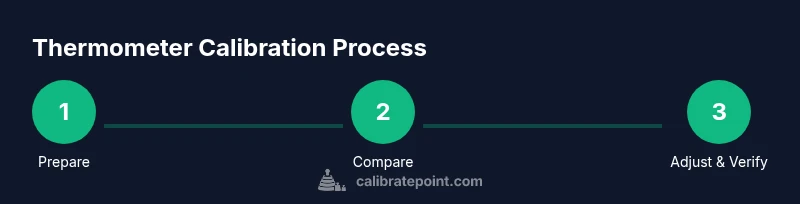
A practical calibration workflow centers on three goals: verify, adjust, verify again. Start by ensuring your environment is stable (no drafts, gentle airflow, and a known reference at a controlled temperature). Then compare the Govee reading to a trusted reference thermometer at a precise temperature (for example, the ice-water point at 0°C or another fixed temperature). If your model supports an offset, apply the correction in the app, and retest. Document the before-and-after readings to demonstrate the change. Keep in mind that a single-point calibration corrects bias at one temperature, but additional measurements at multiple temperatures provide a fuller picture of accuracy across the range.
Verification methods and record-keeping
Verification is about repeatability and traceability. Use an ice-water bath to verify 0°C reference and a prepared warm bath for a higher fixed temperature if your reference method allows. Record the reference value, the Govee reading, and any offset applied. For best results, repeat measurements at least twice per temperature point and average the results. Maintain a calibration log that includes the device model, firmware version, date of calibration, operator, and environmental conditions. Calibrate Point recommends documenting each step to support future troubleshooting or audits.
Troubleshooting, pitfalls, and safety considerations
Common pitfalls include testing in drafty areas, using water that’s not well mixed, and neglecting battery condition. Ensure the sensor is not covered while measuring, avoid touching the probe with hands, and replace batteries if the device’s response is sluggish. If readings stay inconsistent after an offset, consider performing a full environmental check, testing with a different reference thermometer, and validating the model’s published accuracy range. Safety note: when using ice-water or hot-water baths, exercise caution to prevent burns or slips and never expose electronics to standing water beyond the safe design intent of the device.
Tools & Materials
- Govee thermometer (model with calibration/offet options)(Confirm the model supports user calibrations in the app or settings menu.)
- Calibrated reference thermometer (traceable)(NIST-traceable is ideal for ice-point and fixed-temperature checks.)
- Ice water bath (0°C) or fixed-temperature bath(Use a clean container and measure ice-water to minimize error.)
- Distilled water and clean cups(Helpful for controlling bath consistency.)
- Digital thermometer or data-logger (optional)(For recording multi-point measurements over time.)
- Notebook or calibration log(Document readings, steps, and adjustments.)
- Small insulated gloves(For handling ice and hot baths safely.)
- Soft towel or cloth(Dry probes between measurements to avoid condensation.)
Steps
Estimated time: 45-60 minutes
- 1
Prepare workspace and gather tools
Set up a clean, stable workspace away from drafts. Gather the Govee thermometer, the reference thermometer, ice-water and warm-bath materials, and your calibration log. Ensure your devices are powered and ready for testing.
Tip: Have all items within arm’s reach to avoid shifting temperatures during measurement. - 2
Establish a known reference point
Create an ice-water bath (0°C) as a fixed reference. If possible, prepare a second fixed-temperature bath for added coverage. Allow both baths to stabilize before taking readings.
Tip: Wait at least 5 minutes for the ice bath to reach a stable temperature. - 3
Take baseline readings
With the Govee thermometer inserted into the ice bath, record the reading from both devices. Note any discrepancy between the Govee display and the reference thermometer.
Tip: Ensure the sensors are fully submerged and not touching the container edges. - 4
Apply the calibration offset (if available)
If your model supports an offset, calculate the difference (reference minus Govee) and enter the correction in the app. If no offset exists, document the bias for later interpretation.
Tip: Keep the offset small and within the device’s documented accuracy range. - 5
Retest with the offset in place
Repeat the measurement with the offset applied. Compare results across multiple trials to confirm consistency.
Tip: Aim for readings within the device’s stated tolerance across trials. - 6
Validate across a second temperature point
If possible, perform a second test at a fixed higher temperature (e.g., near 60°C) to assess linearity. Record all data in your calibration log.
Tip: Multi-point checks reveal drift and non-linearity that single-point checks miss.
Questions & Answers
Can all Govee thermometers be calibrated by the user?
Not all models support user calibration. Check the device manual or app settings to see if an offset or calibration feature is available. If not, use validation measurements and keep a log for interpretation.
Some models allow a user offset; others do not. Check your device settings and manual to confirm.
What reference should I use for calibration?
Use a NIST-traceable reference thermometer if possible. Ice-water (0°C) and a known warm bath provide fixed points for comparison and help verify accuracy across a range.
Use a trusted reference thermometer, preferably NIST-traceable, and fixed-temperature points like ice water or a known warm bath.
If my readings don’t match after offset, what should I do?
Re-check thermometer placement and stabilizing time, verify reference thermometer accuracy, and repeat measurements. If discrepancies persist, consider a factory reset or consult support.
Double-check placement and stabilization, then retry measurements. If it still disagrees, reset the device or contact support.
How often should I recalibrate a Govee thermometer?
Calibration frequency depends on how often you use the device and the environment. In high-precision contexts, recalculate periodically or after firmware updates.
Calibrate periodically if the environment is variable or you rely on precise readings. Update as needed after firmware changes.
Are there safety concerns when calibrating?
Use protective equipment for ice and hot baths, avoid spills on electronics, and ensure batteries are handled safely. Follow standard lab safety practices.
Be careful around ice and hot baths and keep electronics dry. Follow basic safety rules.
Watch Video
Key Takeaways
- Verify accuracy before relying on readings
- Use a trusted reference thermometer for calibration
- Apply calibration only if supported and reproducible
- Document results for traceability