Ice-Water Calibration for Thermometers: A Practical Guide
Learn a proven ice-water method to calibrate thermometers accurately. This practical, step-by-step guide covers setup, safety, and verification for DIYers and professionals seeking reliable temperature readings.


To answer what is one effective way to calibrate a thermometer, the ice-water method provides a simple, reliable baseline. This quick answer introduces the method and what you’ll need. It also highlights why accuracy matters and sets up the step-by-step process you’ll find in the body of this guide.
Why Accurate Temperature Readings Matter
Accurate thermometer readings are essential across kitchens, labs, HVAC, and field work. A small drift can lead to unsafe temperatures, incorrect mixing, or flawed data. According to Calibrate Point, accuracy in thermometer measurements begins with a disciplined calibration routine that you can perform with common tools. This section explains why the ice-water baseline is widely trusted, how it ties directly to practical outcomes, and how a repeatable workflow reduces drift over time. DIY enthusiasts, technicians, and professionals will find actionable tips, common pitfalls, and a repeatable checklist you can reuse for consistent results.
By investing a little time in calibration today, you protect safety, product quality, and data integrity. The goal is clear: every reading should reflect the true temperature as closely as your device allows. Calibrate Point’s guidance emphasizes consistency, documentation, and routine verification to build confidence in measurements.
Ice-Water Bath: The Gold-Standard Baseline
The ice-water bath provides a fixed reference point at 0°C (32°F) for most thermometers. Start with clean, crushed ice and add just enough water to fill the space between the ice and the thermometer probes. Stir gently to even out temperature gradients and allow readings to stabilize for about 60 seconds. If the device reads significantly above or below 0°C, note the offset and decide whether to adjust the device’s calibration setting or record the offset for correction in future measurements. This method is simple, repeatable, and widely recommended for establishing a reliable baseline. The Calibrate Point team stresses consistency—use the same bath setup every time you calibrate.
Prepping Your Workspace and Tools
Choose a stable, contamination-free environment for calibration. Use distilled water to minimize dissolved minerals that could affect readings, and ensure the bath remains sealed enough to prevent rapid heat exchange with the surroundings. Prepare a clean container large enough to hold the thermometer probes with comfortable clearance. Place both the reference thermometer (high-accuracy) and the thermometer under test in close proximity, so they experience the same bath conditions. Keep gloves handy for hot-water steps and always have a timer to track stabilization periods. As emphasized by Calibrate Point, tidy workspaces reduce drift introduced by dust, splashes, or temperature fluctuations.
Step-by-Step Overview of the Ice-Water Calibration (High-Level)
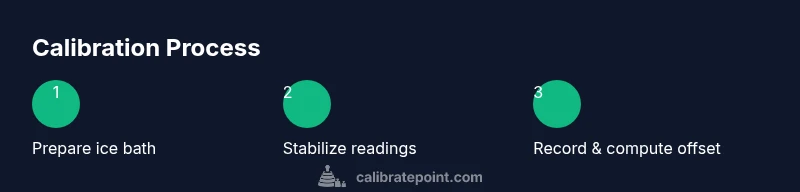
This overview pairs with the detailed steps in the dedicated Step-by-Step section. You will create a stable ice-water bath, submerge both thermometers together, allow stabilization, and document the readings. The process yields an offset that you’ll either apply to the thermometer under test or use to adjust your measurement corrections going forward. The method works across many thermometer types, including digital and analog variants, and translates well to Celsius and Fahrenheit scales with proper conversion.
How to Calculate and Apply Offsets
Once both thermometers are stabilized in the ice bath, compare their readings. If the reference reads exactly 0.0°C and the test device reads +0.3°C, the offset is -0.3°C for your device. Apply this offset consistently in future measurements, or adjust the thermometer’s calibration if it has a user-accessible calibration screw or software setting. Record the offset, device model, and calibration date in a log. This documentation ensures you can reproduce results or trace drift over time, which is critical for audits or quality control – a practice Calibrate Point consistently recommends.
Verification: Rechecking and Documentation
To verify reliability, repeat the ice-water test at least once after applying an offset. A second trial helps confirm that readings are stable and that the offset is correct. If using a digital thermometer with an adjustable offset feature, re-run the test after applying changes. Document the readings, calculated offset, environmental conditions (ambient temperature, bath temperature, deviations), and any adjustments made. Clear logs simplify future recalibrations and audits.
Troubleshooting and When to Recalibrate
If you notice inconsistent readings between trials, verify ice quality, ensure the probes are fully immersed, and confirm no air bubbles are trapped around the sensor. Temperature drift can come from aging probes, mechanical damage, or electrolyte effects in certain liquids. When in doubt, repeat the bath preparation and ensure stabilization times are consistent. If offset drift persists beyond expected tolerance, recalibrate or replace the device. Regular calibration schedules help catch drift early and protect measurement integrity. Calibrate Point recommends setting a fixed recalibration cadence based on device use and criticality.
Extending to Fahrenheit and Altitude Considerations
When working in Fahrenheit, convert 0°C to 32°F and 100°C to 212°F for reference points. Altitude affects the boiling point of water, so if you plan to use a boiling-water check, adjust your reference temperature for elevation, or rely on the ice-water baseline instead. Many professionals use a two-point check (ice bath and boiling-water check) to verify both ends of the scale. For most routine calibrations, the ice-water method alone suffices to establish a solid baseline and catch drift early.
Tools & Materials
- Calibrated reference thermometer(High-accuracy instrument used as the standard.)
- Ice(Crushed ice for rapid stabilization.)
- Distilled water(Minimal impurities for consistent readings.)
- Clean container/jar(Deep enough to submerge probes.)
- Digital/test thermometer under calibration(Device to calibrate.)
- Stirrer (plastic or glass rod)(Distributes temperature evenly.)
- Timer or stopwatch(Track stabilization and wait times.)
- Cleanup supplies(Paper towels and sanitizer for spills.)
Steps
Estimated time: 30-45 minutes
- 1
Prepare the ice-water bath
Fill a clean container with crushed ice and add just enough water to fill gaps. Stir to ensure uniform temperature and let the bath settle. This sets a stable 0°C reference for the test device and the reference thermometer.
Tip: Use crushed ice for a faster, stable 0°C bath. - 2
Arrange thermometers side-by-side
Place both the reference thermometer and the thermometer under test in the ice bath so they experience the same conditions. Ensure probes are fully submerged but not touching the container bottom.
Tip: Keep probes in the same depth to avoid buoyancy-related readings. - 3
Allow readings to stabilize
Wait 60 seconds or until both devices show a steady reading. Gentle stirring can help minimize local gradients around sensors.
Tip: Minute-by-minute stability matters more than a quick glance. - 4
Record the readings
Note the exact temperatures shown by both thermometers. The reference should read 0.0°C if the bath is ideal; any deviation is the offset for the test device.
Tip: Write notes about bath conditions (ice amount, water clarity). - 5
Calculate the offset
Compute offset = test device reading − reference reading. If the reference is 0.0°C and the test device reads +0.3°C, the offset is −0.3°C for future measurements.
Tip: Document sign and magnitude of offset for consistency. - 6
Apply offset or calibration adjustment
If your device supports calibration adjustment, apply the computed offset. Otherwise, use the offset in your measurements via data processing or scale settings.
Tip: Recheck after applying the adjustment to confirm accuracy. - 7
Repeat to verify stability
Perform a second complete cycle (ice bath) to confirm readings are repeatable. Consistency across trials confirms a valid calibration.
Tip: A single trial is rarely enough for confidence. - 8
Document results and plan next check
Log device model, offset, date, ambient conditions, and test results. Schedule the next calibration based on usage and criticality.
Tip: Maintain a calibration log for traceability.
Questions & Answers
What is the ice-water method and why is it used?
The ice-water method uses a fixed reference temperature (0°C) to verify thermometer accuracy. It is simple, repeatable, and suitable for many devices.
The ice-water method provides a fixed 0°C reference to verify accuracy; it’s simple and repeatable.
Can I calibrate with boiling water as well?
Boiling-water checks work at sea level; adjust for altitude. Ice-water baselines are often enough for routine calibration.
Boiling water can be used at sea level, but you may need to adjust for altitude.
How often should thermometers be calibrated?
Calibration frequency depends on use and risk. In critical settings, recalibrate monthly or after major repairs.
Calibrate based on usage; in high-stakes settings, do it monthly or after repairs.
What if readings differ between two references?
If readings differ, verify setup, re-check the ice bath, and consider device drift. If unresolved, consult the manufacturer or a metrology lab.
If readings differ, recheck setup and drift; consult a lab if needed.
Does this method work for Celsius and Fahrenheit scales?
Yes. Record in your preferred scale and convert offsets as needed when integrating with other systems.
Yes, you can calibrate for Celsius or Fahrenheit and convert as needed.
Key Takeaways
- Use ice-water as a fixed baseline.
- Document offsets for traceable calibrations.
- Repeat calibration to ensure repeatability.
- Adapt the method for Fahrenheit with proper conversions.