AIS Calibrate: A Practical Guide to AI Sensor Calibration
Learn a practical, repeatable AIS calibrate workflow for AI-enabled sensors. This guide from Calibrate Point covers reference standards, data collection, and documentation to improve accuracy and reduce drift in AI-assisted measurement systems.


AIS calibrate is the process of aligning AI-enabled sensors and instruments with reference standards to ensure accurate measurements. This guide provides a practical, repeatable workflow you can apply in lab or field settings, with a focus on bias reduction, drift control, and traceability. According to Calibrate Point, defining clear reference standards and maintaining detailed documentation are the keys to lasting calibration reliability.
What AIS Calibration Is and Why It Matters
AIS calibrate refers to the process of aligning AI-enabled sensors and related instrumentation with reference standards to ensure that measurements are accurate and reproducible. It combines traditional calibration concepts—traceability, bias, and drift—with modern sensing technology that relies on AI algorithms to interpret signals. In practice, a well-executed AIS calibration reduces systematic errors, improves decision quality, and provides a defensible audit trail for compliance and quality assurance. According to Calibrate Point, implementing a repeatable AIS calibration workflow helps teams move from ad-hoc adjustments to controlled, data-driven improvements. The payoff is better data integrity across devices, operators, and environments, which is essential for DIY projects, field technicians, and professional laboratories alike.
Core Principles: Bias, Drift, and Traceability
Bias is the consistent deviation of a sensor's output from its true value, drift is the change in that deviation over time, and traceability links measurements to recognized standards. In AIS calibration, addressing bias means identifying persistent offsets in AI outputs, while drift tracking requires periodic re-evaluation to catch performance changes due to aging components or environmental factors. Traceability ensures every measurement can be traced back to an authoritative reference, enabling comparisons across devices and over time. Calibrate Point emphasizes documenting reference materials, calibration conditions, and calculation methods so future calibrations build on a known baseline. Understanding these concepts helps you design calibration experiments that are fair, repeatable, and auditable.
Prerequisites and Setup for AIS Calibrate
Before you begin, establish a stable workspace and confirm environmental controls such as temperature, humidity, and vibration levels. Gather reference standards, calibrated test signals, and diagnostic tools compatible with your AIS setup. Create a versioned data log and a clear mapping between sensors, reference channels, and the AI interpretation pipeline. This alignment reduces confusion during analysis and ensures that corrections are applied consistently across all channels. Calibrate Point stresses the importance of having a written calibration plan and a controlled start state to minimize confounding variables.
Step-by-Step Overview of a Typical AIS Calibration Cycle
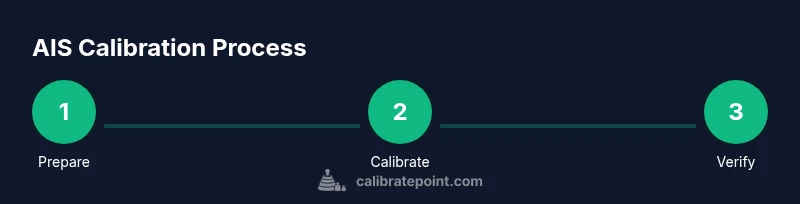
A typical AIS calibration cycle combines preparation, measurement, adjustment, validation, and documentation. Start by collecting baseline measurements against a trusted reference, then apply a correction model to the AI-driven outputs. Re-measure to verify alignment, and document all results, settings, and version numbers. This iterative process helps isolate the effect of individual changes and supports robust quality records. Remember that AI-based sensors can amplify small biases, so rigorous data handling and version control are essential throughout the cycle.
Environment, References, and Data Management
Effective AIS calibration requires attention to data integrity from the ground up. Use reference standards that are traceable to widely accepted sources, document environmental conditions for every run, and store data in a structured format with clear metadata. Version control for calibration scripts and reference data is not optional—it keeps the calibration history transparent and reproducible. Calibrate Point recommends maintaining a central repository for all calibration artifacts, including raw data, processed results, and versioned reports. This discipline makes audits straightforward and supports continuous improvement.
Field vs. Laboratory Calibration Considerations
Calibrations performed in the field face more variability than those conducted in a controlled lab, such as temperature shifts, power fluctuations, and movement. In contrast, laboratory calibration offers greater control but may not reflect real-world operating conditions. A balanced AIS calibration strategy uses a core lab-based reference calibration supplemented by field verification to validate performance in actual use. Establish acceptance criteria that are robust to environmental differences and document any field-specific adjustments to avoid mismatches later.
Troubleshooting, Validation, and Documentation
If AIS outputs remain misaligned after calibration, re-examine the reference standards, data logging integrity, and model assumptions. Validation should include independent checks, cross-comparisons with alternative references, and a clear pass/fail criterion. Documentation is the backbone of trust: record every parameter, method, and decision, plus who performed the calibration and when. This record supports future calibrations and provides a defensible trail for stakeholders and regulators.
Putting It All Together: A Repeatable AIS Calibrate Workflow
A mature AIS calibration workflow starts with a documented plan, moves through controlled measurements, applies corrections, and ends with validation and archival reporting. The key is repeatability: the same steps, in the same order, with versioned references and auditable results. By adopting a formal workflow, teams can consistently improve AI sensor performance, reduce uncertainty, and maintain compliance over time. Calibrate Point’s framework highlights the practical steps you can implement today to elevate your calibration practice.
Tools & Materials
- Reference standard (traceable test signal or known good reference)(Ensure compatibility with AIS sensors and AI interpretation pipeline)
- Calibration software or scripts(Version-controlled, with logging of input/output data)
- Calibration environment controls(Stable temperature, minimal vibration, clean power supply)
- Measurement instruments(Multimeters, signal generators, or sensor arrays as needed)
- Data logging hardware(Timestamped, synchronized across channels)
- Documentation templates(Calibration plan, results, approvals, and version history)
- Personal protective equipment (PPE)(As required by workspace safety policies)
Steps
Estimated time: 60-90 minutes
- 1
Prepare workspace and tools
Clear the area, verify power stability, and gather all required references and instruments. Confirm that sensors are accessible and that the data logging system is synchronized. This creates a clean baseline for the calibration cycle.
Tip: Label all cables and reference channels to prevent mix-ups later. - 2
Define reference standards and acceptance criteria
Choose traceable references and specify the exact acceptance thresholds for each sensor or channel. Document how tolerance relates to the AI interpretation outputs and how corrections will be applied.
Tip: Keep references attached to their calibration certificates for audit trails. - 3
Configure measurement network and data logging
Set up the sensor network, reference channels, and data logger with synchronized timestamps. Verify that all devices calibrate to a common clock to avoid timing bias in the AI outputs.
Tip: Run a quick dry-run to ensure all signals are captured correctly before formal data collection. - 4
Run baseline measurements
Collect baseline data by feeding the reference standards into the AIS pipeline without applying any corrections. Record resulting measurements and any observed discrepancies.
Tip: Capture multiple replicates to assess repeatability of baseline readings. - 5
Compute calibration adjustments
Use your calibration model to derive correction factors from baseline discrepancies. Apply the model to a subset of sensors to test its impact before full deployment.
Tip: Document every parameter used in the model and retain input/output pairs for traceability. - 6
Apply corrections and re-measure
Implement corrections across the AIS pipeline and repeat measurements with the same reference standards. Compare corrected outputs to the references to verify alignment.
Tip: If residual bias remains, iterate with adjusted model parameters rather than overfitting to a single reference. - 7
Validate results and archive
Perform an independent validation check, verify against an alternative reference if available, and finalize the calibration report. Store all artifacts in a version-controlled repository.
Tip: Include a clear pass/fail rationale and date-stamped approvals. - 8
Plan ongoing calibration
Set a schedule for routine calibration and define criteria for triggering unscheduled checks. Keep a change-log of all future revisions to the AIS calibration workflow.
Tip: Automate reminders for the next calibration due date whenever possible.
Questions & Answers
What is AIS calibration and why is it needed?
AIS calibration aligns AI-enabled sensors with reference standards to reduce bias and drift. It ensures measurements are accurate and repeatable across devices and environments.
AIS calibration aligns AI-enabled sensors with reference standards to reduce bias and drift, ensuring accurate measurements.
How often should AIS calibration be performed?
Frequency depends on usage, environmental conditions, and regulatory requirements. Establish a schedule and perform validation checks at each interval to maintain confidence in AI-driven outputs.
Calibration frequency depends on use and environment; set a schedule and validate regularly.
What references should I use for AIS calibration?
Use traceable reference standards compatible with your AIS setup. Document the source, certificate, and linkage to the AI interpretation pipeline.
Use traceable reference standards with proper documentation linked to the AI outputs.
Can calibration be done without specialized equipment?
Basic calibration can start with well-characterized reference signals and simple logging. However, specialized equipment improves accuracy and repeatability, especially for AI-enhanced systems.
Basic calibration is possible with common tools, but specialized equipment improves accuracy.
What if drift is detected after calibration?
Investigate potential environmental changes, sensor aging, or model assumptions. Revisit reference standards and re-run the calibration cycle with adjusted parameters.
If drift is detected, recheck environment, aging, and adjust the calibration model.
How is AIS calibration different from standard sensor calibration?
AIS calibration explicitly considers AI interpretation of signals, requiring alignment of both the sensor readings and the AI processing chain. It emphasizes traceability through both hardware references and software models.
AIS calibration aligns both sensors and the AI processing chain with traceable references.
Watch Video
Key Takeaways
- Define a clear AIS calibrate plan with reference standards.
- Document every step, condition, and version for auditability.
- Repeat calibrations on a regular schedule to maintain accuracy.
- Use structured data logging and validation to prove improvements.
- Version control all calibration artifacts for traceability.