Calibrate Nanodrop: A Practical Step-by-Step Calibration Guide
Learn how to calibrate nanodrop with a practical, step-by-step method. This guide covers blanking, standards, cuvettes, and verification to ensure accurate nucleic acid and protein measurements for reliable lab workflows.


To calibrate nanodrop, you will verify the instrument's path length, establish a clean blank, and run a series of standard solutions to generate a baseline. This step-by-step guide covers required reagents, cuvette preparation, data recording, and verification checks to ensure accurate nucleic acid and protein measurements. By following these steps, you can calibrate nanodrop reliably for routine workflows.
Why Calibrating Nanodrop Matters
According to Calibrate Point Team, precise calibration of a NanoDrop spectrophotometer reduces read drift and improves reproducibility across labs. Nanodrop instruments enable rapid concentration checks for DNA, RNA, and protein, but their accuracy depends on a clean baseline, consistent path length, and validated standards. Without proper calibration, readings drift with temperature, optics wear, and solvent changes, leading to unreliable A260/A280 ratios and questionable purity metrics. A robust calibration routine establishes a trustworthy baseline, validates linearity across the measurement range, and supports consistent results whether you quantify nucleic acids or proteins. In practice, calibrated nanodrop readings translate to fewer repeats, reduced waste, and more reliable data for downstream analyses.
Baseline Blank and Instrument Warm-Up
The first critical step is to blank the instrument with the appropriate solvent (usually water or kit buffer) to remove background absorbance. Ensure the same solvent used in subsequent standards to maintain consistency. Power up the Nanodrop and allow it to reach its stable operating temperature. A short warm-up and a quick blank check help establish a clean baseline before any measurements. During this phase, avoid touching the cuvette’s optical surfaces and keep the bench free from dust or fingerprints. Documentation of the blank value and time of blanking is essential for audit trails and repeatability, especially in regulated environments. Calibrate Point emphasizes consistent blank hardware and software configuration as part of every calibration SOP.
Selecting and Preparing Calibration Standards
Choose calibration standards that cover the expected concentration range for your samples. Use certified standards with traceable certificates for DNA, RNA, and protein as appropriate. Prepare standards with precise pipetting and use calibrated tools to minimize volume errors. Label each standard clearly, record the nominal concentration, lot number, and date of preparation. Keep standards in closed containers when not in use and avoid cross-contamination by using dedicated tips and clean tips between standards. This preparation ensures that your calibration curve is accurate and reproducible across runs.
Cuvette Preparation and Sample Handling
Cuvette cleanliness directly impacts absorbance measurements. Use clean, dry cuvettes or microvolumes designed for Nanodrop; wipe the exterior with lint-free tissue to prevent dust carryover. Inspect cuvette windows for scratches, smudges, or fingerprints and replace any that show defects. Always align samples with the correct orientation and ensure there are no air bubbles in the path of light, which can skew readings. When handling standards and blanks, avoid touching the optical surfaces and practice good labeling discipline to prevent mix-ups. Proper cuvette care is often the simplest way to improve data quality.
Step-by-Step Calibration Workflow (High-Level Overview)
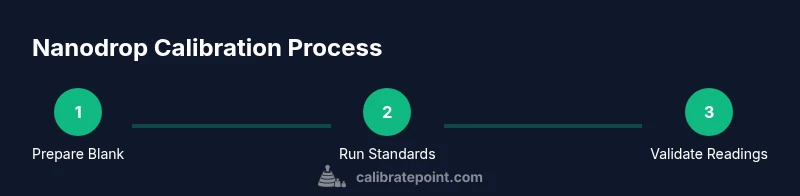
Calibration combines blanking, standards, and validation in a repeatable cycle. Start with a fresh blank reading, then sequentially load standards that span the measurement range. Record A260, A280, A230, and any other required ratios, then plot observed concentrations versus nominal values to assess linearity. If readings deviate beyond acceptance criteria, re-check blanks, re-pipette standards, or re-calibrate the instrument software. Maintain a clear audit trail with time stamps, operator initials, and instrument firmware version to support ongoing quality control. The detailed, step-by-step instructions are provided in the dedicated STEP-BY-STEP block below.
Verification, Maintenance, and Troubleshooting
After completing calibration, verify stability by running a second, independent series of standards and confirming the linearity and accuracy of the results. Schedule routine maintenance for optical components and software updates as recommended by the manufacturer. If drift or inconsistent readings persist, troubleshoot common issues such as solvent incompatibilities, cuvette residues, or incorrect blank selection. Keeping a formal calibration SOP and logging all calibration events helps teams maintain confidence in Nanodrop measurements. Calibrate Point’s guidance highlights the value of routine checks and documentation to maintain data integrity.
Tools & Materials
- Nanodrop spectrophotometer(Ensure firmware is up to date; follow manufacturer guidance for warm-up)
- Certified calibration standards (DNA/RNA/protein)(Cover the expected concentration range; keep certificates for traceability)
- Blank solvent (DNase/RNase-free water or kit buffer)(Use the same solvent for blanks and standards)
- Cuvettes or disposable micro-volume cuvettes(Clean and dry; inspect for scratches)
- Pipettes and tips with calibration(Use calibrated pipettes; avoid cross-contamination)
- Lab notebook or LIMS(Record readings, lot numbers, dates, and operator)
- Alcohol wipes or lint-free cloth(For exterior cuvette cleaning and surface decontamination)
Steps
Estimated time: 45-60 minutes
- 1
Prepare baseline blank
Power on the Nanodrop, select the blank option, and fill the pedestal with the blank solvent to establish a clean baseline. Ensure the same solvent is used for all subsequent measurements to maintain consistency.
Tip: Use a fresh blank or freshly prepared buffer to minimize drift. - 2
Warm up and stabilize
Allow the instrument to warm to the recommended operating temperature and perform a quick blank check to confirm a stable baseline before running any standards.
Tip: Follow manufacturer suggested warm-up time; do not rush this step. - 3
Prepare standards
Prepare a small set of standards that spans the expected concentration range. Use calibrated pipettes and document each standard's nominal concentration and lot number.
Tip: Label each standard clearly and seal when not in use. - 4
Measure standards
Place each standard in the instrument one at a time, ensuring no bubbles form and the cuvette surface is clean. Record absorbance values and calculated concentrations according to the protocol.
Tip: Avoid bubbles and fingerprints on cuvette windows. - 5
Evaluate calibration curve
Plot measured concentrations against nominal values to assess linearity. Check for systematic deviations at either end of the range and investigate potential causes.
Tip: If the curve deviates beyond acceptance, review blanks and volumes before re-running.
Questions & Answers
What is the Nanodrop optical path length and why does it matter for calibration?
Path length directly affects absorbance readings. Consistent path length and proper blanking are essential for accurate concentration measurements. Calibration aligns the instrument so that A260/A280 and related metrics reflect true sample quality.
Path length affects absorbance; ensure consistent path length and proper blanking for accurate readings.
How often should I calibrate the Nanodrop?
Calibrate whenever you notice drift, after instrument maintenance, or when starting a new experiment series. In high-use labs, consider a routine weekly or monthly check aligned with your QA SOP.
Calibrate when you detect drift or after maintenance, and follow your QA SOP for routine checks.
Can any standard be used for calibration?
Use certified standards appropriate to your measurements (DNA, RNA, or protein). Keep standards sealed, avoid cross-contamination, and ensure they lie within the instrument’s measured range.
Use certified DNA, RNA, or protein standards as appropriate, kept sealed and uncontaminated.
What if readings are inconsistent after calibration?
Recheck the blank, inspect cuvettes for damage, confirm solvent compatibility, and re-prepare standards if necessary. If issues persist, consult the SOP and consider instrument service.
If readings are inconsistent, recheck blanks and cuvettes, then re-prepare standards and consult the SOP if needed.
Do I need to calibrate Nanodrop for every sample?
Not for every sample, but you should calibrate as part of a routine QC workflow. Run a quick blank and a known standard before critical runs to ensure results are reliable.
Calibrate as part of routine QC; do a quick blank and standard before critical runs.
Watch Video
Key Takeaways
- Blank before every measurement
- Use fresh, correctly ranged standards
- Document all calibration data meticulously
- Verify with an independent check if needed