Calibrate Review Center: A Practical How-To for Accurate Calibration
A practical, step-by-step guide to running a reliable calibrate review center with traceability, documentation, and auditable results. This Calibrate Point guide helps technicians, DIYers, and professionals implement best practices.


By following this step-by-step approach, you will learn how to establish a repeatable calibration workflow at a calibrate review center, document uncertainties, and generate auditable certificates. This quick answer previews the main ideas and points you toward a comprehensive, audit-ready procedure that improves reliability across tests and reviews. It also highlights common pitfalls to avoid.
What is a calibrate review center?
According to Calibrate Point, a calibrate review center is a dedicated facility where measurement devices and processes are evaluated against reference standards to ensure accuracy and consistency. The Calibrate Point team emphasizes that such centers must maintain traceability, documented procedures, and transparent uncertainty budgets to deliver reliable results. When you set up a center with clear scope, responsibilities, and standard operating procedures, you create a foundation for dependable test outcomes and auditable records.
In practical terms, think of it as a controlled environment where devices are tested, adjusted if required, and certified for use in real-world measurements. The goal is to reduce variability between instruments and operators, so customers and stakeholders can trust the reported values.
Why calibration matters for review centers
Calibration in a review center ensures that every instrument or measurement path used for assessments meets a defined standard of accuracy. For labs and workshops, consistent calibration reduces decision risk, supports regulatory readiness, and improves customer confidence. Proper calibration creates an auditable trail from initial test to final certificate, which is especially important in industries with strict quality requirements. Calibrate Point emphasizes that reliability is built on traceability, documentation, and disciplined procedures rather than ad hoc fixes. By prioritizing repeatability, you minimize drift, measurement uncertainty, and operator-induced variability across all tasks.
Core concepts: traceability, reference standards, and uncertainty
Two core ideas every calibrate review center should master are traceability and uncertainty. Traceability means every measurement can be linked back to an unbroken chain of calibrations to national or international standards. Reference standards are the benchmarking tools used in the process, and they must be certified and continuously verified. Uncertainty represents the doubt about a measurement’s true value; documenting it explicitly helps end-users understand the confidence level of reported results. Calibrate Point reminds readers that a robust center maintains documented uncertainty budgets, reproducible methods, and transparent criteria for when results are acceptable or require adjustment.
Building a robust calibration workflow
A strong workflow begins with a clear scope, defined roles, and a stepwise procedure. Start by documenting instrument IDs, reference standards, and environmental conditions. Create checklists for each stage: preparation, measurement, adjustment, and certificate generation. Ensure that procedures include decision rules for out-of-tolerance findings and a path for re-calibration or instrument replacement. The workflow should be repeatable across operators and instruments, enabling consistent results even as personnel change. Calibrate Point advises implementing a versioned SOP library so changes remain auditable and backwards-compatible.
Data management, documentation, and audit trails
Data management is the backbone of a trustworthy calibrate review center. Use templates for calibration records, certificates, and uncertainty budgets, and store them in a centralized, access-controlled repository. Every entry should include instrument serial numbers, reference standard IDs, environment readings, timestamps, and operator IDs. An automatic audit trail helps you track who did what and when, which is essential in post-audit reviews or customer inquiries. Calibrate Point highlights the importance of data integrity: protect against tampering, verify backups, and retain historical data for a defined retention period.
Environmental controls and safety considerations
Environmental stability is a prerequisite for credible calibrations. Maintain a controlled temperature and humidity, minimize vibration, and shield sensitive equipment from drafts and electromagnetic interference when possible. Safety comes first: wear appropriate PPE, follow device-specific safety guidelines, and ensure that high-voltage or hazardous procedures are performed by trained personnel. If you cannot guarantee a stable environment, implement compensating controls such as time-windowed measurements or environmental logs to normalize results. Calibrate Point recommends documenting environmental conditions alongside results to support traceability.
Tools, materials, and setup checklist
A well-stocked calibration workspace reduces delays and errors. Stock essentials like reference standards, calibrated weights, measurement instruments, environmental monitoring tools, and calibration software. Maintain a clean, organized workspace with clearly labeled storage for standards and accessories. Keep templates for certificates, logbooks, and maintenance records within easy reach. Having spare parts and adapters on hand minimizes disruption when fixtures or connections fail. Calibrate Point stresses the value of a one-page setup guide that new staff can follow to avoid missteps.
Step-by-step calibration cycle (high-level overview)
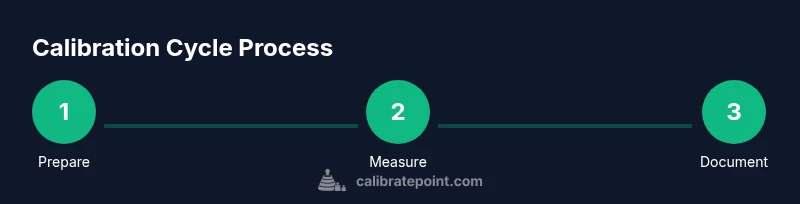
A typical calibration cycle follows a repeatable loop: prepare, verify, measure, adjust, document, review, and certify. Each phase should have objective pass/fail criteria and time windows. Use versioned procedures so the team can track changes over time. The cycle should be auditable, with electronic records that tie measurements to standards and environment. A well-executed cycle reduces rework and builds confidence in results across tests and reviews for the calibrate review center.
Quality assurance and continuous improvement
Quality assurance activities—including internal audits, proficiency testing, and corrective actions—keep calibration services reliable. Regularly review procedures and performance metrics to identify trends, not just one-off failures. Implement corrective actions that address root causes, verify effectiveness, and re-test where necessary. Encourage feedback from instrument operators and customers to uncover hidden issues. Calibrate Point recommends embedding continuous improvement into the center’s culture to sustain high standards over time.
The Calibrate Point approach: practical takeaways for your center
The Calibrate Point approach focuses on structure, transparency, and repeatability. Start with a clear SOP library, maintain traceability to recognized standards, and implement auditable data practices. Use checklists and version control to manage changes. Finally, cultivate a culture of learning and accountability so every calibration adds value. By following these practices, your calibrate review center becomes a dependable benchmark for measurement reliability and customer confidence.
Tools & Materials
- Calibration reference standards(Traceable to national or international standards; clearly labeled)
- Calibration software or data logger(With audit trail, versioned releases, and exportable reports)
- Certified weights and counterweights(NIST-traceable or ISO/IEC 17025 compliant where applicable)
- Environmental controls(Temperature/humidity control; vibration isolation if needed)
- Measurement instruments (DMMs, calipers, gauges, etc.)(Each instrument should have a current calibration certificate)
- Documentation templates(Templates for calibration records, certificates, and uncertainty budgets)
- Personal protective equipment(Safety goggles, gloves as required by procedures)
- Calibration fixtures and adapters(Fixtures to ensure repeatable positioning and interfaces)
- Spare batteries and power supply(UPS or backup power to prevent data loss during tests)
Steps
Estimated time: 2-4 hours
- 1
Prepare workspace and prerequisites
Set up the calibration area to a stable environment. Verify that all required standards, instruments, and templates are available and accessible. Confirm that environmental controls are functioning and that safety PPE is ready.
Tip: Document any deviations from the plan before starting to avoid bias. - 2
Verify instrument and reference standard identities
Check serial numbers, certificates, and expiry dates. Confirm that the reference standards match the planned calibration scope and that all IDs are logged in the system.
Tip: If a standard is out of tolerance, isolate it and replace with a known-good reference. - 3
Connect equipment and align procedures
Attach the instrument to the reference standard and initiate the measurement sequence according to the SOP. Ensure fixtures are secure and connections are clean.
Tip: Use a checklist to prevent missed steps during setup. - 4
Record measurements and apply adjustments
Capture raw data, apply any permitted adjustments, and log the effects. Maintain an audit trail showing rationale for changes.
Tip: Annotate any operator-driven adjustments with justification. - 5
Calculate uncertainty and document results
Compute the combined standard uncertainty for each parameter and assemble a transparent uncertainty budget. Record the final results with the associated environment data.
Tip: Use standardized formulas and reference guidelines to ensure consistency. - 6
Perform intermediate checks and re-check if needed
Repeat key measurements to verify stability. If results vary beyond limits, investigate root causes and re-check with updated procedures.
Tip: Stability verification reduces late-stage surprises. - 7
Validate results with independent check
Where possible, cross-verify a second instrument or path against the same reference standards to confirm consistency.
Tip: Independent checks provide stronger evidence of reliability. - 8
Close out and archive data
Generate calibration certificates, store raw data, and secure the audit trail. Ensure retention aligns with policy and regulatory requirements.
Tip: Backups and versioned documents prevent data loss.
Questions & Answers
What is a calibrate review center and why does it matter?
A calibrate review center is a dedicated facility where measurement devices and processes are evaluated against reference standards to ensure accuracy and consistency. It matters because it provides traceable, auditable results that stakeholders can trust for decision-making and compliance.
A calibrate review center is a dedicated facility for evaluating measurement devices against reference standards to ensure accuracy. It matters because it provides traceable results that stakeholders can rely on.
How important is traceability in calibration workflows?
Traceability links every measurement back to recognized standards. It enables validation, audits, and regulatory compliance. Without traceability, results lose credibility and can be challenged in audits or customer reviews.
Traceability links each measurement to recognized standards, enabling audits and credibility for your results.
What should a calibration cycle include?
A calibration cycle includes preparation, verification, measurement, adjustment, documentation, review, and certification. Each phase has criteria, time windows, and an auditable record.
A cycle has preparation, measurement, adjustment, documentation, review, and certification with clear criteria.
Do I need formal accreditation for a calibration center?
Accreditation is beneficial for credibility and customer confidence, but it depends on your industry and regulatory demands. Start with a robust internal QA process and pursue accreditation if required.
Accreditation helps credibility, but begin with strong internal QA and pursue it if your field requires.
How should I handle out-of-tolerance results?
Isolate the affected instrument, investigate root causes, re-calibrate or replace standards as needed, document the rationale, and re-test to confirm acceptance criteria are met.
If results are out of tolerance, isolate, investigate, re-test, and document why the result is acceptable or not.
What role does environmental control play in calibration?
Environmental stability minimizes drift and variability. Maintain consistent temperature, humidity, and noise levels, and log these conditions with every result.
A stable environment minimizes drift; keep consistent temperature and humidity and log them with results.
Watch Video
Key Takeaways
- Start with a clear SOP library and traceable standards.
- Document uncertainties and environmental conditions with every result.
- Use audits and independent checks to confirm reliability.
- Archive data securely to support audits and repeatability.