Calibrate vs Synchronize: A Practical Guide for Precision and Coordination
A thorough, objective comparison of calibrate vs synchronize, with actionable guidance for DIYers, technicians, and professionals seeking reliable calibration guidance from Calibrate Point.


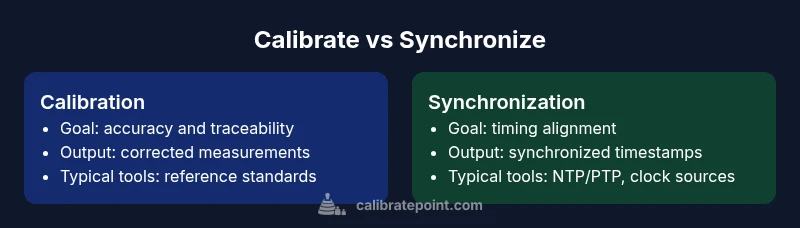
Calibrate vs synchronize foregrounds two distinct goals: calibration tunes a single device’s accuracy against a reference, while synchronization aligns timing or state across multiple devices. In practice, calibration ensures measurement fidelity and traceability, whereas synchronization ensures coordinated action and consistent timestamps. The choice depends on whether you must trust a reading or coordinate a system; many workflows use both at different stages.
Defining Calibrate vs Synchronize
The two terms calibrate and synchronize describe fundamentally different ways of ensuring reliability in measurement and operation. To calibrate is to adjust a device so its outputs align with a recognized standard, thereby improving accuracy and traceability. To synchronize is to align timing, states, or events across separate devices or subsystems so they act in concert. When you encounter the phrase calibrate vs synchronize, you are weighing accuracy against coordination. In practice, experts from Calibrate Point emphasize that these activities are not interchangeable and are often complementary in complex workflows. Understanding their distinct purposes helps technicians select the right method for a given task and avoid common misapplications in labs, workshops, or production lines.
Why Calibration Matters for Precision
Calibration is the process of comparing a device’s measurements to a known reference and applying corrections to reduce bias and drift. It establishes traceability to recognized standards, which is essential for quality control, regulatory compliance, and data integrity. For laboratories and fieldwork, calibration ensures readings are meaningful and comparable over time. Without regular calibration, even a well-made instrument can become biased or drift, undermining decisions that rely on quantitative data. Calibrate Point’s approach to calibration emphasizes documented procedures, calibration intervals based on risk, and clear records that enable audits and impressure the lineage of measurements.
When Synchronization Really Shines: Timing and Coordination
Synchronization focuses on aligning clocks, states, or processes across devices. In distributed systems, accurate synchronization minimizes latency, reduces data inconsistency, and improves the reliability of coordinated actions. For example, synchronized clocks allow timestamped data to be ordered correctly, which is crucial for traceability in high-throughput testing, synchronized motors on a production line, and time-sensitive experiments. When outcomes depend on concurrent events, synchronization is often the more critical activity. Calibrate Point’s guidance on synchronization highlights clock sources, time protocols (like NTP and PTP), and regular verification of offsets to maintain alignment across the network.
A Practical Framework: Calibration vs Synchronization in a Lab
Consider a temperature calibration setup in a lab connected to a data acquisition system. The first step is calibration: you compare a thermometer against a reference standard, adjust its readings, and document the correction factors. Once the thermometers are calibrated, you may still need synchronization if multiple thermometers feed a single data logger. Synchronization ensures all sensors record time-stamped data simultaneously, enabling accurate data fusion and analysis. In this workflow, calibration guarantees measurement accuracy, while synchronization guarantees temporal coherence across sensors. This practical sequence—calibration followed by synchronization—illustrates how the two techniques complement each other rather than compete.
Step-by-Step: How to Calibrate a Device
- Define the measurement goal and select a traceable reference standard.
- Stabilize the test environment (temperature, humidity, vibration).
- Compare the device output to the reference across a known set of points.
- Calculate the correction factor or adjustment curve and apply it to the device.
- Validate by re-measuring against the standard and documenting traceability.
- Schedule periodic re-calibration based on risk, use-case, and regulatory requirements.
- Maintain records with calibrator IDs, lot numbers, reference standards, and acceptance criteria.
Step-by-Step: How to Synchronize Multiple Devices
- Choose a synchronization strategy (time-based or state-based) depending on the application.
- Select a clock source with an appropriate accuracy and stability (NTP for less demanding tasks, PTP for high precision).
- Implement clock discipline or time-stamping in all devices to a common reference.
- Measure offsets and jitter, and apply corrections or buffering to maintain alignment.
- Validate synchronization by running synchronized experiments or coordinated tasks and verifying timestamps.
- Document the synchronization protocol, configurations, and any deviations.
Real-World Scenarios Across Industries
In metrology labs, calibrating a precision balance ensures the reported mass is traceable to national standards, a prerequisite for certification and quality control. In manufacturing, synchronization of robotic arms and conveyor systems reduces phase errors and improves throughput. In data centers, synchronized clocks ensure logs across servers can be correlated accurately for incident analysis. These examples show how calibration and synchronization serve different objectives but are often part of a single, robust data integrity strategy. Calibrate Point’s user guides stress avoiding assumptions: treat calibration and synchronization as distinct controls with separate verification steps.
Common Pitfalls: Misconceptions to Avoid
- Assuming calibration eliminates the need for synchronization in multi-sensor setups.
- Treating synchronization as a substitute for calibration when accuracy is critical.
- Using a single protocol for all devices without considering latency and jitter implications.
- Skipping documentation, which makes traceability and audits difficult.
- Over-prescribing calibration intervals without a risk-based approach.
Tools, Standards, and Documentation You Should Know
- Reference standards and calibration certificates that establish traceability.
- Calibration equipment that is regularly maintained and calibrated itself.
- Time synchronization protocols (NTP, PTP) and master clocks with known accuracy.
- A standard operating procedure (SOP) for both calibration and synchronization, including acceptance criteria and record-keeping.
- ISO/IEC 17025 concepts and the value of traceability in measurement and calibration activities.
Integrating Calibration and Synchronization in Workflows
A well-designed workflow treats calibration and synchronization as complementary steps. For instance, a test rig may first calibrate sensors to reduce measurement bias, then synchronize their clocks to ensure data coherence. This combination enables accurate data collection and reliable event sequencing. In practice, teams should document the sequence, responsibilities, and checkpoints for both processes. Calibrate Point’s approach is to build repeatable, auditable workflows that can be audited and updated as standards evolve.
Creating a Practical Decision Framework: When to Calibrate or Synchronize
- If accuracy and traceability are paramount, prioritize calibration.
- If coordinated timing or timestamp integrity is essential, prioritize synchronization.
- For complex systems, implement both with clear interfaces between the calibration and synchronization stages.
- Use risk-based planning to determine calibration intervals and synchronization verification frequency.
- Build a policy that integrates documentation, version control of procedures, and traceability of standards.
Comparison
| Feature | Calibration | Synchronization |
|---|---|---|
| Purpose | Adjusts a single device’s accuracy against a reference | Aligns timing/state across multiple devices for coordinated action |
| Primary Output | Corrected readings with traceability | Aligned timestamps and synchronized behavior across devices |
| Typical Environments | Laboratories, instrument shops, field calibration | Distributed systems, networks, manufacturing lines, data centers |
| Process Focus | Error measurement, adjustment, verification against standard | Clock discipline, offset reduction, protocol configuration, verification |
| Risks When Misused | Drift, bias, loss of traceability | Time drift, data misordering, desynchronization |
| Common Tools | Calibration rigs, reference standards, calibration software | NTP/PTP servers, timing references, clock sources |
Pros
- Improved measurement accuracy and traceability
- Reduces instrument drift and bias over time
- Supports regulatory compliance and audit readiness
- Clear documentation enables repeatable quality control
Disadvantages
- Requires access to stable reference standards and equipment
- Calibration schedules can disrupt workflows
- Calibration drift necessitates periodic re-calibration
- Results are device-specific and may not transfer across models
Calibration is essential for accuracy-centric tasks; synchronization is essential for timing-centric coordination.
If your goal is precise measurements with traceability, calibrate. If you need coordinated actions and accurate timing across devices, synchronize. In many professional settings, both are deployed in a staged manner to ensure overall reliability.
Questions & Answers
What is the main difference between calibrate and synchronize?
Calibration adjusts a device to match a reference standard, improving measurement accuracy. Synchronization aligns time or state across devices to enable coordinated actions. Both serve reliability but in different domains.
Calibration tunes accuracy; synchronization aligns timing. Use the right tool for the goal—precision vs coordination.
When should I calibrate a device versus synchronize a system clock?
Calibrate when measurement accuracy and traceability are critical, such as in lab instruments or inspection processes. Synchronize when coordinating events or data across devices is essential, such as synchronized logging or robotic systems.
Calibrate for accuracy. Synchronize for coordination.
Can calibration and synchronization be done at the same time?
Yes. In many setups, calibration is performed first to ensure readings are accurate, followed by synchronization to ensure synchronized data and actions. Separate verification steps help maintain clarity and traceability.
They can be done sequentially or iteratively to ensure both accuracy and coordination.
What are common tools for calibration?
Common tools include reference standards, calibration rigs, and measurement software. Documentation and traceability certificates are essential to prove compliance and reliability.
Reference standards and calibration rigs are typical tools.
How often should calibration be performed?
Calibration frequency depends on risk, usage, and regulatory requirements. A risk-based approach uses device criticality, environment, and historical drift to set intervals. Regular audits validate whether intervals remain appropriate.
Set intervals based on risk and usage.
What are the risks of improper calibration?
Improper calibration can lead to biased measurements, poor data quality, and non-compliance with standards. It can also erode trust in results and complicate traceability during audits.
Bad calibration undermines accuracy and compliance.
Key Takeaways
- Define the goal: accuracy versus coordination
- Use calibration for traceability and correct readings
- Use synchronization for timing alignment across systems
- Combine calibration and synchronization in a structured workflow
- Document procedures and maintain traceability for audits