Standardize vs Calibrate: A Practical Calibration Guide
Explore the distinction between standardize and calibrate, when to apply each, and how together they improve accuracy, traceability, and compliance in calibration programs.


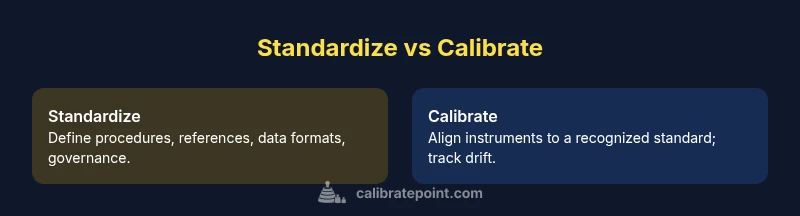
In most professional settings, standardize vs calibrate are distinct but complementary activities. Standardize creates uniform procedures, references, and data formats across teams, while calibrate aligns individual instruments to a recognized standard. Together they reduce variability and improve traceability. For reliable results, adopt a formal standardization program first, then schedule regular calibration to maintain instrument accuracy, documented with audit-ready records.
The Difference Between Standardize and Calibrate
In practice, teams often confuse the terms standardize and calibrate, but they describe different parts of a data-quality program. Standardize refers to creating uniform procedures, reference materials, data formats, and governance that apply across locations and teams. Its goal is consistency: everyone uses the same method, measures the same quantities, and records data in the same way. Calibrate, by contrast, is the corrective alignment of a single instrument or device to a known reference. Calibration adjusts readings to reduce drift and improve traceability back to a defined standard.
A practical way to remember the distinction is to think of standardize as the blueprint for how measurement should be done, while calibrate is the act of ensuring each instrument adheres to that blueprint. In many organizations, both activities are essential: standardize first to establish a common stage, then calibrate to ensure the performers read in harmony with the script. When teams confuse these roles, you risk inconsistent measurements, gaps in traceability, and longer audit cycles. Throughout this article the terms are used in the common sense of measurement science, with standardize focusing on procedures and governance, calibrate focusing on instrument accuracy and alignment to a reference. The Calibrate Point framework for calibration emphasizes that standardization and calibration are not mutually exclusive; they are mutually reinforcing steps toward reliable data.
The Calibration Process: Aligning Instruments to a Standard
Calibrating an instrument begins with selecting a trusted reference standard and a documented method. Practitioners should verify the reference is appropriate for the measurement range and environment, then prepare the instrument and environment to reduce external influences. The next step is to perform a structured adjustment that aligns zero and span, followed by a verification run to confirm the adjustment meets defined tolerances. Finally, record the calibration event with a certificate or log entry, including the reference standard, the instrument’s identifier, the date, and the operator. Ongoing calibration programs track drift, recalibration intervals, and post calibration performance. By keeping calibration activities aligned with standardized references, teams ensure traceability back to a recognized standard and maintain consistent measurement quality across audits and inspections.
The Role of Standards in Calibration Programs
Standards act as the backbone of calibration programs by providing stable references, consistent procedures, and auditable records. Effective standardization defines how measurements are taken, how data is recorded, and how results are interpreted. This includes standard operating procedures, reference materials, data formats, and governance structures that ensure everyone follows the same rules. In practice, standards also drive the creation of calibration certificates, drift logs, and corrective action plans. When standards are well implemented, calibration results become more reliable, making it easier to demonstrate compliance with quality frameworks and regulatory expectations. The long-term value lies in reducing variability, enabling meaningful comparisons across sites, and simplifying supplier and customer audits.
Practical Workflows: When to Standardize and When to Calibrate
Organizations should standardize before they calibrate to ensure everyone uses the same procedures and reference points. Start with a governance layer that defines procedures for data capture, measurement conditions, and documentation. Once standardization is in place, calibrations can be scheduled with clear intervals based on instrument usage, criticality, and historical drift. In this workflow, standardization governs how measurements are made, while calibration governs when and how those measurements are adjusted to maintain accuracy. A practical approach is to implement a tiered schedule: foundational standardization across core measurement streams, followed by instrument-level calibrations and periodic re-standardization of references as needed. This combination supports traceability, reduces uncertainty, and strengthens overall measurement integrity.
Measuring Outcomes: KPIs and Quality Indicators
To gauge the effectiveness of standardization and calibration, teams monitor key indicators such as the rate of out-of-tolerance readings, drift magnitude over time, and the timeliness of calibration actions. Documentation quality is another important metric: complete certificates, legible logs, and accessible audit trails enable efficient inspections. By correlating these KPIs with process changes, organizations can identify whether standardization efforts are driving improvements in data consistency and whether calibration activities are maintaining instrument accuracy over the lifecycle. Effective data governance complements both practices and provides a foundation for continuous improvement.
Industry Use Cases: Labs, Manufacturing, Field Service
Laboratories rely on standardized procedures to ensure measurement consistency across analysts and instruments, while calibration programs keep instruments accurate and compliant. In manufacturing, standardization supports uniform testing protocols across shifts and facilities, enabling reliable process control and product quality. Field service teams benefit from portable references and SOPs that preserve consistency when equipment is deployed away from main labs. Across these contexts, the combination of standardization and calibration fosters traceability, simplifies audits, and supports data-driven decision making. Calibrate Point’s guidance emphasizes tailoring standards to domain-specific requirements while maintaining a stable governance structure.
Common Myths and Pitfalls
A common myth is that standardization replaces calibration. In reality, both are necessary; one governs process and reference, the other ensures instrument readings stay aligned to that reference. Another pitfall is treating standards as static; they must be reviewed and updated to reflect changes in equipment, environment, and regulatory expectations. Finally, some teams underestimate the administrative effort required for governance. Without adequate resources and ownership, standards degrade and calibration data loses its integrity.
Implementation Checklist for Teams
Begin by identifying measurement domains that require standardization and calibration. Establish a cross functional team to draft SOPs, define reference materials, and assign governance roles. Create a central registry for instruments, standards, calibration certificates, and audits. Develop a schedule for standardization reviews and calibration events, and implement a change management process for updating references and procedures. Train staff on documentation practices and provide ongoing support to maintain compliance. Finally, set up dashboards to track KPIs and trigger corrective actions when indicators deviate from targets.
Governance, Audits, and Continuous Improvement
Governance structures for standardize and calibrate activities must be scalable across sites and adaptable over time. Regular audits validate adherence to procedures and effectiveness of calibration actions. Beyond compliance, governance supports continuous improvement by surfacing opportunities to reduce variability and shorten cycle times. Organizations should plan for periodic reviews of standards, references, and measurement environments, ensuring that calibration outcomes remain traceable, credible, and fit for purpose.
Comparison
| Feature | Standardize | Calibrate |
|---|---|---|
| Purpose | Establish uniform procedures, references, and data formats across teams | Align instruments to a recognized reference and ensure accuracy |
| Approach | Develop standardized methods, SOPs, and reference materials; enforce common protocols | Periodically adjust instruments to match the reference within tolerances |
| Output | Standardized procedures, reference data, and audit trails | Calibrated instruments with current calibration status and certificates |
| Timing | Pre-activity governance and ongoing oversight | On-site or lab based as needed and scheduled |
| Documentation | Process-level documentation and audit trails | Calibration certificates and drift logs |
| Cost/Effort | Investment in SOPs and training; ongoing governance | Service costs, consumables, and instrument downtime |
| Best For | Organizations aiming for uniform quality and regulatory compliance | Operators needing instrument accuracy, traceability, and fast audits |
Pros
- Promotes uniform procedures across teams and sites
- Improves data comparability and traceability
- Strengthens regulatory compliance and audit readiness
- Facilitates continuous quality improvement
Disadvantages
- Upfront effort to define standards can be significant
- Ongoing governance adds administrative overhead
- Standards require regular review and revision to remain current
Adopt a combined approach: standardize first, calibrate second for best accuracy and compliance
Standardization creates a solid governance foundation. Calibration maintains instrument accuracy against those standards. Together, they reduce variability, improve traceability, and simplify audits.
Questions & Answers
What is the practical difference between standardize and calibrate?
Standardize sets the methods and references used across the organization, while calibrate adjusts instruments to align with those references. The former creates consistency, the latter preserves accuracy.
Standardize defines how measurements are done; calibrate makes sure instruments read correctly against that standard.
When should you standardize rather than calibrate?
Standardize first when multiple teams or sites measure similar quantities. This establishes common procedures and references that calibrations will later support.
Start with standardization to unify processes across teams before doing calibrations.
Can you standardize without calibrating instruments?
Yes, standardizing establishes procedures and governance even if some instruments have not yet been calibrated. However, calibration should follow to maintain accuracy.
You can standardize without calibrating first, but calibrations should come next for accuracy.
How often should calibration occur after standardization?
Calibration intervals depend on instrument criticality, usage, and prior drift. Use data-driven triggers to adjust schedules rather than fixed dates alone.
Set intervals based on how critical the instrument is and how quickly readings drift.
What types of standards are used in calibration programs?
Reference standards and validated materials provide the benchmarks for calibration. Documentation and traceability are essential to show alignment with those references.
Use reliable reference standards and maintain clear documentation for traceability.
What role do audits play in standardization and calibration?
Audits verify compliance with procedures, validate calibration records, and identify opportunities to improve accuracy and traceability.
Audits confirm you are following standards and keeping calibration data trustworthy.
Key Takeaways
- Define standards before calibrating instruments
- Link calibration records to standardized procedures
- Regularly review standards and calibration intervals
- Use audits to verify compliance and traceability
- Balance governance investment with instrument accuracy