Calibration Curve Examples: A Practical How-To Guide
A practical guide to building and interpreting calibration curves with real-world examples, covering curve types, data handling, and error assessment essential.


This guide helps you build and interpret calibration curve examples for common measurement tools. You’ll learn how to collect standards, construct a curve, fit a model, and assess fit quality. Whether you calibrate thermometers, scales, or sensors, step-by-step examples show how to apply curve data to real measurements in practice.
What calibration curve examples are and why they matter
Calibration curve examples illustrate how a measurement instrument responds to known reference values across its operating range. They are essential for converting raw instrument readings into accurate quantitative results. According to Calibrate Point, well-documented calibration curve examples improve traceability and reduce drift during routine checks. In practice, you’ll typically collect multiple standards, plot the responses, and fit a model that relates the instrument signal to the true value. By exploring calibration curve examples, technicians learn to identify linear regions, non-linear behavior, and where the curve deviates from ideal performance. This knowledge helps you design robust calibration protocols, select appropriate standards, and communicate results with confidence. For DIY enthusiasts and professionals, calibration curve examples provide a concrete template you can adapt to thermometers, scales, pH meters, or torque wrenches. The goal is to produce a curve that remains stable over time and offers a predictable, defensible mapping from readings to true values.
Types of calibration curves: linear, polynomial, and spline
Calibration curve examples come in several shapes. The simplest is a linear curve where the signal changes proportionally with the true value. When a straight line fits well, you can use simple linear regression to estimate the slope and intercept. But many instruments exhibit non-linear responses, especially near the extremes of the range. In those cases, calibration curve examples might employ polynomial or spline models to capture curvature. Each model has trade-offs: polynomials can overfit, while splines provide flexibility with knot placement. Calibrate Point recommends starting with a linear model and only moving to a non-linear approach after diagnostic checks. For each model, compare residuals, check for bias across the range, and use visual inspection of plotted points to confirm that the chosen curve reflects physical reality as well as statistical fit. In all cases, document the chosen model in your calibration protocol so others can reproduce results.
Planning your calibration curve study: choosing instruments and standards
Before collecting data, define the instrument, the range of interest, and the performance criteria. Calibration curve examples require at least five well-distributed standards across the range; more points improve fit and reveal non-linearity. When working with thermometers or pH meters, choose standards with known values traceable to a recognized reference. Prepare standards carefully, label them, and maintain stable environmental conditions to avoid drift. Document the calibration interval, the reference sources used, and any adjustments performed during preparation. If you are calibrating multiple units of the same model, ensure that the standard set covers the same range for all units. Good documentation of standards, procedures, and environmental controls is what makes calibration curve examples credible and reusable across projects.
Data collection templates and documentation
Accurate calibration curve examples rely on clean data capture. Prepare a data collection template that records: standard value, instrument reading, environmental conditions, time stamp, operator, and any notes about the measurement. Use replicates to estimate random error and identify outliers. If you record data in a spreadsheet, include a separate sheet for data cleaning steps and a log of any outliers removed and the justification. The template should also capture the reference source of each standard (certificate number, expiration date, and traceability chain). Consistent units and clear terminology help you reuse calibration curve examples across projects, devices, and teams. Calibrate Point recommends validating the data collection process with a quick pilot run before the full set of standards to catch logging mistakes and misreported values.
Building the curve: plotting and modeling
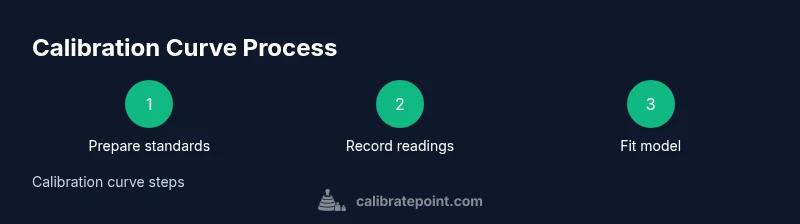
Plot the standard values on the x-axis and the instrument responses on the y-axis. Start with a simple scatter plot to visually inspect the relationship. Fit a model to the data using your chosen method (linear, polynomial, spline). Record the model equation and the fit metrics. Validate the fit by checking residuals for randomness and ensuring there are no systematic patterns. If your curve shows curvature near the ends of the range, consider introducing a non-linear model or restricting the calibration to a sub-range where linear behavior holds. Use software features to extract slope, intercept, and confidence intervals for the parameters. Document the final equation and the intended range of validity in the protocol.
Interpreting the curve: slope, intercept, R^2, and beyond
We interpret calibration curves to convert raw readings to true values. The slope indicates sensitivity; the intercept accounts for zero offset. The R^2 statistic helps gauge linear fit quality but should not be the sole criterion. Examine residual plots for randomness and uniform spread across the range. For non-linear curves, report the model form, domain of applicability, and prediction intervals. Consider transforming the data if needed to stabilize variance. Document the uncertainty of predictions, and provide practical guidance on how to apply the curve to new measurements within the validated range.
Real-world cases: thermometer, pH meter, torque wrench
Calibration curve examples come to life in real devices. A digital thermometer may show nearly linear behavior across a moderate range, but it exhibits non-linearity near the upper limits. A pH meter often requires multiple buffer solutions to cover its operating range and may require temperature compensation. A torque wrench calibration involves applying known torque levels and recording the instrument's reading to ensure accuracy across the torque range. For each case, include the standards used, the curve form, and the decision rules for when the curve is considered valid. If you publish the curve, include a sample calculation showing how to convert a reading to the true value using your final equation.
Common mistakes and how to avoid them
Common errors include using too few data points, failing to distribute standards evenly across the range, neglecting environmental controls, and not documenting uncertainty. Avoid extrapolating beyond the validated domain, and never apply a curve without confirming its validity for the current sample type and measurement conditions. Regularly review your curve alongside maintenance records to catch drift or instrument aging early. Calibrate Point emphasizes maintaining a clear, auditable trail from standards to final results.
Integrating calibration curve results into daily workflows
Once a curve is established, embed it into standard operating procedures, instrument maintenance logs, and quality checks. Include explicit steps for applying the curve to a measurement, calculating the uncertainty, and re-validating periodically. Training should cover how to read the curve, interpret its limits, and recognize when an instrument needs re-adjustment or re-calibration. By integrating calibration curve results into workflows, teams improve consistency, reduce measurement variation, and support regulatory compliance. Calibrate Point reminds readers that the most valuable curves are those that are traceable, repeatable, and transparently documented.
Tools & Materials
- Calibration standards (traceable to reference)(Minimum five levels across the measurement range; document certificates.)
- Pipettes, volumetric flasks, or calibrated droppers(For preparing precise standards with known values.)
- Blank solution or zero standard(Useful for background correction where appropriate.)
- Documentation templates or lab notebook(Capture standard details, environmental conditions, and notes.)
- Data analysis software (Excel, Python, or dedicated software)(Used for plotting, fitting models, and calculating uncertainties.)
- Protective equipment (gloves, goggles)(Depends on the substances used in standards.)
- Temperature or environmental monitor(Helps track drift and ensures stable conditions.)
Steps
Estimated time: 1.5-2 hours
- 1
Define range and targets
Identify the instrument's operating range and the target accuracy. Specify the range over which the curve will be applied and the decision rules for when to re-calibrate. This sets the scope for your calibration curve examples.
Tip: Tip: choose points that cover the entire range, including ends where non-linearity may appear. - 2
Select and prepare standards
Choose at least five standards across the range with traceable values. Prepare and label them carefully, ensuring stability and traceability of each standard.
Tip: Tip: verify standards against certificate values before use. - 3
Record measurements with replicates
Measure each standard in triplicate if possible. Record instrument readings, temperature, time, and operator. Replicates help estimate random error and identify outliers.
Tip: Tip: randomize measurement order to minimize systematic bias. - 4
Plot data and choose a model
Create a scatter plot of standard values vs. instrument responses. Try a linear model first; if residuals show structure, test a polynomial or spline.
Tip: Tip: use residual plots to decide on the simplest adequate model. - 5
Fit the curve and extract parameters
Fit the chosen model and record slope, intercept, or coefficients. Capture fit statistics and the equation that maps readings to true values.
Tip: Tip: include confidence intervals for parameters. - 6
Validate with independent points
Use at least one independent standard or cross-check with a known sample to verify predictive accuracy. Compare predicted vs. actual values.
Tip: Tip: if validation fails, revisit point 4–5 and adjust the model. - 7
Document range of validity and usage
Record the curve’s valid domain, expected error, and instructions for applying it to new measurements. Store all materials for auditability.
Tip: Tip: align with relevant standards and regulatory requirements.
Questions & Answers
What is a calibration curve and why is it used?
A calibration curve links instrument signal to a known standard, enabling conversion of readings to true values. It provides traceability, helps assess measurement accuracy, and supports decision-making in quality control.
A calibration curve is a map from your instrument signal to known reference values, used to convert readings accurately and support quality checks.
How many data points do I need for a calibration curve?
Aim for at least five well-distributed points across the range. More points improve the detection of non-linearity and the robustness of the fit.
Use at least five points across the range, more if you expect non-linearity.
What indicates a good fit for a calibration curve?
Look for a high R-squared value, small residuals, and no systematic patterns in residual plots. For non-linear curves, check predictive accuracy across the range.
A good fit has strong predictive accuracy with random residuals and clear validity across the range.
When should I use a non-linear model for a calibration curve?
If residuals show curvature or variance changes across the range, non-linear models like polynomial or spline fits may be appropriate. Validate with independent data.
Use non-linear models when the data shows curvature or non-constant variance, and validate carefully.
How often should calibration curves be re-validated?
Re-validate when instrument changes, after maintenance, or when results drift. The schedule should reflect the device’s stability and regulatory requirements.
Re-validate after maintenance or noticeable drift, following your device’s stability plan.
Can calibration curves be used across different instruments?
Only if the instruments share the same response characteristics and standards. Otherwise, create instrument-specific curves to maintain accuracy.
Only reuse curves if the devices have identical response characteristics; otherwise, calibrate each instrument separately.
Watch Video
Key Takeaways
- Define clear range and targets for the curve.
- Use sufficient, well-distributed standards across the range.
- Choose the simplest model that fits without overfitting.
- Validate curve with independent data before use.
- Document all steps for traceability.