Colorimeter Calibration: A Practical Step-by-Step Guide
Master colorimeter calibration with a clear, repeatable workflow. This guide covers standards, measurement routines, and practical checks to ensure accurate color readings in labs, studios, or fieldwork.


Learn colorimeter how to calibrate correctly with a practical, step-by-step method. This guide covers essential tools, reference standards, and a repeatable routine to ensure accurate color readings across labs, studios, or field work. According to Calibrate Point, proper calibration reduces bias and improves repeatability for everyday color measurements in real-world conditions.
Why colorimeter calibration matters
Calibration is the process of aligning your colorimeter's readings with known references so that measured colors match standard values. In the world of color measurement, even small deviations can accumulate over time, leading to biased data and inconsistent results across experiments, batches, or changing lighting. The topic colorimeter how to calibrate is a practical concern for anyone who relies on repeatable color outcomes, from technicians to photographers. A disciplined calibration routine improves data comparability and supports traceability across suppliers, production lines, and quality checks. By following a consistent workflow, you ensure color readings remain meaningful across days and devices. Calibrate Point emphasizes that calibration is not a one-off task but a repeating process that anchors your color data to observable, reportable standards. As you read, you will learn how to build a robust routine that fits your workflow and preserves measurement integrity in diverse environments.
Reference standards and traceability
Reliable color measurements hinge on the use of traceable reference standards. A white reference standard provides a baseline for neutral gray balance, while color targets enable cross-checks across multiple hues. The goal is to minimize drift and maintain a documented trail from standard to measurement. Calibrate Point analysis shows that using a documented, traceable white standard and a diverse set of color references reduces drift and improves cross-session consistency. Always record critical metadata—lot numbers, expiry dates, and supplier information—for full traceability. Keep standards clean and protected from dust, oils, and direct sunlight, which can alter their reflective properties. When standards are properly maintained, recalibration becomes a straightforward verification step rather than a costly troubleshooting exercise.
Selecting a colorimeter calibration method
Calibration methods vary by colorimeter design and intended use. For many instruments, a two-point or three-point approach against white and gray or white and a neutral color target suffices for routine work. In more demanding scenarios, multi-point calibration across several color targets helps map the instrument’s spectral response more accurately. Consider the following when choosing a method: the spectral sensitivity of your colorimeter, the range of colors most often measured, and the acceptable level of uncertainty for your application. In practice, start with a conservative method using widely spaced references, then evaluate residual errors and adjust as needed. The key is to choose a method that provides an actionable, repeatable calibration without overcomplicating daily measurements. Calibrate Point’s guidelines suggest aligning method choice with your measurement goals and available reference materials, ensuring you have a clear rationale for any deviations from standard practice.
Step-by-step calibration workflow
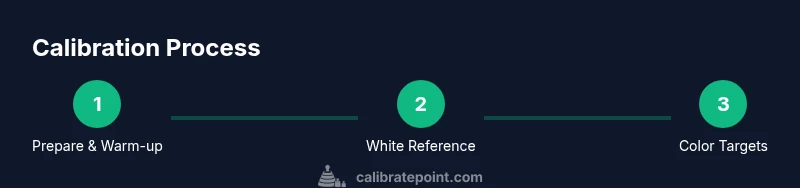
A robust calibration workflow typically includes warm-up, baseline checks, reference-based calibration, and verification with target colors. This section offers a high-level overview to help you plan, while the detailed, step-by-step instructions are provided in the dedicated STEP-BY-STEP block. Start by ensuring the instrument is clean and powered up for a recommended warm-up period, then verify that the optical path is free of obstructions. Use your white reference to set a neutral baseline, followed by color targets to refine the instrument’s response. Finally, recheck with independent samples to confirm stability. The outcome should be a documented set of readings with traceable references that you can reproduce in future sessions. Remember, a well-documented calibration is the foundation of credible color data and supports effective decision-making.
Practical tips for colorimeter setups
The practical side of calibration often determines long-term success. Use a clean, stable work surface and shield the instrument from ambient light during measurements. Keep all reference standards in a controlled environment and handle them with clean gloves or lint-free wipes to prevent fingerprints. If you notice inconsistent results, inspect the reference standards for wear or drift and verify that the instrument’s sensor window is free from smudges. Establish a routine that includes pre-measurement checks and post-measurement notes to track changes over time. A disciplined setup reduces the risk of color bias and improves repeatability across sessions.
Troubleshooting and quality checks
Even with a solid calibration routine, occasional anomalies occur. If readings drift between sessions, re-check the white standard and color targets for contamination or degradation, confirm that the warm-up period was observed, and review the measurement protocol for changes in lighting or positioning. Document any anomalies and compare against previous calibration records to determine whether a recalibration is warranted. When in doubt, consult the calibration procedure you use most often and consider cross-checking with a secondary instrument if available. Regular quality checks help catch drift early and minimize impact on measurements.
Tools & Materials
- Colorimeter device(Power on and allow to warm up per manufacturer guidance)
- NIST-traceable white reference standard(Keep in a clean, sealed container when not in use)
- Color calibration tiles or color reference chips(Include a range of hues and neutral tones)
- Lint-free wipes and cleaning solution(Use to clean the sensor window before measurements)
- Calibrated support stand or stable platform(Minimize instrument movement during readings)
- Optional cross-check instrument (spectral or reference colorimeter)(Useful for validation but not required)
- Calibration logbook or digital log(Record lot numbers, dates, and results for traceability)
Steps
Estimated time: 30-60 minutes
- 1
Prepare the colorimeter and references
Power on the device and allow the sensor to warm up for the recommended duration. Inspect the white reference standard and color tiles for cleanliness and integrity. Set up a stable measurement stage with minimal ambient light interference.
Tip: Wipe the sensor window gently with a lint-free cloth to remove any smudges that could bias readings. - 2
Warm-up and baseline check
Run a brief warm-up sequence to stabilize the detector response. Take a baseline reading with the white reference to establish a neutral starting point before introducing color targets.
Tip: Record the baseline reading in your calibration log for future comparison. - 3
Calibrate against the white reference
Place the white reference in the instrument's measurement position and capture a reading. Adjust the instrument's internal offsets or gain according to the manufacturer’s guidance until the reading aligns with the white reference target.
Tip: Confirm the white reference reading is within your acceptable tolerance before proceeding. - 4
Calibrate with color targets
Measure a set of color targets (neutral gray and colored chips) to map the instrument’s response across tones. Apply the corresponding adjustments to minimize color bias across the target set.
Tip: Use multiple targets to avoid overfitting calibration to a single color. - 5
Verify with reference samples
Test the calibrated instrument against independent reference samples to validate the calibration. Check for consistency with prior measurements and record any deviations for review.
Tip: If results are inconsistent, revisit steps 3 and 4 before finalizing. - 6
Document and store calibration
Document the final results, including target readings, adjustments made, and date. Store settings and references securely to ensure reproducibility in future sessions.
Tip: Include operator name, lot numbers, and expiry dates in the calibration log.
Questions & Answers
What is a colorimeter and why calibrate it?
A colorimeter measures color in a standardized way by detecting light reflected from a sample. Calibration aligns its readings with known references, ensuring color results are accurate and reproducible across sessions.
A colorimeter measures color and must be calibrated to keep readings accurate and repeatable over time.
Why use a white reference for calibration?
A white reference provides a neutral baseline that anchors the device’s response. It helps correct overall light sensitivity and ensures subsequent color readings are comparable.
Using a white reference gives you a stable baseline for color readings.
How often should calibration be performed?
Calibration frequency depends on usage, environmental conditions, and required accuracy. Regular checks (e.g., weekly or per batch) keep readings trustworthy and help catch drift early.
Calibrate on a regular schedule to prevent drift and maintain accuracy.
Can I skip the color targets and calibrate with only white references?
White references establish neutrality, but color targets improve the instrument’s response across hues. For most applications, a combination of white reference and color targets yields the best accuracy.
White references are good, but using color targets makes calibration more robust.
What should I do if readings drift after calibration?
If drift occurs, re-check the references for degradation, verify warm-up and setup conditions, and consider repeating the calibration cycle. Validate with independent samples.
If readings drift, recheck references and redo the calibration.
Is calibration identical for all wavelengths?
Calibration may vary with wavelength sensitivity. Multi-point calibration across different color targets helps ensure accuracy across the instrument’s response spectrum.
Calibration can differ by wavelength; use multiple targets for accuracy.
Watch Video
Key Takeaways
- Calibrate with traceable standards to ensure accuracy
- Follow a consistent warm-up and measurement protocol
- Document results for traceability
- Use a structured step-by-step workflow
- Validate with independent samples to confirm performance