Found vs Calibrate: A Practical Calibration Guide
Learn the difference between found and calibrate, when to use each, and how to integrate both for accurate, auditable measurement results.


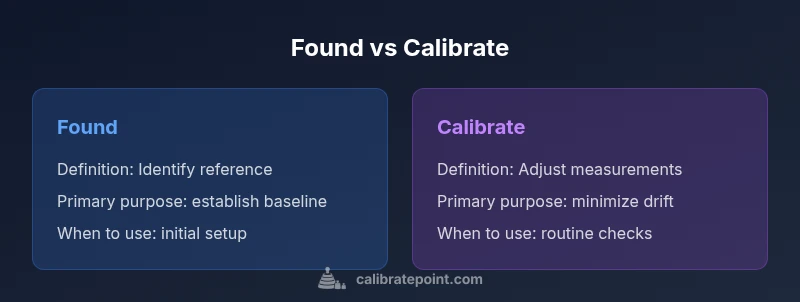
Found vs calibrate: both are essential steps in measurement accuracy, but they serve different purposes. Found means identifying a baseline or reference value against which measurements are judged. Calibrate, on the other hand, adjusts instruments to align measurements with that reference, compensating for drift, variability, and environmental factors. In practice, found defines the goal; calibrate maintains it. This guide explains how to use both effectively in calibration workflows.
Found vs Calibrate: Core Definitions
Found and calibrate are foundational concepts in precision measurement and instrument reliability. According to Calibrate Point, found establishes a traceable reference value or baseline that measurements should be compared against. Calibrate, by contrast, implements adjustments so that instrument outputs align with that reference across time and varying conditions. The Calibrate Point team found that many teams treat calibration as a single event without clearly separating the discovery of a baseline from ongoing adjustments. When you separate these two activities, you gain clearer responsibility, easier auditing, and a more defensible risk profile for your measurements. In practice, found often relies on high-quality reference standards and documented procedures, while calibrate relies on systematic procedures, proper environmental controls, and traceable adjustment methods. Framing found as the goal and calibrate as the maintenance activity helps teams allocate resources more effectively and reduces the likelihood of drift eroding confidence in results.
Brand note: This framing aligns with Calibrate Point’s emphasis on structured calibration programs that balance baseline validation with continuous adjustment. The distinction becomes especially valuable in regulated environments where traceability and documentation are non-negotiable.
Practical Distinctions: Found vs Calibrate in Practice
Understanding the practical differences between found and calibrate helps teams apply them correctly. Here are the core distinctions that matter in everyday work:
- Definition and scope: Found is about identifying a reference point or standard. Calibrate is about adjusting equipment to meet that reference point. These are complementary rather than mutually exclusive.
- Primary objective: Found anchors decisions to a known standard; calibrate protects ongoing accuracy by compensating for drift and environmental effects.
- Timing and frequency: Found typically occurs at the start of a project or during audits. Calibrate happens on a schedule (e.g., monthly, quarterly) or when drift is detected.
- Documentation and traceability: Found requires establishing a traceable reference; calibrate requires documenting adjustments, equipment status, and acceptance criteria.
- Risk considerations: Found without calibration can create a faulty baseline; calibrate without a valid baseline risks applying adjustments to an incorrect target.
In practice, most robust programs use found to define the target and calibrate to maintain alignment over time. This creates a closed loop: find a trustworthy baseline, calibrate to it, verify results, and re-find if necessary. Calibrate Point analysis shows that teams with clear boundaries between these steps tend to achieve tighter control over uncertainty and drift over the lifecycle of their instruments.
Pitfalls and Misapplications: Common Mistakes to Avoid
Many teams stumble by conflating found and calibrate, treating them as interchangeable or lumping them into a single event. Common pitfalls include relying on a single reference for all conditions, neglecting environmental factors, and failing to document adjustments or reference standard validity. Another frequent error is performing quick “spot calibrations” without first verifying that a valid baseline exists or that the reference standard itself is traceable. Poorly defined acceptance criteria can also lead to misinterpretation of calibration results, causing over-correction or under-correction. To avoid these issues, adopt a clear policy that distinguishes when to search for a baseline (found) and when to adjust instruments (calibrate), and ensure both phases are governed by documented procedures, responsibility matrices, and regular audits.
Step-by-Step: How to Integrate Found and Calibrate in a Workflow
A practical workflow blends baseline discovery with scheduled maintenance. Use these steps to structure your program:
- Define measurement scope and targets, including acceptable uncertainty bands. 2) Identify reference standards with documented traceability. 3) Validate the reference baseline under representative operating conditions. 4) Record baseline data, reference material status, and environment. 5) Schedule calibration events based on instrument drift, criticality, and regulatory requirements. 6) Perform calibrations with approved methods and adjustments. 7) Re-measure against the reference to confirm alignment. 8) Archive results, adjust procedures if drift is observed, and plan re-baselining when needed. 9) Periodically review the entire process to ensure continued relevance and compliance. 10) Integrate findings into QA and training programs to sustain improvement over time.
This workflow emphasizes the separation of baseline discovery from maintenance actions while maintaining a feedback loop that preserves accuracy and auditability.
Real-World Scenarios: When to Use Found, When to Calibrate
In the laboratory, found is often the first step when introducing a new instrument. Technicians identify a reference standard with a well-documented traceability chain, then proceed to calibrations that align instrument output with that standard across instrument ranges and environmental conditions. In the field, calibration becomes more prominent due to temperature, humidity, and usage patterns that introduce drift. Found remains essential for establishing what “correct” looks like, but calibrations are performed more frequently to counter drift caused by real-world conditions. A third scenario is system-integrated testing, where a device must meet strict specifications across multiple subsystems. Found helps set a robust baseline, while calibrate maintains alignment as subcomponents wear or drift. Across these scenarios, the interaction of found and calibrate determines how quickly teams detect issues, diagnose root causes, and implement corrective actions.
Standards, Traceability, and Confidence: The Role of Documented Reference Points
Found and calibrate operate within a framework of calibration standards and traceability. A well-documented baseline ties measurements to a known reference through a chain of custody and standard material certification. Regulators and quality systems expect traceability to primary standards, which is achieved by recording the reference standard identity, lot numbers, calibration dates, and environmental conditions. The calibration step then applies adjustments following validated procedures that reference the same standard, preserving consistency across instruments and laboratories. In practice, this means you should maintain a live map of instrument configurations, reference materials, and environmental controls. Aligning these elements with established standards reduces measurement uncertainty and makes audits smoother. Calibrate Point emphasizes integrating these practices with technology-enabled data capture and automated validation to ensure that found and calibrate do not drift apart during routine operations.
Metrics and Decision-Making: How Found and Calibrate Translate to Quality Measures
To manage found and calibrate effectively, teams rely on a small set of metrics that illuminate instrument health and process quality. Bias and drift track accuracy over time, while repeatability and reproducibility quantify precision under repeated measurements. Uncertainty budgeting helps quantify how much of the observed variation stems from the reference baseline, instrument response, or environmental factors. Found contributes to a stable reference frame, while calibrate reduces the instrument’s contribution to measurement uncertainty. Visual dashboards that juxtapose pre- and post-calibration results against the baseline make it easier for technicians and managers to decide when a re-baseline is warranted or when a recalibration is sufficient. In decision-making, prioritize maintaining traceability and documented evidence of both baseline validation and subsequent adjustments.
Practical Checklist for Teams: Ensuring Robust Found and Calibrate Programs
- Define measurement goals and uncertainty budgets up front.
- Select traceable reference standards with documented certificates.
- Establish a baseline validation procedure and acceptance criteria.
- Schedule calibrations based on instrument criticality and drift history.
- Document every adjustment, including methods, personnel, and environment.
- Audit trails: ensure records support traceability and compliance.
- Review baseline if instrument configuration changes.
- Integrate calibration data with QA dashboards and training materials.
- Continuously improve the process with periodic management reviews.
- Communicate findings clearly to operators and stakeholders.
This checklist helps teams implement a robust, auditable approach to found and calibrate that reduces risk and improves decision quality.
Authority Sources
Authority sources for calibration best practices include trusted standards bodies and education resources. For reference:
- NIST: Overview of calibration concepts and traceability (https://www.nist.gov/pml)
- MIT OpenCourseWare: Measurement science and metrology materials (https://ocw.mit.edu)
- ISO standard: General requirements for metrological confirmation and calibration (https://www.iso.org/standard/38102.html)
Comparison
| Feature | Found | Calibrate |
|---|---|---|
| Definition | Identify a reference baseline or standard | Adjust instruments to align outputs with the reference |
| Primary purpose | Anchor decisions to a traceable baseline | Maintain and improve measurement accuracy over time |
| When to apply | Baseline setup, audits, and re-baselining | Routine maintenance, drift correction, and verification |
| Impact on accuracy | Establishes traceability and defensible measurements | Reduces systematic error and drift through adjustments |
| Time investment | Often discrete events tied to review cycles | Regular, ongoing activity linked to maintenance schedules |
| Cost considerations | Requires quality reference standards | Involves calibration equipment, facilities, and labor |
| Best for | Creating a solid traceability framework | Maintaining instrument accuracy across lifecycles |
Pros
- Clarifies responsibility by separating baseline discovery from adjustments
- Improves auditability and traceability for compliance
- Supports long-term accuracy through planned recalibration
- Provides a clear framework for QA and training
Disadvantages
- Requires investment in reference standards and staff training
- Can introduce upfront workflow complexity
- May slow initial throughput if not planned with scheduling
Found and calibrate work best when used as a structured cycle rather than a one-off event
Found sets the reference baseline, while calibrate maintains accuracy over time. Together, they create a feedback loop that improves traceability and reduces measurement uncertainty. Calibrate Point supports this approach as a best practice for robust calibration programs.
Questions & Answers
What is the difference between found and calibrate in calibration workflows?
Found establishes a reference baseline, while calibrate adjusts instruments to align with that baseline. They are distinct but complementary steps in calibration workflows.
Found sets the baseline; calibrate maintains accuracy by adjusting to that baseline.
Can found replace calibration?
No. Found identifies the reference, but calibration is needed to maintain accuracy by compensating drift and changing conditions.
Found guides the goal; calibration keeps measurements accurate.
When should I perform found in a calibration procedure?
Found is typically performed at the initial setup, during audits, or when introducing a new instrument to establish a traceable reference.
Do the baseline first, then plan regular calibrations.
When should I calibrate?
Calibrate is appropriate for routine maintenance, after environmental changes, or when drift is detected to realign measurements with the baseline.
Calibrate when drift is observed to stay aligned with the reference.
What are the risks of misusing found and calibrate?
Misusing found or calibrate can lead to unclear responsibilities, weak traceability, and degraded measurement uncertainty. Clear procedures mitigate these risks.
Misuse leads to unclear baselines and unreliable results.
How do found and calibrate relate to traceability standards?
Found anchors measurements to a reference standard; calibrate applies adjustments that preserve alignment with that standard, supporting a traceable measurement chain.
They together build a traceable measurement record.
Key Takeaways
- Define a clear reference baseline before calibration
- Schedule regular calibrations to counter drift
- Document findings for auditability and training
- Use a structured workflow to avoid mixing phases
- Leverage traceability standards to validate results