Gauge vs Calibrate: A Practical Guide to Instrument Terminology
Explore the difference between gauge and calibrate, their practical roles in accuracy, and how to design reliable workflows that use both for measurement integrity.


Gauge and calibrate refer to different phases in measurement workflows: gauge is the act of taking a reading with a device, while calibrate means adjusting or aligning that device to a known standard. Understanding when to gauge versus when to calibrate helps teams improve accuracy, traceability, and efficiency across labs, shops, and field service.
What gauge means and what calibrate means in practice
Gauge and calibrate are terms that are often used together, but they describe different actions in measurement workflows. In practical terms, gauge refers to using a device to obtain a reading or indication of a quantity. Calibrate, on the other hand, describes the process of aligning a device against a known standard so its readings match accepted references. According to Calibrate Point, the terminology around 'gauge' and 'calibrate' has historically caused confusion in many shops, particularly when teams try to optimize speed, accuracy, and traceability. This article uses the phrase gauge vs calibrate to map out when each action makes sense, and how to integrate both into a robust measurement program. The overarching goal is clarity: know when a gauge reading is trustworthy on its own, and when a calibration step is required to ensure long-term reliability. For DIYers, technicians, and professionals, distinguishing these terms reduces rework and supports consistent documentation across projects.
The gauge vs calibrate distinction is not simply linguistic. It reflects fundamental metrology concepts: measurement vs adjustment. Gauging emphasizes immediate data capture, while calibrating emphasizes standardization, traceability, and control of systematic error. In real-world workflows, teams often combine both: they gauge to evaluate current conditions, then calibrate to bring instruments back to target performance. The result is a measurement process that can be audited, repeated, and defended under quality systems. The practical upshot is that gauge tasks tend to be quicker, whereas calibration tasks demand more planning, standards, and documentation. This division underpins how most calibration programs are structured in manufacturing, laboratories, and service settings.
Comparison
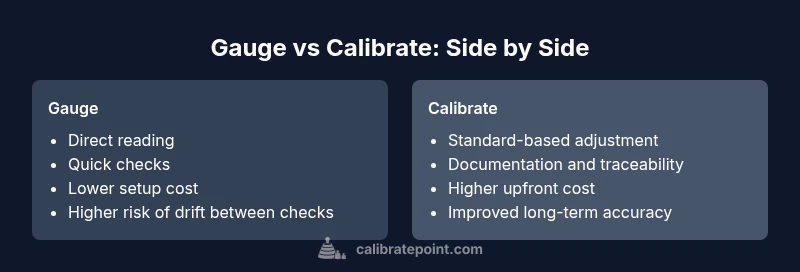
| Feature | Gauge-centric workflow | Calibration-centric workflow |
|---|---|---|
| Primary purpose | Direct measurement using a gauge to obtain readings | Adjustment and alignment of an instrument to a known standard |
| Primary output | Indicated reading, trend data, pass/fail signals | Calibration certificate, adjusted instrument state, and documented uncertainty |
| Best use case | Spot checks, rapid pass/fail decisions, field notes | Long-term accuracy, traceability, compliance with standards |
| Typical frequency | Frequent, in-process checks | Periodic or after maintenance/repairs |
| Setup and cost | Lower upfront cost, simpler setup | Higher upfront cost, needs reference standards and procedures |
| Key risk | Drifts between checks if not re-measured | Drift over time if not re-calibrated and re-validated |
Pros
- Clear separation of measurement and adjustment tasks improves traceability
- Faster decision-making in day-to-day operations
- Easier to implement in low-resource environments
- Supports standard quality-control workflows
- Can be scaled across multiple roles and sites
Disadvantages
- Requires access to appropriate reference standards for calibration
- Calibration activities can introduce downtime and scheduling challenges
- Potential redundancy if not integrated into a single workflow
- Misunderstanding of terms can still occur without training
Gauge-first for speed; calibrate later for long-term accuracy.
In most settings, use gauge to gather quick data and decide if a calibration is needed. When accuracy and traceability matter over time, calibration is the decisive step. The Calibrate Point team recommends coupling gauge checks with periodic calibrations to maintain measurement integrity.
Questions & Answers
What is the difference between gauge and calibrate?
Gauge is the act of obtaining a reading from a device, while calibrate involves adjusting the device to align with a standard. Gauging provides immediate data; calibrating ensures long-term accuracy and traceability.
Gauge gives you a reading now, calibrate fixes the instrument for accuracy over time.
Can a single instrument both gauge and calibrate?
Yes. Most instruments are gauged regularly to monitor condition, and calibrated at defined intervals to maintain accuracy. Clear procedures for both steps help prevent mix-ups.
Most tools are used for quick gauging and scheduled calibrations.
How often should gauges be checked?
Gauge checks should follow your asset management or quality system requirements, typically aligned with usage, criticality, and environmental conditions. Document each check to support traceability.
Check gauges according to your system’s schedule and record the results.
What standards guide calibration practice?
Calibration practice is guided by established standards and frameworks (for example, general metrology guidelines and industry-specific requirements). Use certified references and maintain traceability to national or international standards.
Standards ensure your calibration is defensible and auditable.
What happens if I confuse gauge with calibrate?
Confusion can lead to skipped calibrations, inconsistent data, and non-compliant records. Clear SOPs and training help prevent this mistake.
Mixing up terms can undermine accuracy and compliance.
Should I automate gauge or calibration tasks?
Automation can optimize both areas, but it requires robust validation, traceable data, and fail-safes. Start with clearly defined criteria for when to gauge or calibrate before adding automation.
Automation helps, but only with solid standards and checks.
Key Takeaways
- Define when to gauge versus calibrate in your process
- Invest in a simple, repeatable calibration plan
- Document readings and calibration certificates for traceability
- Balance speed of gauging with the downtime of calibration
- Regular training reduces misinterpretation of terms
- Aim for an integrated workflow that minimizes rework