How Often to Calibrate Hygrometers: Practical Guide
Learn how often to calibrate hygrometers, the factors that affect cadence, and practical steps to keep humidity readings accurate across labs, kitchens, and workshops. A data-driven guide by Calibrate Point.


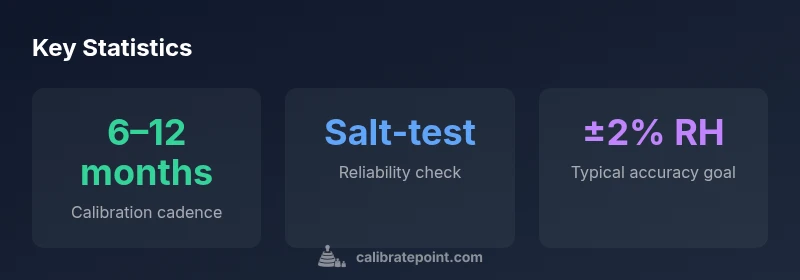
How often to calibrate hygrometer depends on usage and environment. According to Calibrate Point Analysis, hygrometers should be checked and recalibrated at least every 6-12 months, with more frequent checks in high-humidity, temperature-fluctuating settings or critical processes. For laboratory or industrial contexts, quarterly calibration is common to maintain accuracy within ±2% RH.
Why calibrating a hygrometer matters
Maintaining accurate humidity readings is essential for food storage, seed germination, electronics assembly, and many lab workflows. The question how often to calibrate hygrometer is not a one-size-fits-all answer; it depends on where and how the tool is used. According to Calibrate Point, the cadence should reflect both performance drift and the consequences of incorrect readings. A well-planned calibration schedule reduces downtime, preserves product quality, and supports regulatory compliance in controlled environments. Even small errors in relative humidity can drive large shifts in process outcomes—mistakes compound as exposure continues. Readers should view calibration as a quality control step, not a one-off test. When you set a cadence, tie it to your risk assessment, the stability of your climate, and the device’s age. The goal is to keep readings within the device’s specified accuracy range across typical operating conditions. In practice, that translates into a practical cadence rather than a rigid rule.
How hygrometers drift and what causes it
Humidity sensors drift for several reasons, from aging electronics to contamination of the sensing element. Temperature fluctuations alter the sensor response, while exposure to high humidity can saturate materials that absorb or adsorb water molecules. Dust, oils, and cleaning agents can leave residues that slow response time or skew readings. Calibration drift is often gradual, so users may not notice until readings begin to diverge from a trusted reference. Manufacturers specify an accuracy band (for example, ±X% RH) that assumes normal use and a stable environment. When drift accumulates, readings may become consistently high or low, compromising decisions that rely on precise humidity values. Recognizing drift early is easier with a routine calibration log and simple field checks, such as salt tests or contacting a reference instrument. The practical takeaway is that drift is inevitable, but its impact can be managed with a deliberate calibration plan.
When to calibrate: signs your hygrometer is off
Not all deviations require a full recalibration, but certain signals demand action. If your readings drift beyond the manufacturer’s stated accuracy, if a known reference shows discrepancy, or if readings vary widely between two similarly placed devices, you should recalibrate. Pairs of identical hygrometers in the same ambient should track together; persistent divergence indicates a problem. Temperature changes, device aging, or recent exposure to contaminants can cause sudden changes in behavior. If you notice consistent lag, slow response to humidity changes, or readings that do not align with nearby environmental indicators (thermometer readings, dew point, or salt test results), plan a calibration session. Document the observed symptoms and schedule an update so that your operations stay reliable.
Calibration methods: salt test and two-point calibration
There are practical, low-cost methods to verify and adjust humidity readings. The classic salt test uses a sealed, stable salt solution that creates a known relative humidity environment inside a closed chamber; when you place the hygrometer inside, a stable reading near 75% RH is expected. For more precise adjustment, a two-point calibration uses two reference points inside the device’s operating range, often near 0% RH and near the mid-range (for example 60–70% RH). By mapping the sensor output to these known points, you can correct offset and gain errors. It’s important to follow a documented procedure and to allow sufficient stabilization time after each step. If your instrument supports manufacturer software or external calibration standards, use those first; salt tests are excellent for quick checks, but two-point calibration yields the most accurate device correction over a broad range.
Step-by-step home calibration workflow
We’ll outline a practical workflow you can perform in a workshop or home lab. Step 1: Gather supplies—salt, distilled water, a sealed container, a small bag or cap to suspend salt solution, a known reference thermometer, and your hygrometer. Step 2: Prepare the salt reference at approximately 75% RH by mixing salt and water in the sealed container and waiting for equilibration. Step 3: Place the hygrometer in the chamber, close it, and wait until the reading stabilizes. Step 4: Note the current reading and compare it to the expected RH; adjust the device’s offset or gain setting if available. Step 5: If you perform two-point calibration, repeat with a second reference point (e.g., near 35% RH). Step 6: Record results, label the date, and store the device with calibration documentation for future audits. Step 7: Validate by re-checking against the salt reference and observation from ambient conditions.
Factors that influence calibration frequency
Your calibration cadence should reflect environmental factors, device design, and how critical humidity is to your process. Harsh environments with wide temperature swings or continuous exposure to moisture tend to accelerate drift, increasing the need for more frequent checks. The device type matters as well: analog sensors may require different handling than digital capacitive sensors. The stakes of the readings matter too: food storage or seed germination may tolerate tighter tolerances, while pharmaceutical or electronics fabrication demands stricter accuracy. Finally, the occurrence and duration of calibrations affect long-term reliability: large gaps between calibrations raise the risk of undetected drift, while overly frequent calibrations can disrupt operations without meaningful gains. Use a documented risk assessment to decide whether you calibrate every 6 months, quarterly, or at other intervals, and adjust based on observed drift.
How to document calibration and keep records
Create a simple calibration log to capture date, device serial, location, environmental conditions, reference method, results, and any corrective actions. A digital record is ideal because it can be backed up and audited. Include a photo of the salt reference setup or the calibration screen if supported. Regularly review logs to identify patterns, such as devices that consistently drift after a specific season or location. Keep certificates or notes with your instrument to streamline inspections and compliance. This documentation is not just bureaucratic; it helps you prove device performance during audits and helps ensure consistent process outcomes.
Hygrometer types and how that affects calibration cadence
Different hygrometers use different sensing technologies, and those differences influence how often you should calibrate. Analog, resin-based, or hair hygrometers respond differently to humidity exposure than modern digital capacitive sensors. In many setups, digital humidity sensors provide fast, stable readings but drift can still occur with aging, contaminant exposure, or thermal stress. When selecting a device, consider whether you need more frequent recalibration due to higher accuracy requirements or longer maintenance windows. In practice, sticking to manufacturer recommendations remains prudent, but your real-world cadence should reflect observed drift in your environment.
Practical cadence recommendations by use case
Finally, translate your findings into concrete cadences. For home storage or hobby experiments, a 6–12 month schedule plus a quick monthly field check is reasonable. In small laboratories or workshops with controlled environments, calibrating every 6–12 months and validating with a salt test quarterly supports reliable readings. In production environments or critical processes, quarterly calibrations, coupled with regular cross-checks against a reference instrument, help ensure traceability and regulatory readiness. Keep a living document of your cadence decisions and revise as your environment changes or as you collect more drift data. This approach makes the big question how often to calibrate hygrometer become a practical, repeatable routine rather than a one-off event.
Calibration cadences by use-case
| Scenario | Recommended Frequency | Notes |
|---|---|---|
| Home use | 6-12 months | Keep logs; salt test occasionally |
| Laboratory/Controlled environment | 3-6 months | Use calibrated reference; track environmental conditions |
| Industrial/process control | Quarterly or more often | Maintain traceability; audit-ready |
Questions & Answers
What is an acceptable RH range for calibration verification?
Acceptable ranges depend on the device and application; always refer to the manufacturer’s specs. If drift or readings fall outside tolerance, recalibration is warranted. Use reference checks to confirm consistent performance before relying on results for decisions.
Acceptable ranges depend on your device and use; check the spec and verify drift with a reference.
Can I calibrate a hygrometer using a salt test at home?
Yes, the salt test provides a simple baseline verification. For best results, follow a documented protocol and ensure the setup is sealed and stable. Use supplementary checks with a reference instrument for improved accuracy.
Salt tests give a quick check; for best accuracy combine with a reference standard.
Is one-point calibration sufficient for hygrometers?
One-point calibration corrects offset but may not correct gain across the range. Two-point calibration provides accuracy across a broader RH span. Always check device documentation to see supported methods.
One-point can fix offset; two-point is better for range accuracy.
How often should I calibrate if readings are used for storage guidelines?
Follow a risk-based cadence. If storage conditions are critical, calibrate more often and validate with a reference instrument to maintain trust in readings.
If storage is critical, calibrate more often.
What tools are needed for home calibration?
You’ll need salt, distilled water, a sealable container, a known reference thermometer, and your hygrometer. A simple setup allows quick checks without specialized equipment.
Salt, water, a container, a reference thermometer, and your hygrometer.
How can I tell if my hygrometer is broken?
If repeated calibrations fail to bring readings within tolerance or drift persists after recalibration, consider servicing or replacement. Check for environmental factors that could skew results before concluding failure.
If drift remains after calibration, consider replacement.
“Regular calibration is the backbone of measurement reliability. Drift is predictable when you track it with a disciplined schedule.”
Key Takeaways
- Define your risk-based cadence.
- Use salt tests for quick checks.
- Document every calibration for audits.
- Choose cadence based on environment and device type.