How Often Should You Calibrate a Thermometer: A Practical Guide
Learn how often you should calibrate a thermometer, with guidance for clinical, food, and home use, plus methods and maintenance tips from Calibrate Point.


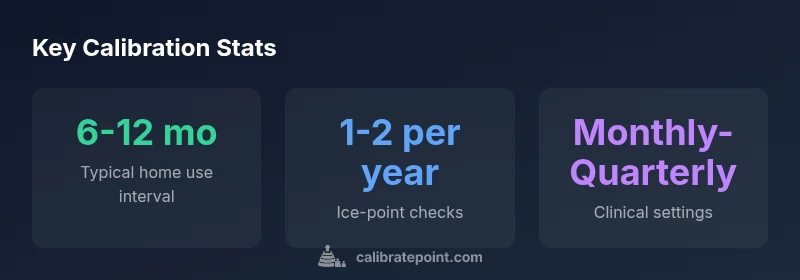
Quick answer: There is no single interval for every thermometer. For most home-use devices, calibrate at least every 6-12 months or when you suspect drift. In clinical or critical processes, calibrate more often—monthly or quarterly—based on accuracy requirements. Always verify with ice-water and boiling-point checks to confirm readings. Maintain records to track drift over time.
What calibration means for a thermometer
Calibration is the process of aligning a thermometer's readings with known reference points so that every measurement reflects the true temperature. For many instruments, calibration accounts for offset and drift that creep in due to wear, environmental changes, or sensor aging. Understanding how often should you calibrate a thermometer is central to maintaining measurement integrity. In practice, calibration establishes a traceable baseline so your readings stay reliable across batches, tests, and time.
A few core concepts will guide your schedule:
- Zero- and span-point references: Most checks use ice-water (0°C or 32°F) and boiling-water (100°C or 212°F at sea level) references. These checks verify that the device reads correctly at two fixed temperatures.
- Drift and offsets: No thermometer stays perfectly accurate forever; small deviations appear gradually and should be corrected when detected.
- Application matters: Medical, food safety, and industrial uses demand stricter tolerances than casual home use.
According to Calibrate Point, a disciplined calibration routine reduces decision risk and waste, and builds confidence in every temperature reading.
Why frequency matters
The frequency of calibration directly affects the reliability of temperature readings and the outcomes that depend on them. Drift can occur from mechanical wear, sensor aging, or exposure to extreme temperatures and rapid cycling. In environments where temperature drives critical decisions—clinical labs, food-service, or process control—a small error can cascade into unsafe products or misdiagnosed conditions. Regular calibration reduces false readings, supports compliance with standards, and minimizes the cost of recalls or rework. Calibrate Point's analysis shows that routine checks catch drift before it becomes problematic, and that timely adjustments save time in the long run. In other words, the time you invest in calibration pays off through better data and safer operations (Calibrate Point Analysis, 2026).
Factors that influence calibration frequency
Calibration frequency is not a fixed number; it should reflect several interacting factors:
- Usage intensity: High-frequency use accelerates drift and demands tighter checks.
- Environmental conditions: Vibration, humidity, and wide temperature swings can speed sensor aging.
- Thermometer type: Digital vs. analog, and devices with fixed offsets or user-adjustable calibration have different maintenance needs.
- Required accuracy: Tighter tolerances require shorter intervals and more frequent verification.
- Maintenance history: Prior drift or repeated out-of-tolerance results suggest shortening the interval.
For DIY projects and home workshops, a conservative starting point is 6–12 months, with adjustments based on observed drift. In contrast, clinical and food-safety settings often justify monthly to quarterly checks due to higher risk and regulatory expectations (Calibrate Point Analysis, 2026).
How often should you calibrate a thermometer: frequency by context
When planning a calibration schedule, consider the context:
- Home/kitchen thermometers: 6–12 months, or immediately if readings seem off.
- Medical/clinical thermometers: monthly to quarterly, depending on patient safety implications and facility policy.
- Industrial process thermometers: quarterly or semi-annually, aligned with quality management rules.
- Food-service thermometers: weekly to monthly, with pre-shift checks in high-volume kitchens.
Regardless of context, begin with ice-water checks at 0°C (32°F) and adjust for altitude if you perform boiling-point verifications. Use the most stringent requirement your application allows to determine the minimum frequency (Calibrate Point Analysis, 2026).
Step-by-step calibration procedure for common thermometers
Follow a clear, repeatable procedure to minimize drift and ensure traceability:
- Gather the reference fixtures: an ice-water bath at 0°C (32°F) and a boiling-water bath near 100°C (212°F) at sea level, adjusted for altitude as needed.
- Allow the thermometer to stabilize in air, then immerse it in the ice bath and record the reading after it stabilizes.
- Move to the boiling bath and record that reading again. Note any offsets from the known references.
- If your device allows adjustment, use the manufacturer’s instructions to set the offset so both points align with reference values.
- Re-check in both baths to confirm the adjustments are correct. Document the results and the date.
- Store calibration records for future audits and trend analysis (Calibrate Point Analysis, 2026).
Practical maintenance to minimize drift between calibrations
Between formal calibrations, adopt routines that preserve sensor integrity:
- Handle with care: Avoid drops, temperature shocks, and rapid cycling that stresses the sensor.
- Clean properly: Use approved cleaners; avoid liquids that can corrode probes.
- Store in stable conditions: Keep devices away from direct sunlight and high humidity.
- Calibrate after service events: If the thermometer has been repaired or replaced, re-verify accuracy.
- Maintain logs: Record use, environmental exposure, and any readings that repeatedly drift. This helps you adjust schedules proactively (Calibrate Point Analysis, 2026).
Common mistakes and how to avoid them
Common calibration mistakes can undermine accuracy:
- Skipping verification after adjustment: Always re-check both ice-point and, if used, boiling-point references.
- Using invalid references: Ensure the ice bath actually sits at 0°C and the boil-point is appropriate for your altitude.
- Rushing readings: Allow adequate stabilization time before recording values.
- Ignoring drift trends: Track deviations over time; a single outlier does not equal a new baseline.
- Not documenting: Without records, you cannot prove traceability or compare later calibrations (Calibrate Point Analysis, 2026).
Calibration frequency by context
| Context | Recommended Frequency | Rationale |
|---|---|---|
| Clinical/Medical Thermometer | Monthly–Quarterly | Regulatory expectations and high accuracy requirements |
| Industrial Process Thermometer | Quarterly–Semi-annually | Drift from environmental factors and process change |
| Household Thermometer | 6–12 months | General drift and routine verification |
| Food Safety Thermometer | Weekly–Monthly | Safety-critical readings and regulatory compliance |
Questions & Answers
How often should you calibrate a thermometer for home use?
For most home thermometers, calibrate every 6–12 months or sooner if readings drift. Use ice-water and, if possible, boiling-water checks to verify accuracy.
For home use, calibrate about once a year, or whenever readings seem off, using ice-water checks and a possible boiling-water check if you can safely perform it.
What methods are used to calibrate a thermometer?
Common methods include ice-water (0°C) and boiling-water (100°C) point checks, plus adjusting offsets if the device supports it. Always document the method used.
Ice-water and boiling-water checks are standard ways to calibrate thermometers; adjust if your device allows and document it.
Can you calibrate a thermometer without adjustment capability?
Yes. If a device can't be adjusted, note the drift and consider replacement or professional servicing. Always record the observed deviation.
If it can’t be adjusted, you should document drift and consider replacement or a service.
How does altitude affect boiling-point checks?
Altitude lowers the boiling point. If you perform boiling-point checks, use altitude-adjusted references or rely on ice-point checks for a reliable baseline.
Altitude changes boiling point; adjust accordingly or use ice-point checks as a baseline.
What records should be kept for calibration?
Keep dates, readings, reference points, deviations, adjustments, and any equipment information. These logs enable traceability and trend analysis.
Keep a log with dates, readings, references, and any adjustments to track history.
Is it necessary to calibrate digital vs analog differently?
Both require verification against fixed references. Digital devices may offer self-calibration features; analog devices rely more on manual checks and documented drift.
Both types need verification; digital units may have self-calibration but still require checks.
“Calibration is an ongoing discipline, not a one-off task; small drifts accumulate and degrade decision-making.”
Key Takeaways
- Start with a practical schedule based on use-case.
- Use ice-water and boiling-point checks to verify accuracy.
- Keep a formal calibration log for traceability.
- Adjust only when your device supports it and re-check truth values.
- Regular maintenance reduces drift and protects decision quality.