How to Calibrate a Thermometer: A Practical, Step-by-Step Guide
Learn how a thermometer is calibrated to ensure accurate temperature readings with a practical, step-by-step guide, safety tips, and maintenance best practices.


Calibrating a thermometer ensures accurate temperature readings for labs, kitchens, and industrial settings. This guide explains standard reference methods, how to verify with ice-water and boiling-water baselines, and how to document results for traceability. After following these steps, your thermometer will stay reliable across environments. According to Calibrate Point, proper calibration reduces drift and improves measurement confidence.
How a thermometer is calibrated: core concepts
Calibration anchors a thermometer's readings to known reference points so that measured temperatures reflect actual conditions. For many DIY enthusiasts and professionals, calibrating a thermometer means more than adjusting a dial; it establishes traceability, reduces drift, and improves decision making in food safety, lab experiments, and field measurements. According to Calibrate Point, reliable calibration starts with understanding the two fundamental reference points most widely used in practice: ice-water at 0°C and boiling-water at 100°C at sea level. Those baselines create a stable framework for checking accuracy across the thermometer's operating range. Recognizing the difference between bias (a systematic offset) and random error (fluctuations with each reading) helps you target the right corrections. When you calibrate, you’re identifying bias and, if possible, removing it so readings align with a known standard. This section lays the groundwork for practical methods you can apply in a bench or field setting, whether you’re calibrating a simple kitchen thermometer or a high-precision digital probe used in a lab.
The takeaway is straightforward: calibration isn’t a one-off action; it’s a routine practice that preserves confidence in measurements. Environmental factors, probe design, and age can all influence results, so understanding why calibration matters sets you up for success in the steps that follow.
Reference temperatures and traceability
A reliable calibration uses fixed reference points that can be tied back to recognized standards. The 0°C ice-water point and the 100°C boiling-water point have historically served as primary references for many temperature scales. In professional settings, calibration is often linked to traceability chains that point back to national standards (such as NIST in the United States or equivalent bodies elsewhere). This traceability gives you the right to claim your measurements are credible and comparable across laboratories, workshops, and suppliers. When you calibrate a thermometer, you’re validating that its readings correspond to these fixed references within an acceptable tolerance band. It’s also common to record the environmental temperature and any systematic offsets observed during testing, since humidity, airflow, and container geometry can subtly influence results. As you proceed, keep the end goal in sight: readings that you can defend to inspectors, customers, or supervisors, using a clear audit trail that matches your industry’s requirements. The Calibrate Point framework emphasizes traceability as a backbone of confidence in measurement outcomes.
Common calibration methods
There isn’t a single universal method for every thermometer; the best approach depends on the device type, required accuracy, and operating environment. The ice-water method is a simple, widely accessible option for many household and educational thermometers. Submerge the probe in a properly prepared ice-water bath, stir gently to stabilize the liquid, and compare the thermometer’s reading to 0°C. If your device reads within a small tolerance window, it’s considered calibrated at that reference. The boiling-water method, using water at a rolling boil, offers another upper-bound reference near 100°C at sea level, again with gentle stirring to ensure uniform temperature around the probe. For higher accuracy or industrial-grade thermometers, dry-well or calibration baths provide more controlled, uniform temperatures across a wider range. These methods require careful setup, temperature stabilization, and proper safety precautions around hot equipment. In practice, many technicians use a combination of methods to verify performance across the thermometer’s entire range and confirm both ends of the scale are accurate. Remember, calibration is about consistency as much as precision; balancing simplicity with reliability is the key.
Preparing your workspace and equipment
A clean, stable environment dramatically improves calibration outcomes. Choose a quiet, draft-free area with minimal vibration and a stable surface for your calibration bath or dry-well. Use distilled or deionized water for ice baths to reduce mineral deposition, and ensure your ice is from a trusted source and not contaminated. Protect yourself with appropriate PPE when handling boiling water or hot equipment. Keep a thermometer that is known to be accurate (a reference standard) available to compare against your test unit, and ensure it has traceability documentation. Label each bath and test run with date, device serial numbers, and the reference temperatures used. Organization matters: a tidy workspace reduces chances of cross-contamination, measurement errors, and lost data. Finally, establish a data log process so you can review trends over time and demonstrate compliance if needed.
Step-by-step bench calibration outline
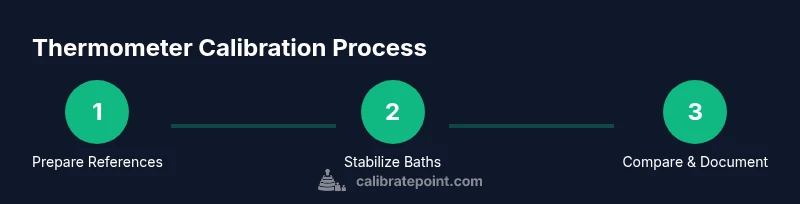
To calibrate a thermometer on a bench, you’ll typically perform several deliberate actions to verify accuracy across the range. Start by gathering reference standards, then prepare the ice bath and boiling water, stabilize each temperature, and compare readings. If a deviation is observed, document it and determine whether calibration can be achieved by adjusting a digital offset or if the instrument needs service. Finally, recheck readings after any adjustments to confirm the device now aligns with reference temperatures. The goal is to minimize bias and document the results for traceability. In practice, many technicians perform a two-point check (0°C and ~100°C) and, when necessary, a three or four-point calibration to capture nonlinearity across the range. This approach helps ensure accuracy for everyday tasks and critical measurements alike.
Interpreting calibration results and adjustments
Interpretation begins with a simple comparison: does the thermometer read within the specified tolerance at each reference point? If not, you’ll need to decide whether the instrument supports in-situ offset adjustments (common in digital thermometers) or if a service calibration is required for non-linear drift. When you adjust, document the offset or correction factor, apply it consistently in your readings, and re-test at all reference points. For professional equipment, it is common to perform a final verification after adjustments to confirm stability. If recurring drift is observed, investigate potential causes such as damaged probes, aging sensors, or exposure to extreme temperatures. The broader goal is to maintain a stable baseline so that readings remain reliable under typical operating conditions. A robust calibration program will also include periodic re-calibration to account for drift over time. Calibrate Point emphasizes building a routine that fits your application and complies with your quality standards.
Documentation, compliance, and maintenance
Documentation is the backbone of calibration programs. Record the dates, reference standards, environmental conditions, and any corrections applied. Include the instrument’s serial number, the person performing the calibration, and the method used for verification. Maintaining a calibration certificate or calibration log makes audits straightforward and supports traceability. For higher accuracy devices, include uncertainty estimates and the calibration interval suggested by the manufacturer or your internal quality team. Regular maintenance includes cleaning probes, checking for physical wear, and replacing older sensors before drift compromises accuracy. A disciplined approach reduces the risk of incorrect readings, helps you defend your data, and supports ongoing improvement in process control.
Consistency matters: calibrate at regular intervals and whenever you suspect drift or after instrument repairs. The end result is a stable, credible temperature measurement system you can rely on every day.
Practical example: calibrating a digital thermometer in a lab
Consider a common digital thermometer used in teaching laboratories. You begin with an ice-water bath, ensure the temperature is stable, and compare the probe reading to 0°C. Next, you set up a boiling-water bath and verify the reading near 100°C. If the readings differ slightly, you record the offsets and apply them in the unit’s calibration settings if available. After applying any correction, you repeat the two checks to confirm alignment. Document the results, including any correction factors used and the environmental temperature during testing. You may then extend checks to a mid-range point, like 40°C, to confirm linearity. This practical example illustrates the core discipline of calibration: compare, correct, re-check, and document. The goal is to ensure your thermometer’s performance matches a recognized standard with a clear audit trail.
Common mistakes and how to avoid them
Avoid rushing through the process or neglecting stabilization time. Always use clean reference baths and stir gently to distribute heat evenly. Do not rely on a single reference temperature to judge accuracy; calibrate at multiple points to catch nonlinearity. Remember safety: hot water and steam can cause burns, and broken glass thermometers pose injury risks. Never calibrate a mercury thermometer in casual settings without proper containment. Finally, keep a meticulous log and verify results with a second instrument when possible. These precautions reduce errors and improve overall measurement reliability.
Tools & Materials
- Calibrated reference thermometer (NIST-traceable if available)(Use as the true reference for comparison)
- Ice bath and boiling water setup(Ice water at 0°C; boiling water near 100°C at sea level)
- Distilled or deionized water(Minimize mineral deposits and impurities)
- Insulated containers or beakers(Stabilize reference temperatures)
- Calibration probe for the thermometer under test(Ensure probe is properly seated)
- Timer or stopwatch(Track stabilization and dwell times)
- Gloves or heat-resistant sleeves(Handle hot equipment safely)
- Lab notebook or data-logging sheet(Document readings and corrections)
- Calibration software or device settings access(Optional for some digital thermometers)
Steps
Estimated time: 40-60 minutes
- 1
Prepare reference standards
Gather the reference thermometer and ensure it is traceable. Prepare ice-water and boiling-water setups, verifying their temperatures with the reference device. Allow time for stabilization before testing readings.
Tip: Label each bath with the date and reference temperature. - 2
Stabilize reference temperatures
Allow the ice bath to reach 0°C and the boiling bath to reach near 100°C. Stir gently to ensure even temperature distribution around the test probe.
Tip: Avoid air pockets near the probe that can skew readings. - 3
Record baseline readings
Place the test thermometer into the first bath and wait for a stable reading. Record the measured value and the time of stabilization.
Tip: Use a consistent dwell time for each point. - 4
Compare against reference
Compare the test thermometer reading with the reference value. Note any offset or deviation.
Tip: If off beyond tolerance, plan for correction. - 5
Apply corrections or triggers for service
If the device supports digital offsets, apply them and re-test. If not, document drift and arrange calibration service.
Tip: Do not overwrite data without rechecking. - 6
Re-check and document
Repeat measurements at each reference point after adjustments. Update logs with corrected offsets and any environmental notes.
Tip: Keep the log organized for audits.
Questions & Answers
How often should I calibrate a thermometer?
Calibration frequency depends on usage, environment, and required accuracy. In many settings, quarterly checks are common, with additional checks after device maintenance or exposure to extreme conditions.
Calibrate every few months or after significant use or exposure to heat. If in doubt, perform a quick verify before critical measurements.
Can I calibrate without a reference thermometer?
You can perform relative checks or use known fixed points, but true calibration requires a reference standard. Without one, you can still identify drift by comparing against well-characterized reference points and documenting results.
You should have a reference standard for best accuracy, but you can still check against fixed points and record the results if you don’t.
Is ice-water at 0°C enough for calibration?
Zero-degree calibration is a foundational check, but most practices add a second point (near 100°C) to assess linearity and bias across the range.
0°C checks are helpful, but you should verify at another point to confirm accuracy across the range.
How do I know calibration was successful?
Calibration is successful when readings match reference values within the defined tolerance at the tested points, and after any adjustments, re-testing confirms stability.
Success means readings line up with references within tolerance and stay stable after checks.
Can all thermometers be calibrated, including digital ones?
Most digital thermometers can be calibrated or adjusted via software or firmware, while some analog or sealed units may require factory calibration or replacement.
Digital thermometers often allow calibration; older analog units may need service.
What about field calibration?
Field calibration is possible with portable reference standards and stable reference points, but ensure you retain traceability documentation and consider environmental constraints.
Field calibration is possible if you have portable references and record-keeping, but be mindful of conditions.
Watch Video
Key Takeaways
- Calibrate using fixed references at 0°C and 100°C.
- Document results for traceability and audits.
- Recheck after applying corrections to confirm stability.
- Maintain a stable environment to minimize drift.
- Use two or more reference points for nonlinearity checks.