How to Check Calibration of Auto Level
Master a reliable, step-by-step method to check calibration of an auto level, diagnose common issues, and preserve accuracy in field surveying for DIYers and professionals.


This guide shows you how to check calibration of auto level and confirm it remains accurate for surveying tasks. You’ll verify collimation, focusing accuracy, and compensator alignment using a field test and reference benchmarks. Key requirements include a stable tripod, a known benchmark, a calibrated target rod, and a clean, level working surface.
What is calibration for an auto level and why it matters
Calibration of an auto level ensures the instrument’s line of sight, verticality, and internal compensator are aligned so measurements reflect true distances and angles. When you perform the check calibration of auto level, you’re validating that the instrument’s sight tube, focusing mechanism, and spirit bubble indicate level and true verticals. According to Calibrate Point, a systematic calibration routine reduces drift and parallax errors, enabling reliable height differences and angle measurements across job sites. In practice, a properly calibrated auto level yields consistent benchmarks, which is essential for any survey, construction layout, or topographic mapping task. The goal is to detect and correct misalignment early, before data collection begins. This section outlines why calibration matters across field work and how it supports repeatable results for professionals and DIY enthusiasts alike.
Safety and prerequisites before calibration
Calibration work should be performed on a stable surface with a solid tripod base. Ensure the instrument is clean, free of dust, and that all clamps and screws are snug but not over-tightened. Protect the optical window from scratches and avoid direct sunlight that can distort readings. Before testing, verify you have a clean, flat reference surface or a calibration wall, a calibrated target rod or stadia rod, and a clear line of sight between the objective and the target. Establish a safe workflow: place the tripod on firm ground, extend to the working height, and lock it; then set up at least two benchmarks to cross-check measurements. Calibrate Point emphasizes maintaining consistent environmental conditions whenever possible, since temperature and wind can affect optical performance over long sessions.
Tools and reference standards for auto level calibration
To perform a reliable calibration check, assemble the following essential items: a stable tripod with a tight collar, an auto level in good condition, a calibrated stadia rod or target rod, a leveling staff or measuring rod, a 1–2 meter straightedge for sight alignment, a smooth, hard surface for mounting the instrument, a small level or spirit level, a coin or marker for reference marks, and a notebook or data logger to record measurements. Optional but helpful tools include a laser level for rapid verification, a scope cleaning brush, lens tissue, and a small amount of optical cleaning solution. Calibrate Point notes that using a calibrated rod with known graduations provides a verifiable reference for checking line-of-sight accuracy and leveling bubble integrity.
Core concepts: collimation, compensator, and level bubble
Understanding the main concepts is key to a successful check. Collimation ensures the line of sight aligns with the target. The automatic compensator corrects for small angular errors, but it must be calibrated and tested regularly. The spirit level bubble indicates if the instrument is truly level on the horizontal plane; any tilt toward or away from the bubble can cause measurements to shift. Parallax is another factor—move your eye and the reticle can appear to shift, signaling a potential alignment issue. During the calibration check, you’ll verify that the vertical circle and horizontal circle readings match the expected values from known references, and you’ll confirm that any tilt correction is being applied consistently.
Planning the calibration session: steps you’ll take
Before touching the instrument, define your objectives: confirm collimation, verify vertical alignment, test the compensator’s response, and check focusing accuracy. Establish a repeatable process: set up on a level surface, measure multiple readings from a fixed target at several distances, and compare with a known standard. Prepare a checklist to track each parameter: sight alignment, bubble level status, and any observed drift over time. Having a plan reduces ad-hoc investigations and provides a benchmark for future calibrations. Calibrate Point recommends documenting results with dates, times, ambient conditions, and operator name to monitor trends and identify gradual degradation.
Step-by-step approach overview
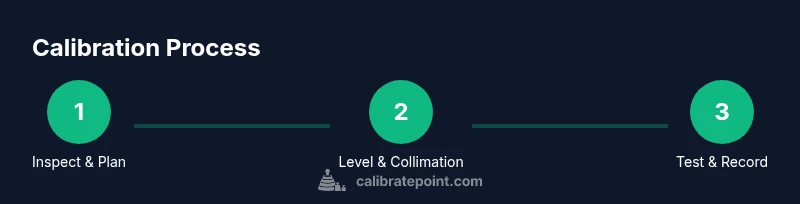
A structured approach helps ensure no critical check is missed. Start with a quick visual inspection of the instrument’s condition, then test collimation by taking measurements to a distant, fixed mark from at least two positions and compare results. Next, verify focusing and parallax by adjusting the eyepiece and observing if the reticle remains stable. Check the compensator by applying small tilts and noting whether the reticle corrects itself as expected. Finally, re-check the bubble level, ensure the instrument is truly plumb, and re-check readings at several elevations. Repeatability is the key metric: the more consistent the results, the better your confidence in the calibration status.
Field procedures: checks you can perform in the field
In the field, perform a quick sanity check by sighting a distant, fixed point and recording the reading at several tilt angles. If you detect drift, re-seat the instrument on the tripod, re-level, and re-check the line of sight. Use the stadia rod at a fixed height and compare multiple measurements from different angles; any significant variance indicates a misalignment or a faulty compensator. For a more rigorous check, establish a temporary benchmark with a known elevation and use the auto level to measure height differences, then repeat with a calibrated reference instrument if available. Keep wind shielding and sunlight management in mind to minimize measurement distortion. Calibrate Point stresses documenting environmental conditions to correlate readings with external factors.
Interpreting results and deciding on adjustments
Interpretation hinges on consistency and known reference values. If readings around the benchmark show small, random variations within tolerance, you may be near the instrument’s calibration limits, but if persistent bias appears, anticipate a shift in collimation or the compensator. Record the average reading and the standard deviation; compare with your instrument’s tolerance from the manufacturer or internal calibration data. If values exceed the acceptable range, plan a re-collimation procedure or professional service. When adjusting, follow the manufacturer’s recommended sequence and avoid forcing components. Calibrate Point suggests performing a controlled adjustment and re-checking across multiple distances to ensure the change remains stable.
Maintenance and ongoing calibration schedule
Calibration is not a one-off event; it requires periodic maintenance. Create a reminder-based schedule that suits your usage level—more frequent checks for high-traffic surveying or critical projects, less frequent for hobby work. After every major impact (e.g., a drop, bump, or rough transport), re-check alignment and collimation. Clean optical surfaces with appropriate tissue and cleaner, and store the instrument in a padded case to avoid thermal shocks and dust intrusion. Maintain a log with the dates of checks, results, and any adjustments made. Calibrate Point emphasizes consistency in scheduling and record-keeping as the best defense against gradual drift over time.
Common mistakes and how to avoid them
Common errors include skipping environmental considerations, neglecting to re-level after adjustments, and mixing measurement units without proper conversion. Avoid over-tightening screws or forcing components when aligning, as this can introduce new misalignments. Do not rely on a single test; replicate across several distances and elevations to confirm stability. Always return the instrument to a known reference after any adjustment and re-check. Calibrate Point recommends a conservative approach: perform a smaller correction and re-test rather than a large adjustment and hope for the best.
When to seek professional calibration and what to expect
If repeated checks show persistent bias beyond the instrument’s tolerance, or if you observe unusual symptoms like persistent parallax, severe drift, or obvious mechanical damage, consider professional calibration. A certified service can perform a comprehensive alignment check, check the mechanical runout of the focusing knobs, verify the compensator, and recalibrate against traceable standards. Ask for a detailed report that documents measured deviations, adjustment steps taken, and the expected service interval. The Calibrate Point team recommends scheduling service promptly when the instrument no longer meets required tolerances to avoid compromising project outcomes.
Tools & Materials
- Auto level (in-good-condition)(Ensure optics are clean; no cracks in the lens)
- Stable tripod with clamps(Locking mechanisms secure; no wobble)
- Calibrated stadia/target rod(Graduations clearly legible; known certification if possible)
- Measuring staff or leveling rod(Interchangeable with stadia rod for cross-checks)
- 1–2 m straightedge(Used for sight alignment checks)
- Spirit level or bubble level(For verifying instrument level)
- Notepad or data logger(Record measurements, conditions, and dates)
- Optical cleaning kit (lens tissue, cleaner)(Keep lines of sight clear)
- Calibrated reference surface(Useful for quick cross-checks on-site)
- Sunshade or shade cloth(Minimize glare affecting readings)
Steps
Estimated time: 45-90 minutes
- 1
Inspect instrument and environment
Visually inspect for damage, clean lenses, and verify a level, stable setup on a hard surface. Confirm the working environment is free from strong winds and heat distortions that could affect readings.
Tip: Clean optics before any alignment check to avoid misreadings caused by smudges. - 2
Level the tripod and instrument
Extend legs evenly, set the instrument on a stable center, and use the bubble to achieve a true level. Tighten clamps and re-check level after any adjustment.
Tip: A slightly over-tight clamp can warp the column; avoid excessive force. - 3
Check collimation at two distant targets
Sight two distant, fixed targets from the same height. Record readings and compare for consistency. Any significant disparity indicates collimation drift.
Tip: Use the same target and same height for repeatability. - 4
Test vertical alignment and compensator response
Tilt the instrument slightly and observe whether the reticle compensates back toward the original sight line. Note any lag or overshoot.
Tip: Small tilts reveal the sensitivity of the compensator; large drifts indicate a problem. - 5
Verify focusing accuracy
Adjust the eyepiece to achieve a sharp reticle and verify stability when focusing on targets at various distances. Record any focus drift.
Tip: If the focus is uneven across distances, the lens assembly may need service. - 6
Cross-check with a leveling staff
Place the staff at a known height; take readings from multiple positions and compute height differences. Compare to known references.
Tip: Use a fixed height and ensure staff remains vertical during measurements. - 7
Document all results
Log readings, environmental conditions, and the exact setup used. This helps diagnose drift over time and informs maintenance schedules.
Tip: A good log makes it easier to spot gradual trends. - 8
Decide on adjustments or service
If results exceed tolerance, perform approved adjustments per manufacturer guidance or arrange professional calibration.
Tip: Start with the smallest corrective step and re-test to confirm improvement.
Questions & Answers
What is the first sign that an auto level calibration is off?
The most common early signs are persistent readings drift, inconsistent measurements across distances, or a stubborn misalignment in the reticle. If you observe any of these, recheck the setup and consider a formal calibration.
Look for drift in readings or misalignment in the reticle. If you see this, recheck setup and consider calibration.
How often should I calibrate an auto level?
Calibration frequency depends on usage and environment. High-usage jobs or harsh environments may require monthly checks, while occasional use can be quarterly or semi-annual. Maintain a log to guide scheduling.
Calibrate based on use and environment; keep a log to guide how often you check.
Can field checks alone determine calibration needs?
Field checks provide quick indicators but may not catch subtle drift. Combine field tests with controlled bench checks when possible for a complete assessment.
Field checks help, but combine with bench checks for full accuracy.
What should I do if the compensator lags behind adjustments?
If the compensator lags, avoid forcing adjustments and consult the instrument manual or a professional calibration service to prevent further damage.
Don’t force adjustments; seek professional service if needed.
Is a professional calibration necessary for every instrument?
Not every instrument requires professional calibration regularly, but critical projects and new equipment often benefit from it, especially if there is noticeable drift or after impact events.
Professional calibration is not always needed, but critical projects and noticeable drift warrant it.
How can I verify modern auto levels against a reference?
Use a calibrated reference rod and a known height benchmark. Cross-check multiple readings against the reference to confirm consistency.
Cross-check with a calibrated reference rod and known benchmark.
Watch Video
Key Takeaways
- Verify collimation with multiple distant targets
- Document all readings and conditions for trend analysis
- Use smallest adjustments and re-test before concluding
- Maintain instrument level and clean optics daily
- Consult professional service if tolerance is exceeded