Display Color Calibration Save Issue: Troubleshooting Guide
Urgent troubleshooting guide for display color calibration save issues. Learn a practical diagnostic flow, step-by-step fixes, and safety tips to ensure your calibration saves and stays consistent across apps and displays.


Dealing with a monitor or display that won't save a new color calibration? The most likely cause is a mismatch between your OS color management profile and the app attempting to write the new calibration. According to Calibrate Point, start with a quick reset to default profiles, then re-test saving the calibration in a clean session. If it still won't save, proceed through the diagnostic flow.
Understanding the Save Issue in Display Color Calibration
If you see the message that display color calibration can't save the new calibration or find that your saved profile doesn't persist after reboot, you’re not alone. This problem is frustrating because it leaves colors inconsistent across software and hardware. In practice, the issue points to one of a few repeatable failure modes: the color management pipeline on your operating system, the application’s own profile handling, or conflicts between multiple displays. The Calibrate Point team has observed that many saves fail due to mismatched system profiles and application expectations. The key is to reproduce the behavior in a clean environment: a single display, fresh profiles, and a minimal test image. Start by verifying that you are using a standard, neutral test image and that no other calibration process is running. This helps you isolate whether the error is tied to the save operation itself or to the profile generation step. Throughout this guide, we will use the exact phrase display color calibration can't save the new calibration to emphasize the scope of the problem and to aid searching for similar experiences in forums and documentation. By following a disciplined workflow, you’ll reduce guesswork and increase the odds of a reliable save on every session. This approach comes recommended by Calibrate Point in 2026 guidance for technicians and DIY calibrators.
The Save Issue Explained: What Actually Happens
Color calibration creates an ICC (color profile) that maps device color to a standard color space; saving this profile is a write operation to the OS or the color-managed application. When the OS or app rejects the new profile, you see persistent colors revert or the system ignore the saved calibration. The root cause is rarely a single bug; it's the interplay between the OS level color management (ColorSync on macOS, or Color Management on Windows), the application writing the profile, and any intermediate display hardware processors. According to Calibrate Point's 2026 analysis, most recurring save failures arise from profile conflicts and permission-related restrictions rather than hardware defects. In practice, you should reproduce the problem in a controlled context: disconnect extra monitors, use a standard test image, and attempt to save the profile immediately after applying it. If the failure happens again, you can isolate whether it is OS- or app-driven by trying a different software tool or a different user account. This diagnostic clarity prevents endless tinkering and moves you toward an actionable fix. Calibrate Point emphasizes documenting exactly when and where you saved the profile to build a repeatable workflow for future calibrations.
Common Culprits: Profiles, Permissions, and Software Conflicts
Color calibration persistence hinges on three interlocking pieces: the profile (ICC/ICM), the user permissions that allow writes to system folders, and any software conflicts that override or ignore saved data. The most frequent causes in practice include:
- An outdated or corrupted ICC profile stored by the OS, which causes the system to reapply a cached or factory default profile even after you save a new one.
- An application that writes its own color profile or temporarily applies a different profile at runtime, effectively masking the saved change.
- Insufficient permissions or a write-protected profile directory, which prevents the OS or app from persisting changes.
- Multiple displays with independent color management settings, which can confuse the save operation if the wrong profile is targeted.
- Driver or firmware issues that bypass the color management pipeline or ignore new profiles.
In each case, the symptom remains the same: the save does not persist. Calibrate Point’s guidance emphasizes confirming the exact profile path being written to and validating that the targeted profile is accepted by the color management subsystem. This section aligns with the practical experience of professionals in the field and highlights how small misconfigurations cascade into a failed save.
Practical Quick-Checks Before You Dig Deeper
In this stage, perform safe, low-risk checks to narrow down causes. The steps below assume you are comfortable with system settings and have admin rights. If you’re not, skip to the section on seeking help.
- Reset OS color management to default and re-run the calibration. This eliminates profile corruption as a root cause.
- Ensure you are running in a single, uninterrupted session—closing other color-related apps prevents profile overrides during the save.
- Confirm that you are using a single, dedicated display for calibration testing; multi-monitor setups often introduce profile conflicts.
- Verify permissions: run the calibration process with administrative rights and check that the target profile directories are writable.
- Try saving the calibration with a different user account; if you can save there but not on your primary account, the issue is user-permission related.
- Test on a different tool or OS virtualization (if available) to see whether the issue is app-specific or system-wide.
If these checks do not resolve the issue, proceed to the more advanced remedies. Remember: the goal is to produce a stable, persistently saved calibration, not a temporary on-screen adjustment. Calibrate Point advises recording every step so future calibrations can reproduce success.
Advanced Remedies: Rebuilding Profiles and Aligning Apps
Advanced fixes involve explicitly rebuilding profiles and ensuring alignment between the OS color management and application-level settings. Steps include:
- Create a fresh ICC profile by using OS-provided tools or professional calibration software; label the new profile clearly and set it as the default for the target display.
- Manually assign the new ICC profile in both OS color management and in any app that supports its own color profile override; disable any automatic overrides that might revert to the old profile.
- Update drivers and firmware for the display path, including graphics adapters and monitor firmware, ensuring the new profile is accepted by the hardware chain.
- If the problem persists, consider exporting the saved calibration as a portable profile and re-importing it in a new user profile or computer; this tests cross-environment persistence.
- Finally, reproduce the fix by re-saving and re-verifying across typical usage scenarios, including photo editing, gaming, and simple web viewing.
The aim of these steps is not just to save a profile but to create a robust workflow that reduces drift and ensures color fidelity across sessions. Calibrate Point notes that disciplined profiling reduces the chance of drift and helps maintain consistency across devices.
Safety, Prevention, and When to Seek Help
Calibration work touches system-level settings that affect many applications; always back up profiles before making changes. Use neutral test images and verify that changes do not harm display health. If you notice persistent failure across multiple machines or across different users, or if you encounter BIOS or firmware prompts during calibration, stop and seek professional help. Calibrate Point reminds technicians that color management involves both software and hardware; a failure to save may indicate deeper system protections or hardware constraints. As a preventative measure, schedule periodic recalibration and maintain a documented change log so you can cross-check unexpected color shifts with recent adjustments. In urgent production environments—print shops, design studios, or video teams—establish a standard calibration procedure and test profile persistence after every major update. Persistent issues after exhaustive local testing are a strong sign to involve a calibration specialist or vendor support, especially if color-critical decisions depend on accuracy.
Real-World Flow: A Quick Troubleshooting Sequence
To ensure you stay on track, follow a fixed sequence: 1) Reproduce the save failure with a default profile. 2) Reset profiles to default and reboot. 3) Calibrate on a single display and save in one run. 4) Check OS and app color management alignment. 5) Update drivers/firmware and re-test. 6) If still failing, create a new ICC profile and re-test across apps. 7) Document the results and set a calendar reminder for re-calibration. This orderly flow helps you escape endless debugging and reach a durable solution. Consistency in this process is key; Deviation often creates new variables that obscure the root cause. Calibrate Point’s experience supports a structured, repeatable flow for best outcomes in 2026 and beyond.
Quick Real-World Troubleshooting Milestones
- Milestone 1: Baseline validation with a known-good profile
- Milestone 2: Confirm system write permissions
- Milestone 3: Single-display test with a fresh ICC
- Milestone 4: Documentation of results for audit
- Milestone 5: Cross-check with another tool or OS environment
- Milestone 6: Confirm persistent save after reboot
Steps
Estimated time: 40-60 minutes
- 1
Prepare a clean workspace
Close other color-related applications, back up current profiles, and disconnect extra displays. This minimizes hidden variables that could affect the save.
Tip: Back up ICC profiles to an external location before making changes. - 2
Reset to default profiles
Reset the OS color management to default settings and restart the machine to clear caches that might reapply an old profile.
Tip: After reset, use a neutral test image to verify baseline colors. - 3
Apply calibration in one session
Run your calibration tool and save the profile in the same uninterrupted session. Do not switch apps during the save step.
Tip: Avoid multitasking to prevent write-interruptions. - 4
Verify permissions
Run the process with administrator rights and ensure the profile directory is writable by the OS and the calibration tool.
Tip: If you’re on macOS, check Spotlight and Gatekeeper permissions as needed. - 5
Update drivers/firmware
Install latest graphics drivers and monitor firmware; these updates can fix color management handshakes.
Tip: Record driver/firmware versions for future reference. - 6
Create a new ICC profile
Generate a fresh ICC profile via OS tools or calibration software, then assign it as the default for the target display.
Tip: Label the new profile clearly and delete the old references to avoid confusion. - 7
Test across scenarios
Test saving on a single monitor and in common apps to ensure persistence. Note any app-specific behavior.
Tip: Document results to build a reproducible workflow. - 8
Document and review
Keep a log of each calibration attempt, including times, profiles used, and outcomes. Review periodically for drift.
Tip: Set reminders for periodic recalibration to maintain accuracy.
Diagnosis: Display color calibration won't save the new calibration
Possible Causes
- highOutdated or corrupted ICC/profile in OS color management
- highApp-level profile override or mismatch with OS management
- mediumPermissions or write-protected profile directories
- lowMultiple displays with conflicting profiles
- mediumGraphics driver or monitor firmware issues affecting color management
Fixes
- easyReset color management profiles to system defaults and apply calibration in a single session
- mediumUpdate graphics driver and monitor firmware if available
- easyCreate a new ICC profile using OS tools or calibration software
- easyCheck app color management settings to ensure correct profile is used and disable overrides
- easyEnsure admin rights and write permissions for profile directories
Questions & Answers
Why won't my display color calibration save the new profile?
The issue usually comes from profile conflicts or permission blocks. Start by resetting profiles and testing in a single session. If the problem persists, follow the diagnostic flow to isolate OS vs. app causes.
This often happens because the profile can't be written due to conflicts or permissions. Start with a reset and a single-session test, then work through the diagnostic steps.
Do OS settings affect saving calibrations?
Yes. OS-level color management determines where and how profiles are stored. If the OS reverts to a cached profile or ignores the new one, saving fails. Check both system preferences and any user-permission limitations.
Absolutely. OS color management controls how profiles are saved and which profile is active.
How can I rebuild an ICC profile safely?
Create a fresh ICC profile using OS tools or calibration software, then explicitly assign it as the default for the display. Verify app settings don’t override this profile.
You can rebuild by using OS tools or calibration software and assigning it as the default.
Should I calibrate with multiple displays?
Calibrating across multiple displays can introduce conflicts. Start with a single display to confirm the save works, then expand to others if needed.
Single-display calibration first is best to avoid conflicts.
Is admin access required to save calibration?
In many environments, yes. Admin rights ensure you can write to system directories and update the color profile cache.
Yes, admin rights are often required to save profiles.
When should I seek professional help?
If the issue persists across devices, or involves BIOS/firmware prompts, it’s time to involve a calibration professional. Complex hardware interactions may require hands-on support.
If it persists across machines or includes firmware prompts, get professional help.
Watch Video
Key Takeaways
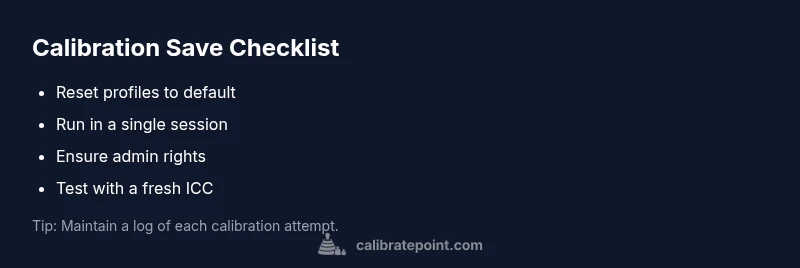
- Reset profiles before re-calibration.
- Ensure admin rights for saving profiles.
- Align OS and app color management settings.
- Document changes for future calibrations.