How to Calibrate a Food Scale: A Practical Guide
Learn how to calibrate a food scale with a practical, safe method. This Calibrate Point guide covers tools, steps, and troubleshooting for accurate kitchen measurements.


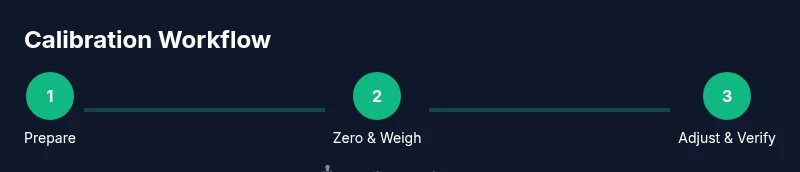
Calibrate your food scale by zeroing, weighing certified masses, and adjusting until the readings align with the weights. This concise guide covers the essentials and safety notes; open the full step-by-step article for detailed procedures and troubleshooting.
Why calibrate a food scale matters
Accurate measurements are the backbone of reliable cooking, nutrition tracking, and portion control. A misread on a kitchen scale can lead to over- or under-seasoning recipes, incorrect ingredient weights, and errors in meal-prep logs. Calibrating your food scale ensures the mass it reports matches the true mass, helping you achieve consistent results. According to Calibrate Point, consistent calibration reduces measurement drift and keeps measurements aligned with standard weights across tasks. In this guide we explore why calibration matters for home cooks, technicians, and professionals who rely on precise mass data in everyday work. We also discuss how scale design and calibration concepts influence accuracy, from tare functionality to linearity across the weighing range.
Understanding scale types and how they impact calibration
Food scales come in several designs, with digital and mechanical models offering different calibration needs. Digital scales often store a calibration offset in firmware and may rely on tare and auto-zero features, while mechanical scales rely on springs and precise alignment of the internal mechanism. Regardless of design, the core calibration concept is the same: ensure the reported mass matches the true mass when standard weights are used. When calibrating, be mindful of the device’s tare function, linearity across the scale’s range, and how environmental factors like temperature can shift readings. Calibrate food scale routines should accommodate both consumer-grade scales and lab-grade instruments, adapting weight sets and procedures accordingly.
When to calibrate your scale
Calibration is not a one-and-done task. Calibrate your scale after moving it to a new location, after spills or exposure to moisture, or if you notice drift in readings during routine use. Temperature changes can influence spring-based and even digital sensors, so calibrate in a stable room with minimal drafts. If you routinely measure very small quantities, schedule more frequent checks to preserve accuracy. For professional environments, establish a calibration cadence and document each session to support traceability.
Tools and materials you’ll need
Before starting, assemble a small, safe kit to support reliable calibration. The must-haves are a set of certified calibration weights, a flat and level work surface, a clean weighing tray or plate, and a soft microfiber cloth for surface preparation. If your scale has an adjustment screw or calibration menu, you may also need a small precision screwdriver or the appropriate tool recommended by the manufacturer. Keep a lab notebook or digital log to record readings and any offset adjustments.
Core calibration concepts you should know
Calibration aligns the scale’s measurements with known reference masses. Zeroing or taring removes any offset from the weighing surface or container, while adjusting the scale’s internal calibration constant corrects systematic errors across the measurement range. When using multiple weights, ensure the scale shows accurate readings at several points, not just at a single mass. Consistency across light and heavy masses is a strong indicator of good calibration stability. Finally, maintain the scale in a stable environment free from vibration and drafts, which can affect precision.
Regular practice: making calibration a habit
Incorporate calibration into your routine by scheduling checks after major use, after relocation, or when you notice performance changes. Create a simple log that records date, environmental conditions, weights used, and the observed readings. If you share equipment, this log aids others in understanding measurement baselines. Regular calibration also supports compliance with internal quality standards and helps you troubleshoot discrepancies quickly.
Troubleshooting calibration issues
If readings don’t match known masses, re-check the tare, ensure the scale is on a flat surface, and verify the weights’ accuracy. Check for propulsive readings that drift with temperature or after repeated use. In some scales, you may need to recalibrate using a factory procedure or offset correction. If the problem persists, consult the manufacturer’s guidelines or contact a calibration professional. Document any persistent drift for future reference.
Best practices for environment and weight ranges
Always calibrate on a flat, level surface away from heat sources or air drafts. Use weights that cover a broad range, starting from small masses for sensitivity and ending with larger masses near the scale’s upper limit. Store calibration weights in a protective case and verify their mass before use. For very precise measurements, consider using certified weight sets with traceable calibration certificates and keeping the calibration date readily available.
Safety and maintenance considerations
Handle weights with clean hands or gloves to prevent adding oils or moisture to the masses. Keep weights free of dust and debris, and clean any spills from the scale surface before recalibration. If the scale displays physical damage or the display is unreadable, stop using it and seek professional inspection. Always disconnect or power down the scale when performing maintenance beyond simple zeroing.
Practical examples and scenarios
Imagine you’re preparing a nutrient-dense meal plan and need portions to be exact to 100 g increments. Start with zeroing, then place a 100 g weight on the center, and adjust the calibration until the display reads 100 g. Repeat with 50 g and 200 g weights to verify linearity, then document the results. In a professional setting, validate calibration with a 10%, 50%, and full-scale weight to ensure performance across the spectrum.
Tools & Materials
- Certified calibration weights set (e.g., 50 g, 100 g, 200 g, 500 g, 1000 g)(Weights should be traceable and within tolerance of the scale range)
- Flat, level workspace surface(Avoid tilting surfaces; use a stable table or countertop)
- Weighing tray or flat plate(Keeps weights clean and protects the scale surface)
- Soft microfiber cloth(For cleaning surfaces and weights before calibration)
- Precision screwdriver or manufacturer-specified tool(Only if the device has a hardware calibration adjustment)
- Calibration log or notebook(Record date, conditions, readings, and decisions)
Steps
Estimated time: 25-40 minutes
- 1
Prepare workspace
Clear the area, clean the scale top, and ensure the surface is level. Power on the scale and allow it to settle for 1–2 minutes before starting.
Tip: Use a level on the counter to confirm horizontal alignment. - 2
Zero and tare
Place an empty weighing vessel on the scale and press tare to zero the display. Confirm the readout is exactly zero.
Tip: If your scale lacks tare, use the smallest empty weight possible and subtract manually. - 3
Select calibration weights
Choose weights that span the scale’s useful range (e.g., 50 g, 100 g, 200 g, 500 g). Ensure each weight is clean and verified.
Tip: Avoid dirty weights; residue alters apparent mass. - 4
Place the first weight
Center the 100 g weight on the tare plate and wait 5–10 seconds for the reading to stabilize.
Tip: Place weights gently to prevent dynamic artifacts. - 5
Record and compare
Note the displayed mass and compare it to the known mass. Acceptable tolerance varies by scale; document deviation.
Tip: If the readout is off by more than tolerance, proceed to adjustment. - 6
Adjust calibration (if available)
Enter the calibration menu or use the adjustment screw as per the manufacturer’s instructions to bring the readout to match the weight.
Tip: Small adjustments yield precise results; do not overshoot. - 7
Repeat with additional weights
Test with a 50 g and a 500 g weight. Confirm readings align within tolerance across multiple points.
Tip: Check both light and heavy masses to verify linearity. - 8
Re-zero and re-check
Remove weights, tare again, and verify that the scale reads zero. Then re-test several weights to confirm stability.
Tip: Stability is key—wait a few seconds between tests. - 9
Document results
Log date, ambient conditions, weights used, and any adjustments. Store the log for audits and future calibrations.
Tip: Include a note about location and temperature during calibration. - 10
Verification test
After a cooling period, repeat the calibration check to ensure results persist and drift is minimized.
Tip: Temperature drift can reintroduce error; re-check under stable conditions.
Questions & Answers
Do I always need calibration weights to calibrate a food scale?
Yes, certified calibration weights provide a known reference mass to compare against the scale’s readings. If weights are unavailable, you can perform a basic zero and offset check, but full accuracy requires known masses.
You should use certified weights for accurate calibration; without weights you can check zero and offsets, but weights give the real reference.
How often should I calibrate my kitchen scale?
Calibrate when you notice drift, after moving the scale, or after significant temperature changes. For frequent use, a monthly check is a reasonable baseline.
Calibrate after moving the scale or noticing drift; monthly checks are a good baseline for frequent use.
What if readings still don’t match after calibration?
Re-check tare, surface levelness, and weight cleanliness. If mismatches persist, consult the manufacturer guidance or consider professional calibration services.
If readings still don’t match, review tare and surface, and if needed consult the manufacturer or a pro.
Can a weak battery affect calibration accuracy?
Yes. Low power can cause unstable readings on digital scales. Replace batteries and re-check calibration.
Low batteries can cause unstable readings; replace them and re-check.
Is tare weight considered in calibration?
Tare zeroing should be done before calibration checks to remove container weight; calibration itself assesses the scale’s mass measurement accuracy.
Tare is used to zero the container, then you calibrate the scale’s mass accuracy.
Watch Video
Key Takeaways
- Calibrate food scale regularly to maintain accuracy.
- Use certified weights and a level, stable surface.
- Record results and check multiple mass points.
- Temperature and surface conditions influence readings.
- Maintain a calibration log for traceability.