How to Calibrate a Digital Weighing Balance: Step-by-Step Guide
Learn how to calibrate a digital weighing balance with a proven, step-by-step process. This guide covers setup, standards, verification, and documentation for accurate, repeatable measurements.


This guide explains how to calibrate a digital weighing balance to achieve zero stability and accurate readings across its range. You’ll prepare the balance, select traceable reference weights, perform zero and span adjustments, and verify results with test masses. The method applies to common bench balances and portable scales, emphasizing traceability, repeatability, and safe handling.
Understanding Digital Weighing Balances and Calibration
When you ask how to calibrate a digital weighing balance, you are aiming for measurements you can trust. A properly calibrated balance reads zero with no mass on the pan and shows accurate values across its entire weighing range. This consistency matters for inventory, formulation, and QC checks. According to Calibrate Point, calibration quality hinges on a stable environment, traceable reference weights, and a documented procedure. If your balance is used in production or compliance-sensitive work, you should plan a formal calibration routine and keep a calibration log.
Begin with a stable setup: a clean, level bench, away from vibration sources like doors or fans, and at a comfortable ambient temperature. Let the instrument warm up as required by the manufacturer—some models specify a 15–30 minute warm-up before readings settle. Record the time, ambient conditions, and any deviations you observe. Zero balance when empty read the display, then verify with a few simple check masses. The tolerance spec in your manual will tell you what constitutes an acceptable deviation. The goal is traceability: every reading must be linked to a certified reference weight with a documented certificate. This practice creates a defensible audit trail and improves repeatability for ongoing measurements.
Required Tools, Materials, and Reference Standards
Before you begin, assemble the essential tools and reference materials. You will rely on certified reference weights that carry a current calibration certificate (class E2 or better), a range of test masses covering the balance’s operating span, and cleaning supplies to maintain a dust-free, corrosion-resistant pan. Maintain a dedicated calibration log (paper or digital) to capture readings, adjustments, and environmental conditions. A thermometer/hygrometer helps you track ambient temperature and humidity, which can influence readings. Use weight tongs to handle masses to avoid contaminating or transferring oils. A bubble level helps with initial leveling, though many modern balances incorporate built-in leveling controls. Additional items such as a dust brush, lint-free cloths, and a small timer support a smoother workflow.
Environmental Conditions and Safety Considerations
Calibration should occur under stable environmental conditions. Avoid drafts, direct sunlight, vibrations from nearby equipment, and temperature shifts that exceed the balance’s stated operating range. Place the balance on a vibration-damping surface and close any nearby doors or vents during calibration. Do not place liquids near the scale and keep cleaning solvents away from the mechanical parts. When handling weights, wear gloves if needed to minimize skin oils, but ensure you don’t contaminate the weights with moisture or residue. Always switch off or unplug the balance before heavy cleaning or when replacing accessories to avoid electric shock or damage.
Documentation and Traceability
A robust calibration routine requires thorough documentation. Record the balance model, serial number, calibration date, and the operator’s initials. Note the ambient temperature and humidity during calibration, the reference weights used (including their certificate numbers and expiry dates), and the exact readings observed at zero and at each test mass. Document any adjustments made for zero and span, including the target values and final corrected readings. Store certificates and logs in a centralized system to preserve traceability for audits, quality systems, and regulatory requirements. Periodically review calibration intervals based on usage, stability data, and manufacturer guidance to avoid drift.
Common Pitfalls and Quick Fixes
Even experienced technicians encounter common issues during calibration. If you observe an unstable zero, check for surface cleanliness, confirm level and vibration conditions, and recheck the baseline reading. If readings drift between tests, allow additional warm-up time and re-clean the pan to remove residual contaminants. When you notice a non-linear response (larger errors at higher masses), verify that the reference weights are themselves accurate and that their certificates are valid. Keep a clear separation between test masses and your working area to prevent accidental re-handling errors.
Transition to Verification and Ongoing Practice
After completing initial calibration, perform a verification pass using a separate set of reference weights to confirm the balance remains within tolerance. If further adjustments are needed, repeat zero and span calibration and re-verify. Establish a routine that includes periodic re-calibration, cross-checks against another balance if available, and a documented revision history. With consistent practice, you’ll achieve reliable measurements and maintain confidence in every weighing task.
Tools & Materials
- Certified reference weights (class E2 or better)(Include weights spanning the balance’s range; ensure certificates are current.)
- Test masses covering the usable range(Use a diverse set (e.g., 20g, 50g, 100g) for linearity checks.)
- Clean, lint-free cloth and isopropyl alcohol(For pan surface cleaning prior to calibration.)
- Calibration logbook or digital record system(Document all readings, adjustments, and environmental data.)
- Temperature/humidity monitor(Capture ambient conditions; not always required but highly recommended.)
- Weight tongs or forceps(Handle weights without touching with bare hands.)
- Bubble level or spirit level(Verify initial leveling; many balances include built-in leveling.)
- Small brush or blower(Remove dust from the pan and enclosure.)
Steps
Estimated time: 60-120 minutes
- 1
Prepare workspace and inspect the balance
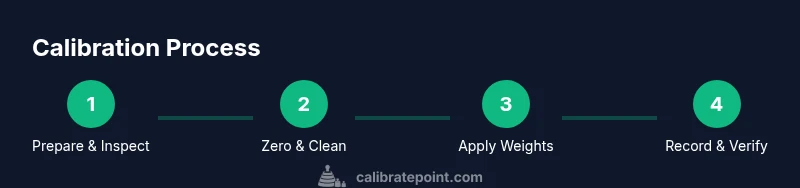
Power on the balance and allow it to reach a stable operating temperature as specified by the manufacturer. Clear the area of clutter, verify the bench is vibration-free, and ensure the pan is clean. This foundation minimizes drift and contamination that can skew readings.
Tip: Turn on the balance well in advance to allow full warm-up; document the warm-up time. - 2
Clean the weighing pan and enclosure
Use lint-free cloth and alcohol to wipe the pan and surrounding surfaces. Check for any residual dust, liquid residues, or sticky substances that could affect mass readings. A clean surface improves contact stability and repeatability.
Tip: Do not oversaturate the cloth; use a light, even wipe. - 3
Level the balance base
If your model includes external leveling feet, adjust them until a bubble shows centered in the level vial. Proper leveling minimizes tilt-induced measurement errors and ensures the pan sits in a true vertical plane.
Tip: Re-check level after placing reference weights, as they can slightly tilt the surface. - 4
Set the balance to zero (tare off)
With no mass on the pan, initiate the zeroing or tare function and confirm the display reads zero within the manufacturer’s tolerance. Document the initial zero value and any minor drift.
Tip: If zero drift persists, inspect for air drafts or residual weight on adjoining surfaces. - 5
Warm-up and stability check
Allow the balance to warm up again if required after any adjustments, then observe readings for a few minutes to confirm stability. Log the stabilization time.
Tip: Avoid touching the display during stabilization to prevent micro-motion affecting readings. - 6
Apply the lowest calibrated reference weight
Place a known standard mass on the pan using weight tongs. Record the reading and compare to the nominal mass. If the reading deviates beyond tolerance, prepare for a span adjustment.
Tip: Use tongs to minimize skin oils transferring to the weight. - 7
Zero and span adjustment (if available)
If the model requires span calibration, adjust the reading to match the reference weight. Repeat with a second weight to ensure linear response across the range.
Tip: Do not adjust multiple times without re-verifying zero; note any changed zero value. - 8
Verify with a mid-range mass
Place a mid-range weight and compare to the expected value. This checks linearity and confirms that adjustments hold across the scale’s mid-range.
Tip: Record both the reading and the deviation. - 9
Verify with a high-range weight
Test a higher mass near the upper end of the scale to confirm the balance performs consistently at the high end of its range.
Tip: If the high-end reading deviates, review whether the weight is within tolerance and whether the pan supports the mass evenly. - 10
Repeat measurements at multiple points
Conduct readings at several masses (e.g., 0%, 25%, 50%, 75%, 100% of range). Confirm that each reading aligns within the specified tolerance.
Tip: Consistency across the range is more important than a single perfect reading. - 11
Document results and adjust as needed
Compile readings, zero, and span adjustments in the calibration log. If results still fall outside tolerance, escalate to service or factory calibration and schedule a retest after maintenance.
Tip: Keep digital copies of certificates and maintain versioned records. - 12
Finalize and store calibration data
Remove test weights, clean the pan again, and close the enclosure if applicable. Ensure all data is stored and that the balance is ready for use with a current calibration label.
Tip: Attach a calibration sticker with date and next due date.
Questions & Answers
How often should a digital weighing balance be calibrated?
Calibration frequency depends on usage, environment, and regulatory requirements. High-precision balances in production typically require more frequent checks, while occasional laboratory use may be scheduled quarterly. Use your last calibration data and manufacturer guidance to set a practical interval.
Calibration frequency depends on use and environment; check your last calibration and follow manufacturer guidance to set a practical interval.
What should I do if readings drift after calibration?
If readings drift, re-check the zero, re-clean the pan, and ensure a proper warm-up. If drift persists, verify the weights and certificates, and consider a re-calibration or service from the manufacturer.
If drift persists after calibration, re-check zero, clean the pan, and verify your reference weights. Consider service if drift continues.
Can I calibrate using household weights?
Household weights are not recommended for calibration. Use certified reference weights with traceable certificates to ensure accuracy and compliance.
Certified reference weights with traceable certificates are needed; household weights are not suitable for calibration.
Do I need to recalibrate after moving the balance to a new location?
Yes. Recheck zero and perform a quick verification after relocating the balance to account for potential new environmental conditions and settling effects.
Yes—recheck zero and verify accuracy after moving the balance to a new location.
What is traceability, and why is it important?
Traceability links each measurement to a certified reference weight and its certificate. It provides an auditable history, supporting quality systems and regulatory compliance.
Traceability links results to certified standards and documents an auditable history for quality and compliance.
What should be included in the calibration log?
Include instrument details, date, operator, ambient conditions, weights used, readings at zero and each test mass, adjustments made, and the next calibration due date.
Your calibration log should include instrument details, readings, adjustments, and due date.
Watch Video
Key Takeaways
- Calibrate with traceable standards and document every step
- Zero and span adjustments require stable conditions and proper handling
- Verify across multiple mass points for linearity
- Maintain organized records for audits and ongoing quality
- Schedule regular re-calibration based on usage