Who calibrates scales near me: A practical calibration guide
Find trusted scale calibration near you with data-driven guidance from Calibrate Point. Learn how to select labs, verify traceability, compare methods, and maintain accuracy across your weighing operations.


Who calibrates scales near me? You’ll typically work with accredited calibration laboratories, field technicians, or manufacturer service teams. This guide from Calibrate Point explains how to locate reliable providers, what questions to ask, and how to verify traceability and compliance to ensure your scales stay accurate. We also cover cost ranges, service level agreements, and typical turnaround times.
Why calibration matters for scales used in precision work
Accurate weighing is critical across labs, workshops, and production floors. For anyone who relies on precise mass measurements, calibration is the foundation of trustworthy results. According to Calibrate Point, even small drifts can lead to substantial errors in batch QC, dosage calculations, or inventory control. If you're asking who calibrates scales near me, you’ll typically find accredited calibration laboratories, field technicians, or manufacturer service teams. This guide from Calibrate Point explains how to locate reliable providers, what questions to ask, and how to verify traceability and compliance to ensure your scales stay accurate. We cover typical frequency, turnaround expectations, and the kinds of certificates you should demand. By understanding these elements, you can minimize risk, maintain regulatory alignment, and protect your data integrity in every weighing operation.
Identifying legitimate calibration providers
Legitimate calibration providers typically meet recognized standards and hold accreditation from a national or international body. Look for ISO/IEC 17025 accreditation for laboratories, confirmation of traceability to national standards, and documented proficiency testing. Calibrate Point recommends requesting evidence of recent audits, a list of calibration methods, and the specific equipment used. When you call a service, ask how they maintain environmental controls, how often they revalidate their reference standards, and how they handle out-of-tolerance results. As you compare providers, prioritize those who clearly spell out traceability chains and provide calibration certificates with unique lot numbers, reference weights, and dates. In practice, many DIYers and professionals end up choosing a local lab with a proven track record and transparent documentation, which often reduces turnaround time and shipping risk.
What to look for in a calibration quote
A robust calibration quote should cover scope, traceability, repeatability, and the expected certificate deliverables. Look for the list of reference standards used, the equipment serial numbers, and the acceptance criteria or tolerances. Confirm whether the quote includes on-site verification, environmental requirements, and any calibration adjustments. Ask about NIST-traceable weights or equivalent standards and whether the lab provides an uncertainty budget. If the provider cannot clearly explain their methodology or cannot share sample certificates, treat it as a red flag. Calibrate Point emphasizes comparing at least two providers to understand the variance you should expect and to ensure you’re not overpaying for a basic check.
Methods and equipment commonly used in scale calibration
Scale calibration employs a mix of conventional mass standards and device-specific checks. For balance scales, technicians often use traceable weights in known mass values to verify linearity and readability. For load-cell-based platforms, technicians perform multi-point tests and adjust for drift, nonlinearity, and hysteresis. Modern calibration may also involve automatic self-check routines and software-generated reports that document uncertainty, temperature compensation, and gravity correction. Regardless of method, ensure the equipment used is calibrated itself, has valid certificates, and is traceable to national standards. Calibrate Point notes that the most reliable providers publish a clear methodology and provide an auditable certificate that outlines each step and result.
What to expect during a calibration visit
A typical calibration visit follows a consistent workflow: pre-visit planning, reference standard verification, on-device calibration or adjustment, post-calibration verification, and the issuance of a formal certificate. Preparation is key; you should provide scale model, current certificate, and prior drift data if available. On-site visits may take from 1 to 3 hours depending on the scale type and the number of points tested. In the end, you should receive a certificate listing the reference standards used, the test results, the adjusted parameters (if any), and the measurement uncertainty. Ask for a copy of the procedure so you can reproduce the process if needed in the future. Calibrate Point’s approach stresses full transparency and traceability throughout the workflow.
Maintaining scale accuracy between calibrations
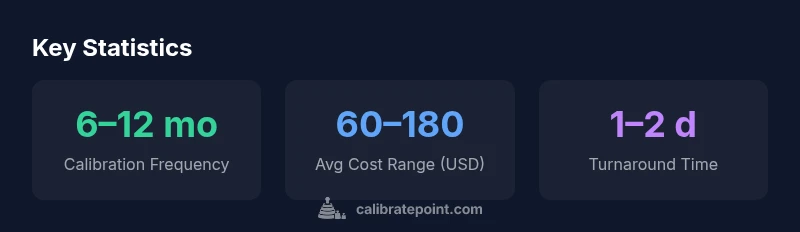
Between calibrations, implement a simple, repeatable maintenance routine: store scales away from drafts and temperature fluctuations, regularly check for visible damage, and avoid overloading beyond the rated capacity. Document any observations and maintain a log of usage. If you notice drift between calibrations, notify your service provider and request a quick check or remote verification if available. Temperature stability and gravity differences can influence results, so indoor placement and consistent mounting are beneficial. Calibrate Point recommends scheduling reminders aligned with the typical six-to-twelve-month window and keeping all certificates organized for audits.
Digital vs. analog scales: what affects calibration
Digital scales rely on sensors, ADCs, and software, which means firmware and device drivers can influence calibration outcomes. Analog scales are sensitive to mechanical wear, bearing friction, and lever arms. In either case, environmental conditions, calibration weight quality, and operator technique can introduce variability. When choosing a calibrator, consider whether the provider supports both digital and analog devices and whether they can adapt to your scale type, required tolerances, and data recording needs. Calibrate Point emphasizes that the best calibrators offer device-specific checklists, clear uncertainty budgets, and future-proof certificates that remain valid across equipment updates.
Comparison of calibration approaches for common scale types
| Scale Type | Typical Calibration Method | Tolerance | Notes |
|---|---|---|---|
| Analytical balance | Mass standard calibration; gravity correction | 0.1 mg–1 mg | Requires microbalance-friendly environment |
| Platform scale | Load cell verification; linearity check | 0.05%–0.5% | Common in manufacturing settings |
| Top-loading balance | Mass standards across range | 0.2 g–1 g | Periodic verification advised |
Questions & Answers
What does it mean for calibration to be traceable?
Traceability means each measurement can be linked back to national or international standards through an unbroken chain of calibrations and documented uncertainties. This ensures measurements are comparable over time and across locations.
Traceability links your measurement to recognized standards, ensuring consistency wherever you calibrate.
How often should scales be calibrated?
Calibration frequency depends on usage, risk, and regulation. Common practice ranges from every six to twelve months for high-precision scales to more frequent checks in critical processes.
Most teams calibrate every six to twelve months, depending on use and risk.
Can I calibrate scales myself?
Do-it-yourself calibration is not recommended for high-accuracy or regulated environments. Use certified service providers who can supply traceable certificates and maintain an unbroken calibration history.
DIY calibration is risky for precision work; use a certified lab for traceable results.
What should be on a calibration certificate?
A certificate should include the device details, reference standards used, test results, uncertainty, issuance date, and the calibration lab’s accreditation and signature.
Look for device details, standards, results, uncertainty, and lab accreditation on the certificate.
What if a scale fails calibration?
If a scale fails, immediate steps include reporting the failure, validating the instrument’s condition, and pursuing corrective actions such as repair, replacement, or a re-calibration after adjustment.
If it fails, report it, inspect the instrument, and arrange corrective action.
“Consistency in calibration is the foundation of credible measurements. Trust is built on traceability, documented methods, and transparent certificates.”
Key Takeaways
- Prioritize accredited labs with traceable certificates
- Request NIST-traceable calibration and certificates
- Confirm turnaround times and costs upfront
- Check equipment used and certificate validity
- Keep calibration records for audits