How to Calibrate a Tachometer
Learn how to calibrate a tachometer to achieve accurate RPM readings. This practical, equipment-friendly guide covers reference sources, setup, a detailed calibration procedure, validation, and documentation for handheld and contact models. Designed for DIY enthusiasts, technicians, and professionals seeking reliable calibration guidance.


This guide shows you how to calibrate a tachometer to ensure accurate RPM readings for both handheld and contact models. You will establish a reliable reference, adjust the sensor or display as needed, and validate against a known RPM source. According to Calibrate Point, maintain traceability, document every adjustment, and verify results with repeat tests. Following these steps helps technicians, DIYers, and professionals achieve consistent results.
Why calibrate a tachometer
If you are learning how to calibrate a tachometer, you will see why calibration matters for accurate RPM readings. Without calibration, measurement drift arises from sensor aging, wiring impedance, and changes at the rotating surface interface. This drift undermines torque control, speed regulation, and safety in many professional contexts. According to Calibrate Point, a regular calibration routine improves measurement reliability, reduces downtime, and strengthens traceability to national standards. Implementing a defined calibration interval lets maintenance teams anticipate spacing and resource needs rather than reacting to unexpected discrepancies. In practice, this guide covers selecting a reference, performing alignment checks, applying adjustments, and validating results through repeat measurements. By following a structured approach, you can establish consistent RPM readouts across devices and tasks, improving performance and confidence in your calibration program.
Understanding tachometer types
Tachometers come in several common formats, and calibration approaches differ accordingly. Optical tachometers detect surface features via reflected light; contact models rely on a physical interface with the rotating surface; infrared or laser variants use non-contact beams to measure surface speed. Each type has strengths and limitations: optical devices can be affected by surface finish and ambient light; contact devices require secure clamping and can introduce friction; non-contact units depend on stable reflective targets. When you plan a calibration, identify the specific type of tachometer you are working with, as well as the target surface and mounting method. The Calibrate Point team emphasizes that matching the reference surface and sensor geometry to the device under test reduces systematic error. This section maps the device’s measurement principle to a robust calibration workflow, including choosing a reference source that is compatible with your tachometer type.
Establishing a reference: traceability
Traceability means that the measurement can be linked to national or international standards via an unbroken chain of calibrations. For a tachometer, this starts with a calibrated RPM reference source or a lab-certified test rotor, verified by a master reference instrument. The goal is to have identical or near-identical speed values across tests, with documented uncertainty and calibration certificates. In practice, annotate each calibration with the reference instrument’s serial, calibration date, and the environment conditions under which readings were obtained. The Calibrate Point guidance stresses that traceable calibration provides confidence for audits, quality control, and regulated work settings. This section outlines how to document the reference source and how to verify that your own tachometer’s readings align with that reference under typical operating conditions.
Tools and calibration environment
Before you begin, assemble a clean, stable workspace and gather all required tools. A bench with a level surface, stable power supply, and controlled ambient conditions helps minimize measurement noise. For the tachometer, you may need a mounting stand or fixture to fix the rotating source, as well as adapters to align the sensor with the reference. Typical tools include a calibrated RPM reference, a rotor or motor with known speed, a signal generator or test wheel, a multimeter, and the tachometer’s user manual. Collect data sheets or certificates to support traceability and recordkeeping. The Calibrate Point team recommends performing calibration in a controlled environment with minimal vibration and a steady temperature to avoid drift across sessions. Optional items include a calibration jig, safety glasses, and a digital logging device for rapid data capture.
Prepare the device under test
Power down the device, disconnect accessories that might affect readings, and ensure the tachometer is fully charged if battery-powered. Mount the tachometer securely to prevent movement during measurement, then clean any dust or oil from the mounting surface and the target area. Confirm that the target surface is compatible with the tachometer’s sensing method (for optical units, ensure a clean, reflective patch; for contact units, verify a firm, low-friction contact surface). Warm up both the tachometer and the reference source as recommended by the manufacturer, typically for several minutes before taking readings. Document the initial setup, including environmental conditions and the mounting configuration, so you can reproduce the test if needed. Precise start conditions help avoid variability and ensure repeatable results.
Step-by-step calibration procedure
- Gather and verify the reference RPM source that will act as the standard for calibration. 2. Secure the tachometer in its normal operating position and connect any required cables or transducers. 3. Apply power, and allow both devices to warm up to their stable operating temperatures. 4. Align the reference surface with the tachometer’s sensing element, ensuring that the measurement path is unobstructed. 5. Take a baseline reading at a low, safe RPM; record the value and note any discrepancies. 6. Move to mid-range RPM and repeat measurements, ensuring repeatability by taking multiple samples. 7. Choose a higher RPM, repeat measurements, and compare them to the reference. 8. If deviations exceed tolerance, adjust as described in the instrument’s manual and re-check. 9. Document results, including serial numbers, readings, and environmental conditions. 10. Re-check readings after a short cooling period to verify stability. 11. Seal calibration data and label the device with the latest calibration date. 12. Archive the test data for future audits.
Validation and tolerance checks
Validation is about confirming that the calibrated tachometer maintains accuracy across the expected speed range. Compare readings against the chosen reference at multiple speeds and look for consistency within the manufacturer’s stated tolerance. If consistent drift appears at one end of the range but not the other, reassess sensor alignment, mounting stability, and target surface condition. Use at least three speeds to establish a basic calibration curve and document any nonlinearity or hysteresis observed. When results meet the expected criteria, you have demonstrated the tachometer’s readiness for routine use. Documentation of the test setup, reference conditions, and results is essential for future audits and quality control.
Common mistakes and how to avoid them
Common pitfalls include skipping warm-up for the reference and device, using an incompatible reference surface, and failing to secure the tachometer during testing. Avoid placing sensors near heat sources or vibration zones, which can introduce drift. Do not rely on a single reading; always collect multiple samples and average them. Ensure cables and connectors are seated firmly and that the environment remains stable during testing. Finally, neglecting proper documentation can undermine the entire calibration effort; make it a habit to record all settings, serial numbers, and environmental conditions.
Maintenance and long-term care
Calibration is not a one-off event; it requires periodic maintenance to stay reliable. Create a calibration schedule based on manufacturer recommendations, usage intensity, and regulatory requirements. Keep all reference certificates up to date and store them with the device. Regular cleaning of sensors, tips, and contact surfaces extends life and reduces drift caused by debris. If the tachometer experiences a replacement of parts or exposure to harsh conditions, recheck calibration sooner. Establish a routine that includes quick checks at the start of each shift to catch any anomalies early.
Documentation and record keeping
Maintain thorough calibration records that include: instrument identification, serial numbers, reference source details, environmental conditions, dates, and results across speeds. Include the uncertainty estimate and the calibration team’s initials or identifiers. Store digital copies in a central repository with version control to support traceability. Use standardized templates to ensure consistency and ease of audits. By keeping robust documentation, you create a reliable calibration history that informs maintenance decisions and quality assurance processes.
Tools & Materials
- Tachometer to calibrate(Include manufacturer model, serial, and user manual.)
- Calibrated RPM reference source(Traceable to national standards; include certificate if available.)
- Motor/rotor with known speed(Stable speed across testing range; compatible with tachometer type.)
- Stable power supply(Regulated voltage; minimize fluctuations during test.)
- Mounting stand or fixture(Allows repeatable alignment and reduces motion during readings.)
- Cables and adapters(Appropriate connectors for the tachometer and reference source.)
- Multimeter or data logger(For capturing supplementary signals and environmental data.)
- Calibration certificates and logbook(Keep for auditability and traceability.)
- Personal protective equipment(Safety glasses if required by equipment or environment.)
Steps
Estimated time: 45-90 minutes
- 1
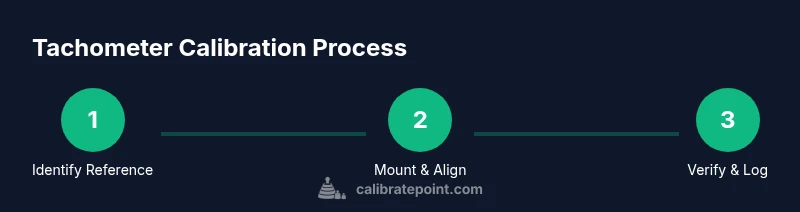
Identify reference source
Confirm the available RPM reference and verify its calibration certificate. Ensure the reference is appropriate for the tachometer type and RPM range you plan to test. If the reference lacks certification, document its limitations and consider an alternative traceable source.
Tip: Double-check serial numbers and calibration dates before proceeding. - 2
Secure mounting and alignment
Mount the tachometer and the reference source in their normal operating positions. Align the sensing path to avoid obstructions and ensure a stable, repeatable measurement geometry. Any misalignment introduces systematic error that persists across readings.
Tip: Use a laser alignment tool if available for precise positioning. - 3
Warm up equipment
Power on both devices and let them warm to operating temperature as recommended by the manufacturer. Establish a stable baseline environment free from drafts and vibrations to minimize drift during measurements.
Tip: Record the warm-up time and ambient temperature for context. - 4
Take baseline low-speed readings
Begin with a low, safe RPM and record several samples. Compute the average reading and compare it against the reference. Note any systematic offset or jitter that appears across samples.
Tip: Use a minimum of five samples to establish a reliable baseline. - 5
Capture mid-range readings
Increase to mid-range RPM and repeat multiple measurements. Look for consistency with the baseline and reference across samples. Document any variation and assess potential causes such as surface cleanliness or alignment drift.
Tip: Keep the rotor surface clean and free of oil or dust. - 6
Capture high-range readings
Test at the upper end of the tachometer’s range. Ensure the reference source remains stable and the measurement path remains unobstructed. Record all data and compare to the reference values.
Tip: Do not exceed manufacturer-recommended high RPM limits during testing. - 7
Adjust calibration if needed
If deviations exceed the device’s tolerance, follow the instrument manual to adjust calibration controls or software settings. Re-measure to confirm that adjustments align readings with the reference across speeds.
Tip: Make incremental adjustments and test after each change. - 8
Validate and document results
Once readings align within tolerance, perform a final validation pass at multiple speeds. Record results, attach environmental notes, and label the instrument with the calibration date. Save a copy of the data for audits.
Tip: Create a concise calibration report that highlights pass/fail across speeds.
Questions & Answers
What is a tachometer and what does calibration achieve?
A tachometer measures rotational speed, typically in RPM. Calibration aligns its readings with a traceable reference, improving accuracy and enabling reliable speed control across applications.
A tachometer measures RPM. Calibration aligns its readings with a trusted reference for accuracy.
How often should I calibrate a tachometer?
Calibration frequency depends on usage, manufacturer recommendations, and regulatory requirements. High-use environments typically require more frequent checks, while casual use can follow a longer interval.
Calibration frequency depends on use and standards; follow manufacturer guidance.
Can I calibrate at home, or do I need a lab?
Basic calibration can be performed at home with a suitable reference and careful method. For high-precision or regulated work, consider a certified lab or a calibrated instrument with traceability.
Home calibration is possible for basic accuracy; labs provide traceable certification for strict standards.
What if the tachometer has no adjustment screw?
Some models rely on software calibration or external adapters. Consult the user manual for non-mechanical calibration options and verify with a known reference.
If there’s no screw, calibration may be software-based; check the manual.
What should I include in calibration documentation?
Record instrument ID, reference details, environmental conditions, dates, speeds tested, readings, and uncertainty. Include operator initials for traceability.
Note the device, reference, conditions, speeds, readings, and who performed the test.
Watch Video
Key Takeaways
- Identify the tachometer type and reference source.
- Mount securely and warm up all equipment.
- Test across multiple speeds for a robust calibration curve.
- Document results and maintain traceable records.
- Archive certificates and maintain calibration the schedule.