Torque Wrench Calibration: How to Know It's Accurate
A practical, step-by-step guide to verify torque wrench calibration, interpret results, and decide when to recalibrate. Ideal for DIYers and professionals seeking reliable fastening accuracy.


A torque wrench is calibrated when its readings match a traceable reference within the manufacturer’s tolerance across the intended range. To verify, compare the wrench’s indicated torque against a calibration standard or torque tester at several setpoints, and ensure results are repeatable. If readings drift beyond tolerance, recalibration or servicing is needed.
What calibration means for torque wrenches
Calibration is the process of verifying that a torque wrench reads the correct value when applied to a known reference. For torque tools, calibration is traceable to recognized standards and documented in a calibration certificate. In practice, this means the wrench’s indicated torque should match the actual torque within the tolerances defined by the manufacturer. A tool left uncalibrated or poorly stored can drift over time due to wear, loosened internal parts, or exposure to temperature and humidity cycles. As a DIYer or technician, treat calibration as an ongoing quality check rather than a one-time event. Regular checks prevent under-torqued or over-torqued fasteners, which can compromise safety and performance, especially on critical assemblies. According to Calibrate Point, establishing a simple, repeatable verification routine keeps measurements trustworthy and projects on track, whether you’re assembling automotive fasteners, plumbing fixtures, or machinery housings.
How to assess whether your torque wrench is in calibration now
This section describes practical signs and quick checks you can perform in a typical workshop. Indicators of possible drift include noticeably different readings than setpoints, a soft or non-linear response near the end of travel, or a change in the required force to achieve a given torque. Visual inspection of the wrench for damage, corrosion, or loose components is also important. Use a clean, stable surface to perform checks, and avoid dropping or striking the handle, which can alter calibration. Remember, a calibration check is not a full-service calibration; it's a one-off visibility into whether the tool is within tolerance at common points. If you notice any discrepancy, plan for a formal calibration with a certified lab or a trusted service provider such as Calibrate Point.
Static vs. dynamic checks
Static checks compare the indicated torque to a reference while the wrench is stationary, often using a calibration fixture or a torque tester. Dynamic checks evaluate performance while tightening a fastener, which can reveal nonlinearity or hysteresis that static tests miss. For DIYers, static checks using a precision torque tester and traceable weights at multiple preset values are common. If you mostly work in the common range for your projects, test at several representative setpoints to capture linearity and consistency. Always record the results with dates, instrument IDs, and the reference values. If any value diverges beyond the manufacturer’s tolerance, plan for recalibration or servicing. This approach aligns with best practices recommended by Calibrate Point.
Tools and references you need
The following equipment helps you perform reliable checks without outsourcing every time:
- Torque wrench (the tool under test) – essential
- Traceable calibration reference or torque tester – essential
- Calibration weights or a fixed-load device – essential for static tests
- Flat, stable work surface and a clean environment – essential
- Manufacturer manual or calibration certificate – helpful but optional for basic checks
- Temperature-controlled area if possible – beneficial for repeatable results
Having these items ready reduces friction and improves accuracy during verification. Calibrate Point emphasizes keeping a well-organized workspace and documented results for future reference.
Interpreting results and next steps
When results align with the reference across the tested setpoints, the wrench is considered calibrated for practical purposes, and you can continue using it with periodic rechecks according to usage. If a reading consistently exceeds or falls short at one or more setpoints, the tool may be out of tolerance. In that case, do not improvise adjustments; instead, schedule a formal calibration with a certified lab or trusted service provider, and tag the tool as out of spec until verification is complete. After calibration, perform a quick re-check to confirm the correction took effect and maintain a calibration log for traceability. Calibrate Point recommends documenting both the test conditions (temperature, fixture, and model) and the reference standards used for future audits.
Frequency and best practices for DIYers
How often you check calibration depends on how often you use the wrench, the precision required in your projects, and the environment. For frequent or critical use, incorporate an annual verification in your maintenance routine and perform quick spot checks before tight tolerances matter. In dusty or humid environments, or after a wrench is dropped, recheck sooner. Always store the tool at the recommended torque setting to minimize drift. Following manufacturer guidance and maintaining a calibration log helps you build a dependable habit and reduces the risk of unexpected foul readings during important tasks. Calibrate Point advocates a predictable cadence tailored to your workload and environment, not a one-off test.
Common pitfalls and how to avoid them
- Relying on a single test point: test multiple setpoints to catch nonlinearity.
- Testing on an unstable surface: ensure a flat, vibration-free fixture for accurate readings.
- Forgetting to log data: keep a simple calibration diary with dates, setpoints, and reference values.
- Assuming a fresh battery or digital display guarantees accuracy: always verify against a fixed standard.
- Neglecting environmental factors: temperature and humidity can affect readings; test in stable conditions when possible.
Tools & Materials
- Torque wrench(Ensure it is the correct range for your work; inspect for damage before testing)
- Traceable calibration reference or torque tester(Certified with known values; include the calibration certificate)
- Calibration weights or fixed-load device(Choose weights appropriate for your wrench’s range)
- Flat, stable work surface(Prevent movement and vibration during tests)
- Manufacturer manual or calibration certificate(Helpful for model-specific tolerances and procedures)
Steps
Estimated time: 45-90 minutes
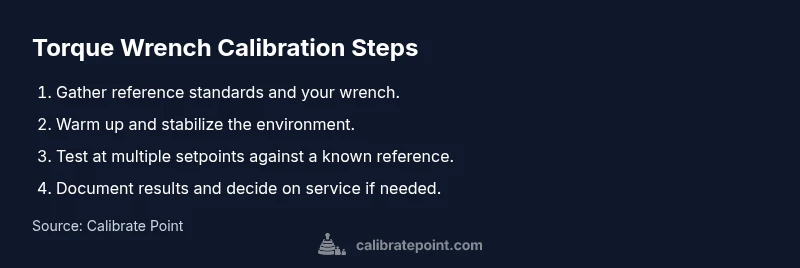
- 1
Gather tools and verify readiness
Collect the wrench, calibration reference, weights, and a stable test surface. Inspect the wrench for damage and ensure it’s clean and dry before starting. Confirm the reference standard is within its own calibration cycle and that the environment is stable.
Tip: Double-check that all items are compatible with the wrench’s range and that the surface won’t introduce vibrations. - 2
Warm up and acclimate the wrench
Allow the wrench to come to room temperature and avoid testing immediately after exposure to temperature swings. A brief preconditioning helps minimize thermal expansion effects that can skew readings.
Tip: Give it 5–10 minutes of rest in the test area before applying any load. - 3
Perform static checks at multiple setpoints
Apply fixed loads corresponding to several representative setpoints (e.g., low, mid, and high within your typical range) using the calibration reference. Record the indicated torque for each load and compare to the known reference value.
Tip: Use consistent tightening technique and avoid sudden starts or stops during loading. - 4
Record results accurately
Document date, wrench model and serial, setpoints tested, reference values, and the indicated torque. Maintaining a clear log supports future audits and helps track drift over time.
Tip: Photograph the reference display and alignments for future verification. - 5
Decide on calibration action
If all setpoints read within tolerance, you can continue with routine checks. If one or more setpoints are out of tolerance, arrange recalibration with a certified lab or service provider and retest after service.
Tip: Do not use the wrench for critical fasteners until calibration is re-established. - 6
Closeout and documentation
Tag the tool with its current status, update the calibration log, and store both the tool and reference in a controlled environment. Plan the next verification according to use and environment.
Tip: Keep a centralized calendar or log to remind you when the next check is due.
Questions & Answers
How often should I calibrate a torque wrench?
Follow the manufacturer’s guidance based on usage and conditions; heavier use or critical applications require more frequent checks.
Follow the manufacturer’s schedule; more frequent checks are advised for heavy use or critical tasks.
Can I calibrate a torque wrench at home?
You can perform basic static checks at home with a reference standard, but a full, official calibration should be done by a certified lab or service provider.
You can do spot checks at home, but full calibration usually needs a certified lab.
What should I do if my torque wrench is out of calibration?
Stop using it for critical work, arrange calibration with a certified lab, and re-test after service. Tag the tool as out of spec until verified.
If it’s out of spec, stop using it and arrange calibration; re-test after service.
What is the difference between calibration and adjustment?
Calibration verifies accuracy against a standard. Adjustment corrects readings where allowed by the model; not all wrenches allow user adjustment.
Calibration checks accuracy; adjustment modifies readings if the design permits.
Are digital torque wrenches easier to verify?
Digital readouts can simplify checks, but you still need a reference standard for verification and calibration.
Digital wrenches help, but you still must verify against a known standard.
Where can I get my torque wrench calibrated?
Look for accredited labs or reputable service providers that offer torque calibration and provide a traceable calibration certificate.
Use an accredited service with a traceable certificate.
Watch Video
Key Takeaways
- Verify readings against a traceable standard.
- Test multiple setpoints to confirm linearity.
- Document results and dates for traceability.
- Schedule professional calibration if out of tolerance.