Check Torque Wrench Calibration: Step-by-Step Guide
Learn how to check torque wrench calibration with a practical, step-by-step method. Tools, setup, reading techniques, and maintenance to keep fasteners accurate and reproducible.


This article explains how to check the calibration of a torque wrench and verify it delivers the intended torque. You’ll learn when to test, what tools to use, and a repeatable procedure you can perform in a shop or DIY setting. The goal is to confirm accuracy, ensure repeatability, and prevent under- or over-tightening on fasteners.
What is torque wrench calibration and why it matters
Torque wrenches are precision tools used to apply a specific amount of torque to fasteners. Calibration is the process of ensuring that the wrench’s indicated torque matches the actual torque delivered. Deviation can lead to under- or over-tightening, which can compromise joint integrity, structural connections, or mechanical assemblies. Regular checks help catch drift caused by wear, handle stress, or temperature exposure. According to Calibrate Point analysis, maintaining calibrated torque readings is essential for reliable results and safe operations in professional settings. Regular, documented checks build trust with clients and reduce rework or warranty claims. In practice, calibration may involve reference standards, traceable instruments, and repeatable procedures to verify accuracy across the wrench’s operating range. The core idea is repeatability: you want consistent readings across tests and applications. In short, calibration is about ensuring every fastening action is reproducible and safe.
When to check calibration
Frequency depends on usage, environment, and the criticality of the fasteners. You should verify calibration before starting a high-stakes job, after the tool has been dropped or damaged, or if it has been exposed to extreme conditions. For daily shop use, many practitioners perform a quick check weekly or monthly, particularly for tools with tight tolerances. If your work involves safety-critical assemblies—such as brake systems, structural bolts, or engine components—a formal calibration check with a reference instrument is recommended at least annually or per manufacturer guidance. Even if the tool feels normal, drift can occur gradually, making periodic checks a prudent habit. Maintain a simple log of readings and test dates to spot drift trends over time and plan service before issues arise. The discipline of regular checks minimizes surprises during critical work and protects personnel.
Tools and standards used in calibration checks
Calibration checks rely on a stable reference and a known torque source. A torque tester or digital torque analyzer provides a direct readout of the actual torque at the wrench’s handle. Some shops use calibration weights or a fixture with a calibrated scale to cross-check readings. For traceability, use tools with current calibration certificates and a reference standard within defined tolerances. The environment should be level and free of vibrations to avoid reading errors. It’s important to distinguish between calibration (verifying accuracy at a reference torque) and adjustment (changing the mechanism to bring it back into spec). When using any reference instrument, ensure it matches the wrench’s nominal range and that the procedure follows the manufacturer’s guidelines. In the Calibrate Point framework, the emphasis is on documented processes, traceable references, and repeatable methods to minimize operator variation.
How the calibration check is typically performed (high-level overview)
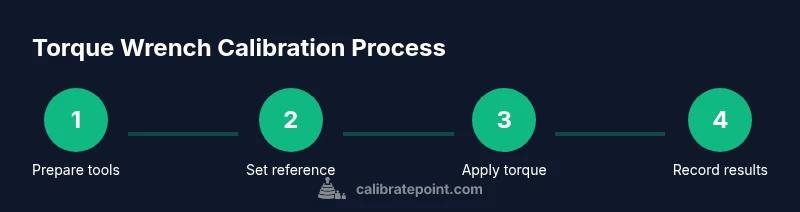
Most checks follow a consistent sequence: prepare tools and workspace; zero or initialize the reference instrument; set the wrench to a target torque within its range; apply torque smoothly and observe the reading; repeat at several points across the range; compare readings to the reference; record results; and decide on actions if readings fall outside tolerance. For linearity verification, some professionals perform readings at multiple points (low, mid, high) to assess consistency. Always follow the manufacturer’s guidelines for your specific wrench type, and consider adding a cross-check with a secondary reference when precision is critical.
How to check calibration with a torque-measuring device
Using a torque tester or calibrated reference, perform a structured check: first, ensure the reference is calibrated and within its own tolerance. Next, zero the wrench and set it to a known intermediate value within the wrench’s usable range. Apply torque gradually and note the instrument’s reading. Repeat at several points across the range (low, mid, high) to assess linearity. Record each reading and compare it to the reference value. If readings consistently align with the reference within tolerance, the wrench is considered in calibration. If not, plan recalibration, adjustment, or replacement according to the manufacturer’s guidelines.
Interpreting results and next steps
If readings are within the manufacturer’s tolerance, continue using the wrench with periodic checks. If drift or inconsistent readings appear, consider recalibration by a qualified service, or use the reference device to adjust and re-verify. Document all results, including date, instrument serials, and operators involved. A tool out of tolerance should be removed from service until it has been recalibrated or replaced. Consistent results build confidence in fastener performance and reduce the risk of joint failure.
Maintenance to keep torque wrenches accurate
Store torque wrenches with the head or handle in a clean, dry environment and avoid exposure to extreme temperatures or moisture. Periodically rotate the wrenches to prevent localized wear, and check the calibration before and after any major project. Clean the tool after use with a soft, lint-free cloth and avoid harsh solvents that could degrade components. Maintain calibration certificates and service records to support traceability and future audits. Regular maintenance is a cornerstone of precision and safety.
Quick setup checklist before calibration checks
- Inspect the wrench for visible damage and ensure it’s within its rated range.
- Place the reference instrument on a stable, level surface.
- Verify that the environment is free from drafts and vibrations.
- Prepare a notebook or log to capture readings and dates.
- Ensure proper PPE where required and follow all safety guidelines.
- Review the manufacturer’s procedures to align with tool-specific requirements.
Authority sources
- OSHA: https://www.osha.gov/
- NIST: https://www.nist.gov/
- SAE International: https://www.sae.org/
Common mistakes to avoid
- Relying on memory instead of recording results.
- Calibrating only once every several years; drift can occur gradually.
- Using damaged or mismatched reference tools.
- Skipping documentation or failing to note the test conditions.
- Assuming a tool is calibrated after a single pass; always verify across multiple points.
Tools & Materials
- Torque tester or digital torque analyzer(Prefer a NIST-traceable reference with documented range coverage)
- Calibrated torque wrench to check(Ensure it’s within its own range and not damaged)
- Calibration weights or a calibration fixture(Range should cover the wrench’s expected torque values)
- Traceable calibration certificate(Keep for records and audits)
- Torque angle gauge (optional for angle-based wrenches)(Helpful for certain torque sequences)
- Clean cloths and isopropyl alcohol(For cleaning the tool and reference surfaces)
Steps
Estimated time: 60-90 minutes
- 1
Prepare reference tools and workspace
Set up a stable, level work surface and inspect all instruments for damage. Ensure the torque tester and the wrench under test are clean and free of debris. This minimizes reading errors and ensures repeatable measurements.
Tip: Document serial numbers and calibration dates before starting. - 2
Zero or initialize the reference instrument
Power on or zero the torque tester and confirm it reads zero at rest. If necessary, follow the device’s startup sequence to ensure accurate baselines before applying torque.
Tip: A stable baseline prevents drift during measurement. - 3
Set the wrench to a known target and verify range
Choose a mid-range torque value within the wrench’s operating window. Lock in this setting if your model requires it and confirm the display or indicator is stable before applying torque.
Tip: Avoid extreme ends of the range for initial checks. - 4
Apply torque and record the reading
Apply torque smoothly to the target value and hold briefly while the reference instrument records the actual torque. Note any delay in indication or user-variability in the reading.
Tip: Use a steady, gradual motion to prevent overshoot. - 5
Repeat at multiple points across the range
Perform checks at low, mid, and high points to assess linearity and uniformity of readings. Repeat each point several times if possible to establish consistency.
Tip: Aim for at least 3 readings per point for reliability. - 6
Compare readings to the reference
Subtract or note the difference between the wrench reading and the reference. Look for consistent bias or drift across points rather than a single outlier.
Tip: A small, consistent bias across the range may indicate a service adjustment is needed. - 7
Decide on calibration action
If readings are within tolerance, you can continue use with periodic checks. If out of tolerance, plan recalibration, service, or replacement according to the manufacturer’s guidance.
Tip: Do not use a tool that fails to meet tolerance requirements. - 8
Document results and store tools properly
Record all results, reference details, date, and operator. Store the wrench and reference in a protective, stable environment to minimize drift until the next check.
Tip: Keep an audit trail for future calibrations.
Questions & Answers
How often should I check torque wrench calibration?
Check based on usage, environment, and criticality of fasteners. For safety-critical work, test before each job or per manufacturer guidance; otherwise, perform a formal check annually or semi-annually. Keep a calibration log to track drift over time.
Check your torque wrench calibration based on how you use it and the importance of your fasteners. For safety-critical work, test before each job or per guidance; otherwise, aim for an annual check and maintain a drift log.
Can I recalibrate a torque wrench at home?
Some wrenches include user-adjustable calibrations, but many require professional service or a certified calibration lab. If your tool isn’t clearly adjustable, or if results are out of spec, seek professional calibration rather than attempting DIY adjustments.
Some wrenches are adjustable at home, but many require professional calibration. If in doubt, seek a certified lab to avoid compromising accuracy.
What should I do if readings are out of tolerance?
Stop using the wrench for critical work, label it as out of tolerance, and arrange recalibration or replacement per the manufacturer’s guidance. Do not attempt improvised fixes that could further misstate torque.
If readings are out of tolerance, stop using the tool for critical work and arrange recalibration or replacement according to the manufacturer’s guidance.
Is a digital torque tester more accurate than weights?
Digital torque testers provide direct readings and can be easier to interpret, but accuracy depends on the reference’s calibration. Weights and fixtures are valid when traceable and properly configured. Always use a certified reference for best results.
Digital testers show direct readings, but accuracy rests on a calibrated reference. Weighing fixtures are valid if traceable and properly used.
Does temperature affect torque readings?
Yes, temperature can influence both the wrench and the reference instrument. Perform checks in a stable environment and consider documenting ambient conditions when recording readings.
Temperature can affect readings. Test in a stable environment and note ambient conditions when recording results.
Watch Video
Key Takeaways
- Check calibration at planned intervals to ensure accuracy.
- Use a verified reference to confirm torque readings.
- Document results to track drift and plan maintenance.
- Store and maintain tools properly to preserve accuracy.