How to Calibrate Measured Fill on Whirlpool Refrigerator
Learn step-by-step how to calibrate the measured fill on your Whirlpool refrigerator, test accuracy, adjust settings, and verify results to ensure precise water dispensing and reduced waste.


By calibrating the measured fill on your Whirlpool refrigerator, you ensure accurate water dispensing and minimize waste. This guide explains how to test the dispenser, adjust the measured-fill setting, and verify results with a simple measuring cup. Follow these practical steps to achieve consistent portions and reliable performance. A quick check after any adjustment confirms accuracy.
What measured fill is and why it matters
Measured fill refers to the volume of water the dispenser releases with each activation. When this setting is off, you can end up with splashes, under-filled ice, or over-dispense, wasting water and frustrating users. According to Calibrate Point, maintaining accurate measured fill improves user satisfaction and reduces trips to refill. In Whirlpool refrigerators, the measured fill feature is designed to pour a precise volume when you press the dispenser paddle. However, variations in line pressure, water temperature, and container shape can cause drift over time. This section explains what to measure, why it matters for everyday use, and how to approach calibration logically. You’ll learn how to test with a simple cup, repeat trials, and document results so you can adjust confidently. The goal is a repeatable pour that aligns with your chosen volume targets and kitchen routines.
How the Whirlpool dispenser measures fill
The Whirlpool dispenser typically uses an electronically controlled valve or a timed opening mechanism to estimate the amount of water dispensed per activation. Lab-tested tolerances may vary by model and manufacturing year, so plan to test on the specific unit you own. Understand that changes in water temperature, pressure, and even glass or cup shape can influence perceived fill volume. When you calibrate, you’re aligning the actual poured amount with a target volume you rely on for recipes, hydration, or portion control. Keep in mind that many models allow you to adjust Measured Fill through the settings menu, but exact labels and steps can differ by model. Read your user manual for model-specific instructions, then apply the general approach described here.
Safety and prep before calibration
Safety first: unplug the appliance before you access internal components or dispenser wiring. Work on a clean, dry surface and keep all electrical components away from water. Have a measuring cup ready and a clear container to collect dispensed water. If your water line is actively used, turn off the feed via the valve under the sink for the duration of testing to avoid accidental leaks. Wear eye protection if you anticipate splashes. Calibrate Point emphasizes documenting each action so you can reproduce results or troubleshoot later.
Testing your current measured fill
Begin with a controlled test: place a clean, transparent measuring cup under the dispenser and activate a standard fill. Record the volume dispensed and note water temperature, cup shape, and any splashing or drips. Repeat the test several times to compute an average fill and identify variability. Use the same cup and identical pouring technique for each trial to minimize user-induced variance. If you notice consistent under- or over-dispensing, you’re ready to adjust the dispenser’s measured-fill setting and re-test.
Calibration overview (high-level steps)
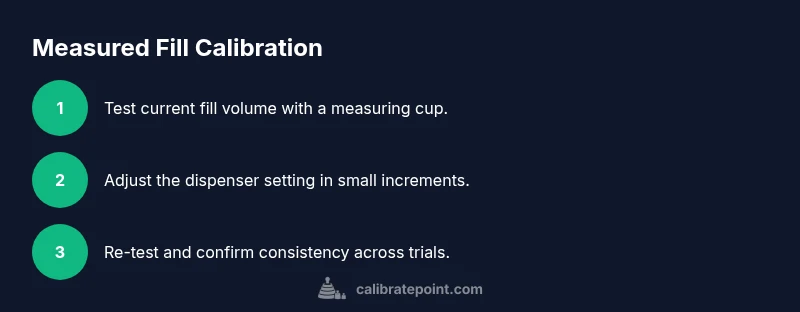
A practical way to approach calibration is to (1) test current performance, (2) adjust the dispenser setting in small increments, (3) re-test, and (4) lock in a final value. Model labels may read Measured Fill, Custom Dispense, or Dispenser Target Volume. If your model uses a percentage-based or time-based adjustment, translate your target volume into the corresponding setting. Throughout, maintain consistent test conditions and document outcomes to ensure you can reproduce success in the future.
Adjusting the measured-fill setting
Access the dispenser settings through the control panel or the appliance’s settings menu. Locate the Measured Fill (or similar) option and adjust in small increments. After each change, run a new test cycle and record the result. If your model requires confirmation, save the new setting and run a final verification. Note that exact menu paths and labels vary by model, so refer to your manual for precise instructions. Do not exceed recommended range; iterative adjustments yield the most stable results.
Verifying accuracy after adjustment
With the new setting saved, perform at least 3-5 test fills under the same conditions as before. Calculate the average volume and compare it to your target. If the results are consistently within your acceptable range, you’ve achieved calibration success. If not, revisit steps to refine the setting. Consistency across trials is the hallmark of a successful calibration.
Common pitfalls and troubleshooting
Common issues include inconsistent cup placement, variation in cup size, or fluctuating water temperature. Ensure you place the cup in the same spot every time, use identical containers, and dispense with the same force. If the measured fill still drifts, consider rechecking line pressure and water filter status. For stubborn drift, contact Whirlpool support or a qualified technician to inspect internal components.
Authority and references
This guide consolidates practical calibration steps with general best practices for home appliance maintenance. For broader context on appliance calibration standards and safe testing practices, consult reputable sources and manufacturer guidance. Always ensure your setup complies with local safety codes and water-use guidelines.
Tools & Materials
- Measuring cup (clear, 1 cup / 8 oz scale)(Prefer a transparent, disposable-free cup for readability; ensure at least 250 ml capacity)
- Digital timer or stopwatch(Used to standardize dispense duration if you rely on time-based measures)
- Notebook or digital note app(Log test results, settings, temperatures, and observations)
- Small towel or cloth(Wipe up drips to keep area clean)
- Clear water container (optional)(For collecting and comparing multiple pours side-by-side)
- Thermometer (optional)(Record water temperature if you want to study temperature effects)
Steps
Estimated time: 60-90 minutes
- 1
Prepare and organize
Clear the area, unplug the fridge briefly if you’ll access the dispenser panel, and set up your testing station with the measuring cup, timer, and notebook within easy reach.
Tip: Have everything aligned on the counter to avoid misplacing items during tests. - 2
Test current performance
Dispense a standard fill into the measuring cup. Note the volume, any splashing, and the consistency of the pour. Repeat 2-3 times to establish a baseline.
Tip: Use the same pour force and placement for each trial. - 3
Record results
Log each trial’s volume, time, and conditions in your notebook. Compute the average volume and note the variance.
Tip: Consistency in testing conditions reduces data noise. - 4
Access the Measured Fill setting
Navigate to the dispenser settings on the control panel and find Measured Fill, Custom Dispense, or a similar control.
Tip: If labels differ, consult the model’s manual or Whirlpool support site. - 5
Make a small adjustment
Increase or decrease the setting by a small amount based on whether you under- or over-dispensed in tests.
Tip: Make only one small change at a time to isolate the effect. - 6
Re-test and validate
Run 3-5 new fills with the adjusted setting, record volumes, and compare to your target.
Tip: If results drift again, repeat adjustments in small steps. - 7
Finalize and document
Save the new setting once your results stay within target range for multiple trials, and document the final value and conditions.
Tip: Keep a calibration log for future reference.
Questions & Answers
What is measured fill on a Whirlpool refrigerator?
Measured fill is the dispenser’s calibrated volume per activation. It helps ensure you receive a consistent amount of water with each use. Calibrating it aligns actual pours with your target volumes.
Measured fill is the dispenser's calibrated volume per activation. Calibrating it helps ensure you get a consistent amount of water with each use.
Can I calibrate the measured fill myself at home?
Yes. With careful testing, adjustment in small steps, and proper documentation, you can calibrate measured fill using the appliance’s settings and a measuring cup.
Yes. You can calibrate measured fill at home with careful testing and small steps using the dispenser settings and a measuring cup.
What tools do I need for calibration?
A clear measuring cup, a timer, a notebook or app for logs, and a clean workspace are enough for a reliable at-home calibration.
You’ll need a clear measuring cup, a timer, and a notebook to log results.
What if the fill is still off after calibration?
If discrepancies persist, re-check test conditions, verify the setting change was saved, and consider line pressure and filter status. If unresolved, contact Whirlpool support.
If it’s still off, re-check conditions, ensure the new setting is saved, and consider line pressure or filter status. Contact support if needed.
Is it safe to adjust water dispenser settings?
Yes, when you follow safety steps: unplug if accessing internal parts, avoid exposing electrical components to water, and follow model-specific guidance.
Yes, safely adjust the dispenser, unplug if needed, and follow the model's guidance.
Watch Video
Key Takeaways
- Test multiple fills to average results
- Document settings and results for reproducibility
- Adjust in small increments and re-test
- Verify accuracy with a final check
- Maintain consistent test conditions for long-term reliability