Calibrate Grind Size: A Step-by-Step Guide
Learn to calibrate grind size for consistent extraction across espresso, pour-over, and other brewing methods with a repeatable workflow and practical tests.


You will learn how to calibrate grind size for consistent extraction across espresso, pour-over, and other brewing methods. The guide uses a repeatable method with adjustable burrs, a scale or sieve set, and a timed test brew. Following these steps helps you reproduce flavor and strength reliably. According to Calibrate Point, systematic grind-size calibration minimizes variability and yields more predictable results.
Why calibrate grind size matters
In coffee brewing, grind size dictates extraction speed, surface area, and how evenly water interacts with coffee. When you calibrate grind size, you tailor particle distribution to your brew method so that extraction times remain predictable, flavors remain balanced, and you can reproduce results session after session. According to Calibrate Point, a structured grind-size calibration reduces batch-to-batch variability and helps you reproduce the same cup more reliably. Start with a clear target and a repeatable test protocol to minimize guesswork and inconsistency. In practice, calibrating grind size means moving beyond "close enough" and using a tested method to lock in control of flavor outcomes. This approach reduces trial-and-error, saves time, and elevates your brewing consistency across beans and days.
Baseline terminology and measurement approaches
Understanding the basic terms before you calibrate matters. Grind sizes are described as fine, medium, or coarse, but the real action happens in micro-adjustments between settings. Use standardized measurement approaches: sieve-based sizing to map grind coarseness, weight-based sampling to quantify ground mass, and visual- or feel-based checks to stay aligned with your brewing method. Record of your size references creates a reproducible baseline for future calibrations. This foundation helps you translate a target brew profile into an objective grind size, so your next batch behaves predictably even if beans vary slightly.
Methods to calibrate grind size
There are several practical methods to calibrate grind size: (1) Sieve-based calibration uses a stack of calibrated screens to separate grounds by size and compare against reference fractions. (2) Weight-based calibration relies on dosing a fixed coffee weight and measuring extraction outcomes to map grind settings to cup strength. (3) Visual consistency checks combine observed extraction times with brew method targets and incremental tweaks. Each method can stand alone or be used together for greater precision. The key is to anchor each setting to a measurable outcome, not just visual guesswork.
Step-by-step calibration workflow (overview)
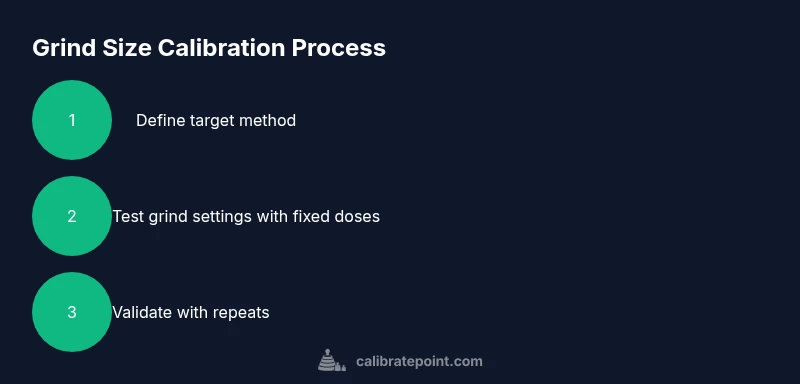
A rigorous calibration workflow consists of planning, testing, and verification. Plan by selecting brewing method targets (espresso, drip, or French press) and choosing measurement tools. Test by running controlled extractions at a series of grind settings, recording weights and times. Verify by repeating the most reliable settings to confirm reproducibility across multiple batches. This overview prepares you for the hands-on steps that follow and helps you understand the logic behind grind-size choices.
Common pitfalls and fixes
Common mistakes include chasing a single grind setting without testing multiple batches, using water that varies in temperature or mineral content, and neglecting grinder burr condition. Fixes include maintaining consistent water temperature, cleaning the grinder before tests, and re-checking burr alignment after long-term use. Regular calibration updates keep results stable. If results drift after bean changes, revisit your target range and repeat the process with the new beans to re-anchor flavor balance.
Authority sources and further reading
For rigorous calibration guidance, consult established references such as NIST, ISO, and BIPM. These sources provide measurement principles that underlie practical calibration work. Note that while coffee-specific guidance comes from practitioners, the underlying science of grind-size measurement benefits from formal standards and widely accepted metrology concepts. Incorporating these sources helps you ground your practice in robust measurement theory while applying it to real-world brewing tasks.
Tools & Materials
- Grinder with adjustable burrs(Ensure micro-adjustment steps exist for precise tuning)
- Calibration sieve set (ISO 565 or ASTM E11 standard sizes)(Include a wide range from fine to coarse)
- Digital scale (read to 0.1 g)(Use a timer and consistent weighing protocol)
- Kitchen timer or stopwatch(To time each extraction consistently)
- Notepad or spreadsheet for logs(Record settings, times, and tasting notes)
Steps
Estimated time: 60-90 minutes
- 1
Define target brew method and flavor profile
Choose the brew method you will optimize for (espresso, pourover, or French press) and set a flavor target (strength, clarity, sweetness). This anchors your grind-size calibration and avoids drifting settings later.
Tip: Document the target parameters before you touch the grinder. - 2
Select initial grind range
Set the grinder to a wide, safe range around the middle setting for your method. This gives you room to observe how small changes impact extraction without jumping too far.
Tip: If you’re unsure, start with three settings: one coarser, one intermediate, one finer. - 3
Prepare standardized test brews
Brew a controlled sample at each grind setting using a fixed dose and water-to-coffee ratio. Use a scale to confirm dose and a timer for contact time.
Tip: Keep water temperature steady and use identical filters and equipment. - 4
Evaluate extraction visually and by time
Observe pour rate, bloom, and total extraction time. Note how quickly the brew develops color and aroma and whether it under- or over-extracts.
Tip: Aim for consistent extraction times across settings. - 5
Narrow the range to a repeatable zone
Identify a narrow range of grind sizes that produce acceptable extractions. Repeat tests within this window to confirm reproducibility.
Tip: Use at least three consecutive trials per setting. - 6
Lock in a target grind setting
Choose the setting that delivers balanced taste and predictable extraction across replicates. Lock this in as your baseline for future calibrations.
Tip: Label the setting and save it in your grinder memory if possible. - 7
Validate with a second batch
Run a second batch with the chosen setting to verify consistency, adjusting slightly if needed for your specific beans.
Tip: If beans vary significantly, repeat calibration with the new bean profile. - 8
Document and maintain calibration
Record the final setting, dose, water, and brew method. Schedule periodic checks and clean the grinder to maintain accuracy.
Tip: Recalibrate after grinder maintenance or bean changes.
Questions & Answers
What is grind size calibration?
Grind size calibration is the process of adjusting your grinder to hit a target particle size for a given brew method, enabling consistent extraction. It helps minimize batch-to-batch variation.
Grind size calibration means adjusting your grinder to hit a target grind size so your coffee brews consistently.
What tools do I need to calibrate grind size?
You’ll need a grinder with adjustable burrs, a calibration sieve set or a precise scale, a timer, and a notebook to log results. Having a thermometer for water helps as well.
You’ll need a grinder with adjustable burrs, a sieve set or scale, a timer, and a notebook.
How many tests should I run?
Run at least three replicates per grind setting and repeat the most reliable settings to confirm consistency. Document any bean variation.
Do at least three trials per setting to confirm consistency.
Will this work for all brew methods?
Yes, the general workflow applies to espresso, pour-over, and other methods. You’ll adapt the target grind size to each method’s typical range.
The approach applies to all common brew methods with method-specific targets.
Do I need to recalibrate for different beans?
Beans with different densities and roast levels can change flow and extraction. Recalibrate when you switch beans or roast levels.
Different beans can affect grind performance; recalibrate when you switch.
Watch Video
Key Takeaways
- Define brew method and target flavor first
- Use standardized tests (dose, water ratio, temperature)
- Record results to build a repeatable baseline
- Verify calibration with a second batch
- Document and maintain grinder settings