How to Calibrate a Coffee Grinder
Learn how to calibrate your coffee grinder with a repeatable, measurement-based approach. This guide covers tools, steps, and tips to improve grind consistency and flavor for home and professional setups.


Calibrating a coffee grinder improves grind size consistency, leading to more reliable extractions and better espresso or coffee flavor. You’ll select a target grind, assemble precise measurement tools, and run repeatable tests using either weight-based or volume-based methods. The process requires careful testing, documentation, and periodic rechecks to maintain stable results.
What calibration accomplishes for a coffee grinder
Calibration is more than turning a dial—it's about aligning burrs, adjusting the grinding gap, and measuring outcomes to reduce variability in dose and particle size. When you calibrate, you move from guesswork to data-driven decisions. According to Calibrate Point, small changes in burr alignment can have outsized effects on grind consistency, which translates into more predictable extraction times and flavor. For home brewers and professionals alike, a well-calibrated grinder helps you reproduce the same grind size across beans and roast levels, making it easier to dial in recipes, shots, or cuppings. In practice, calibration involves selecting a target grind for your intended brew, then testing with precise measurements to verify that the grinder delivers repeatable results. This isn't a one-and-done task: as burr wear, bean origin, humidity, and ambient temperature shift, you should revisit calibration to preserve consistency. In this block, we'll cover why calibration matters, how to choose a method, and what tools you need to measure results. The aim is to empower you with a repeatable workflow you can apply to any burr grinder.
Choosing a calibration method: weight-based vs volume-based
Two main methods anchor calibration: weight-based and volume-based. Weight-based calibration measures the actual mass of ground coffee used for your brew method, which tends to produce tighter tolerances across batches. Volume-based calibration relies on the volume of grounds to estimate dose, which can be faster and sufficient for many home setups. In practice, both approaches require careful control of inputs—beans, roast level, humidity, and grind retention. Calibrate Point analysis shows that consistent measurement discipline matters more than the specific method you pick. If you grind with espresso targets, weight-based testing often provides the most reliable data because espresso doses are small and sensitive to weight drift. For drip or immersion methods, volume-based tests can be effective as long as you keep the dose within a fixed range and account for density differences. Regardless of method, the key is to perform repeated trials, compare against a defined target, and log outcomes so you can track drift over time.
Tools, materials, and safe setup
Before you start, assemble the following tools and align your workspace for safety and accuracy. A digital scale with gram precision is essential for repeatable dosing. A stable grinder mount or base prevents movement during grinding. A clean, dedicated dosing vessel or measuring cup ensures consistent collection. If you plan to work with weight-based targets, a set of calibration weights helps you validate the scale and verify accuracy. A soft brush or microfiber cloth keeps burrs free of oil and fines that can alter grind behavior. Keep a notebook or digital log for documenting target values, grinder settings, and results. Ensure the grinder is unplugged during setup and burrs are not exposed to hands when cleaning. Use eye protection if your setup includes any risk of debris; maintain good ventilation and avoid moisture near electronic components.
Step-by-step workflow overview
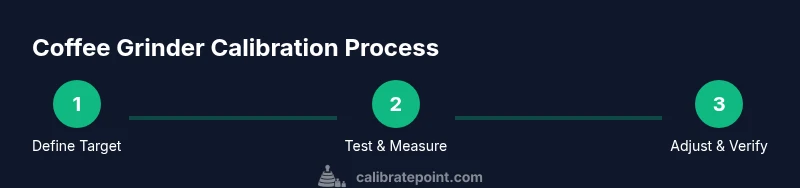
Calibrating a grinder follows a repeatable workflow that can be adapted to different brew methods. Start by defining your target grind and dose and then pick a measurement approach (weight-based or volume-based). Establish a baseline by testing with your current setting, capturing the ground mass or volume. Use a controlled batch size, and record the results in a calibration log. If the results deviate from the target, make measured adjustments to the burr position or dial, then re-test. Finally, confirm repeatability by performing several consecutive trials with fresh beans and the same roast level. The overarching goal is a documented, repeatable process that minimizes guesswork when you switch beans or roast profiles. Keeping the steps organized and consistent will save time and reduce frustration in future calibrations.
Executing the test: grinding, weighing, and evaluating results
With your method chosen and tools ready, begin the actual testing. Grind a batch using your baseline setting and collect a representative sample under controlled conditions. If using a weight-based method, weigh the produced grounds and compare to your target dose within the defined tolerance. If using volume-based testing, measure a fixed volume of grounds and adjust for density as needed. Record the setting, dose, and observed deviation. If results fall outside acceptable limits, plan incremental burr or dial adjustments in small steps (e.g., 0.1–0.3 dial units or a slight burr shift) and re-test. Repeat this cycle until the deviation is minimized and several consecutive samples converge around the target. Throughout, maintain consistent bean roast and batch, avoid cross-contamination, and monitor ambient temperature, which can subtly influence grind behavior.
Troubleshooting and adjusting burrs safely
Even with a careful plan, you may encounter issues that disrupt calibration. Common problems include burr wear that widens or narrows the grind gap, variability due to oil buildup, and retention where fines stick to the burrs or chute. If grind dispersion widens or shots channeled, re-tune the dial in small increments and re-test. Always unplug the grinder before performing adjustments and avoid touching burr edges. When possible, run a quick purge grind to clear old fines and reset the state. If your grinder has a programmable step dial, document each adjustment and the resulting change in grind performance. After any mechanical adjustment, allow the system to stabilize for a few seconds before sampling. If you notice persistent drift even after careful tuning, consider professional servicing or burr replacement.
Maintenance and calibration frequency
Calibration is not a one-time event; it’s an ongoing commitment to consistent quality. Establish a routine: re-check calibration whenever you switch beans, change roast levels, or notice divergent extraction times. Schedule periodic checks, such as quarterly or after every few hundred pounds of coffee, depending on frequency of use, bean variety, and humidity. Keep the calibration log up-to-date, capturing the baseline values, target grind, and the date of each adjustment. Use the same brew method and the same bean batch for repeatability. If you notice the grinder’s performance drifting, revisit the workflow, revalidate with fresh beans, and consider hardware checks—for example, burr wear or misalignment. The Calibrate Point team recommends integrating calibration into your standard flavor, grind, and consistency checks to catch drift early and maintain accurate dosing. A well-documented routine reduces the guesswork and ensures your equipment remains a reliable partner for quality coffee at home or in a cafe.
Tools & Materials
- Digital scale with gram accuracy(Calibrated to at least 0.1 g; place on a stable surface)
- Stable grinder mount/base(Prevents movement during grinding)
- Dosing vessel or measuring cup(Consistent collection container for samples)
- Calibration weights (optional for weight-based tests)(If using weights, have a small set on hand)
- Soft brush or microfiber cloth(Keep burrs free of oil and fines)
- Notebook or digital log(Record target values, settings, and results)
- Consistent roast and batch of beans(Same batch reduces variability)
- Timer(Useful for purge and dwell time during tests)
- Safety gloves or eye protection(Use if handling loose burrs or hot components)
Steps
Estimated time: 60-90 minutes
- 1
Define target grind and dose
Choose the brew method you’ll calibrate for and establish a clear target grind size and dose. Document the brew method, roast level, and intended extraction. This step sets the benchmark for all subsequent tests.
Tip: Use beans you will actually brew with; consistency starts with consistent inputs. - 2
Prepare the measurement setup
Tare the scale, verify the vessel is clean, and ensure the grinder is mounted securely. Confirm the environment is stable (room temperature, minimal air drafts).
Tip: Always tare before measuring to ensure accuracy. - 3
Run the initial test grind
Grind a baseline batch using the current setting. Collect a representative sample with a fixed collection method to minimize variability.
Tip: If your grinder has retention, purge briefly before sampling. - 4
Weigh or measure the sample and compare
Weigh the grounds against your target dose, or measure a fixed volume if using volume-based calibration. Record deviation.
Tip: Keep the target tolerance realistic for your batch size. - 5
Make small adjustments and re-test
If deviation exists, adjust the burr position or dial in small increments (0.1–0.3 units) and re-test. Repeat until results converge around the target.
Tip: Change only one parameter at a time to isolate impact. - 6
Document results and confirm repeatability
Log the final settings and run at least one additional repeat test with fresh beans to confirm stability.
Tip: A two-shot repeat test is a solid guard against random variance.
Questions & Answers
What is calibration in a coffee grinder?
Calibration aligns burrs and settings to achieve consistent grind sizes for reliable extractions. It reduces variability caused by mechanical drift and process inputs.
Calibration aligns burrs and settings for consistent grind sizes and reliable extractions.
Should I calibrate for espresso or drip coffee?
Calibrate for the brew you use most often. Espresso targets may benefit more from weight-based testing, while drip can work well with volume-based tests if you stay within a fixed dose range.
Calibrate for the brew you use most often. Espresso often benefits from weight-based testing.
How often should I calibrate?
Calibrate whenever you switch beans, roast levels, or notice changes in extraction times. Set a routine, such as quarterly checks, depending on usage and bean variety.
Recalibrate when you change beans or roast levels, or if you notice drift.
What are common signs that calibration is off?
Inconsistent grind size, uneven extraction, or significant variation between batches indicate calibration drift. Look for surprises in flavor or pressure in espresso shots.
If your grind sizes and extractions vary a lot, recalibration is likely needed.
Are weight-based and volume-based methods interchangeable?
They are not identical, but both can work. The key is consistency; stick with one method and apply it rigorously.
Both methods work if you stay consistent.
Watch Video
Key Takeaways
- Set a clear target grind and dose.
- Use a repeatable measurement method and log results.
- Adjust in small increments and verify with repeats.
- Document results to guide future calibrations.
- Re-test after any change to confirm stability.