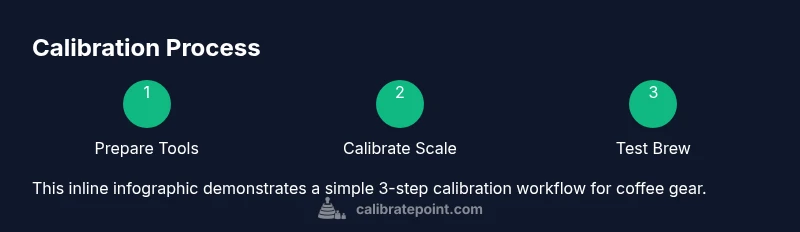
Coffee Calibrate: A Practical Guide to Calibrating Your Coffee Gear
Learn how to calibrate coffee gear—scales, thermometers, and grinders—for precise brew ratios, stable temperatures, and repeatable results. A step-by-step guide from Calibrate Point to help DIY enthusiasts and professionals achieve consistent coffee quality.


You will calibrate your coffee gear for precise brew ratios, stable temperatures, and consistent grind size. Gather a calibrated scale, a thermometer, a gooseneck kettle, calibration weights, a timer, and a grinder with adjustable burrs. Then follow the step-by-step process to complete a repeatable calibration in roughly 45–60 minutes.
Why coffee calibrate matters
According to Calibrate Point, achieving consistent coffee results starts with precise calibration of your essential tools. The term coffee calibrate refers to aligning measurement devices—the scale, thermometer, and grinder—to a known standard so every brew uses the same inputs. When these tools drift, even small errors compound into off-balance brews, inconsistent extraction, and unpredictable flavor. By establishing a repeatable calibration routine, you create a solid foundation for tasting notes, roast profiles, and brewing methods. This isn’t about perfection at the bench; it’s about dependable outcomes in your kitchen, cafe, or lab. The practice is especially important for specialty coffee where precise ratios and temperatures unlock nuanced aromas and body. In short, calibration is the bridge between your equipment and repeatable flavor.
Core measurement concepts for coffee gear calibration
Calibration rests on three core ideas: accuracy (how close a measurement is to the true value), precision (how consistently a measurement can be reproduced), and traceability (linking measurements to recognized standards). Calibrate Point analysis shows that even small drift in a kitchen scale or a thermocouple can lead to noticeable differences in brew ratio and water temperature. To start, define a baseline by using certified weights for the scale, confirm the thermometer reads correctly against a known reference, and establish a baseline grinder setting that produces a repeatable grind size. Keep in mind: calibration is not a single act but a cyclical process that evolves with equipment wear and environmental changes.
Building a repeatable calibration plan
Create a simple, repeatable cadence: prep, measure, test, record, and review. Begin with a clear goal for each device (e.g., scale accuracy within 0.1 g, thermometer accuracy within 0.5 C). Next, document each reading, weight used, ambient temperature, and any adjustments. Use standard test conditions whenever possible: same kettle, same filter, same coffee weight, and a fixed brew time. The plan should accommodate equipment updates (new burrs or new scale) and environmental shifts (humidity, altitude). A formal checklist helps ensure nothing is overlooked and makes the calibration transferable across teams or future you.
Calibrating the coffee scale for accurate brew ratios
Your scale is the backbone of precise brew ratios. Start by placing the scale on a stable, vibration-free surface and taring it with an empty vessel. Use certified calibration weights in common increments (e.g., 50 g, 100 g) to verify accuracy across the scale’s range. If readings drift beyond tolerance, recalibrate the scale according to the manufacturer’s procedure, and repeat with a few test weights to confirm stability. Once the scale is stable, conduct a practical test by weighing a target coffee dose (e.g., 18 g) and water (e.g., 270 g) to verify the intended ratio. Consistent ratio control leads to consistent extraction and flavor.
Verifying water temperature with a calibrated thermometer
Water temperature is a critical variable for extraction. Use a thermometer that’s been validated against a reference standard or a known boiling point test. Boil water, then let it cool to your target brew temperature range (commonly 92–96 C for many coffees). Submerge the thermometer sensor in the water, stir gently, and wait for a stable reading within a degree. If the thermometer reads high or low consistently, adjust your kettle temperature or calibration offset. Document the reference temperature and any offsets you apply so future brews stay aligned.
Calibrating the grinder for consistent grind size
Grind quality directly impacts extraction, so set a baseline grinder position that yields repeatable particle size. Weigh a small amount of beans (e.g., 5–7 g) and run a short grind, then inspect the particle distribution visually and by comparing extraction yield in a test brew. If the grind is too coarse or fine, adjust the burr distance in small steps and repeat until the target extraction and aroma balance is achieved. Keep a log of burr settings, batch size, and observed brew results for future reference. Regular burr maintenance helps keep calibration stable.
Running a test brew and logging results
With all devices calibrated, perform a controlled brew to validate the system. Use the same recipe for several runs, recording coffee dose, water dose, brew time, and sensory notes. Compare results across runs to identify any drift between the scale, thermometer, and grinder. If you detect drift, revisit the calibration steps for the affected device. Logging encourages accountability and makes it easy to pinpoint when recalibration is needed.
Maintenance, frequency, and when to recalibrate
Calibration isn’t a one-and-done task. Recalibrate after any equipment change (e.g., new burrs, scale replacement) or after notable performance shifts. Schedule routine checks (e.g., monthly or quarterly) based on usage and environment. Store calibration logs with dates, readings, and any corrective actions. A short routine—confirm weights, verify temperature, test grind, and run a brew—consistently keeps your coffee calibrate program reliable.
Authority references and further reading
For foundational guidance on measurement standards and calibration best practices, consider these reputable sources:
- National Institute of Standards and Technology (NIST) – Weights and Measures: https://www.nist.gov/pml/weights-and-measures
- NIST – Calibration and Traceability practices: https://www.nist.gov/pml/weights-and-measures/calibration-and-traceability
- Occupational Safety and Health Administration (OSHA) – General guidance on measurement accuracy and safe equipment handling: https://www.osha.gov
The Calibrate Point team emphasizes that calibration is a disciplined, ongoing practice. The Calibrate Point analysis shows that structured, documented checks reduce drift and improve repeatability. The Calibrate Point team recommends using a formal log and periodic rechecks to maintain accuracy over time.
Tools & Materials
- calibrated digital scale(0.1 g resolution or better; place on a stable surface)
- calibration weights (50 g, 100 g)(NIST-traceable if possible; include multiple values)
- calibrated thermometer(±0.5 C or better; probe type suitable for water)
- gooseneck kettle(preferably with variable temperature control)
- timer or smartphone timer(for precise brew times and steps)
- drip or pour-over brewing setup(consistent vessel, filter, and login method)
- coffee grinder with adjustable burrs(document current burr condition and baseline setting)
- reference coffee beans(roast level consistent for test batches)
- spoons/measuring cups and scale for dose(ensure accurate dose measurements)
- notebook or digital log(record readings, adjustments, and tasting notes)
Steps
Estimated time: 60-90 minutes
- 1
Prepare calibration workspace
Clear the workspace, assemble all tools, and verify you have a quiet, level surface. This minimizes vibration and errors in weight readings. Set the ambient temperature to a comfortable room level to avoid thermal drift in equipment.
Tip: Place weights on a stable block or tray to prevent rolling and ensure accurate readings. - 2
Zero and verify the scale
Power the scale, tare to remove the vessel weight, and place a known weight on the pan. Check that the reading matches the weight within tolerance. Repeat with another weight to confirm linearity.
Tip: Do not place the scale on a soft surface or near drafts that can cause fluctuating readings. - 3
Calibrate the scale with certified weights
Place the 50 g and 100 g weights sequentially and confirm each readout is within spec. If not, follow the manufacturer’s calibration procedure and re-test. Record any offset for future reference.
Tip: If your scale has a calibration mode, use it exactly as described in the manual. - 4
Test water temperature accuracy
Boil water, let it cool to your target range, and insert the thermometer to verify reading stability. If the thermometer is off, apply a calibration offset or adjust the water temperature target accordingly.
Tip: Stir gently to ensure an even temperature around the probe and avoid warm-cold pockets. - 5
Baseline grinder setting and test grind
Set the grinder to a baseline burr distance, then grind a small batch and inspect particle size visually or with a test brew. Adjust incrementally until you observe consistent extraction with a controlled taste profile.
Tip: Keep the grinder clean between tests to avoid confounding residues. - 6
Run a standard test brew
Brew using fixed dose and water amounts, record brew time, temperature, and yield. Note tasting impressions and compare against target flavor profile. Repeat once to confirm stability.
Tip: Use a consistent pour technique to limit variables unrelated to calibration. - 7
Adjust based on results
If the brew is under- or over-extracted, adjust dose, brew time, or grind setting in small steps and re-brew a pair of trials. Document every adjustment for traceability.
Tip: Change only one variable at a time to isolate cause and effect. - 8
Record results and establish cadence
Log all measurements, offsets, and tasting notes. Set a calendar reminder for periodic recalibration or when equipment is changed. Review logs quarterly to confirm long-term stability.
Tip: Keep a shared log if multiple team members calibrate the same gear.
Questions & Answers
What tools do I need to start coffee calibrate?
You’ll need a calibrated digital scale, calibration weights, a calibrated thermometer, a gooseneck kettle, a timer, a grinder with adjustable burrs, test beans, and a log to record results.
To start calibrating coffee gear, gather a scale, weights, a thermometer, a kettle, a timer, a grinder, test beans, and a notebook to log results.
How often should I recalibrate after setup?
Recalibrate after any equipment change (like new burrs or a scale) or if you notice drift in readings. Establish a routine cadence (monthly or quarterly) based on usage and environment.
Recalibrate after equipment changes or when you notice drift, and set a regular cadence like monthly or quarterly.
Can I calibrate using kitchen weights or household items?
Yes, but use verified references or certified weights whenever possible for accuracy. Household items may introduce variability, so verify with a known standard.
You can start with common weights, but verify accuracy with certified weights to avoid drift.
What is the difference between calibration and adjustment?
Calibration aligns measurements to a standard, while adjustment changes device settings to meet the calibrated targets. Calibration is the process; adjustment is the action based on the results.
Calibration is the process of aligning readings to a standard; adjustment updates the device to meet those calibrated targets.
Watch Video
Key Takeaways
- Calibrate scales, thermometers, and grinders first.
- Document readings and adjustments for repeatability.
- Test with fixed recipes to verify calibration success.
- Recalibrate after equipment changes or drift.
- Maintain a simple log to track long-term stability.