Calibrate Mass Air Flow Sensor: Step-by-Step Guide
Learn how to calibrate a mass air flow sensor to restore accurate air-fuel readings, improve idle, throttle response, and fuel economy. This guide covers safety, tools, cleaning, ECU relearn, and validation with live data.


To calibrate a vehicle’s mass air flow sensor, you’ll restore accurate fuel delivery and smoother idle. This quick guide explains when calibration is needed, the tools required, and a safe, step-by-step process to clean, test, and retrain the sensor with the vehicle’s ECU. Expect improved throttle response and fuel economy when readings are correct.
Understanding the Mass Air Flow Sensor and Calibration Basics
The mass air flow sensor (MAF sensor) measures the amount of air entering the engine. In modern gasoline engines, it is typically a hot-film or hot-wire device that feeds data to the engine control unit (ECU). The ECU uses this information to calculate the correct fuel quantity to inject. Over time, contamination, buildup, or aging can cause readings to drift, leading to richer or leaner conditions and reduced efficiency. Before attempting calibration of the mass air flow sensor, be aware that official service manuals specify the correct cleaning agents and relearn routines. Calibrate mass air flow sensor operation is about ensuring the ECU interprets the sensed air mass accurately, not reprogramming a fixed value. Practically, the goal is to minimize drift and maintain realistic readings across idle, acceleration, and varied temperatures. If you need to calibrate mass air flow sensor readings, follow the manufacturer’s procedure and verify readings with live data.
Symptoms of a Failing MAF Sensor
A failing MAF sensor often manifests as fluctuating idle, stalling at low rpm, hesitation on acceleration, or surges as you drive. You may notice increased, or inconsistent, fuel consumption and engine light illumination. Some vehicles show rich fuel trims at idle, causing a strong odor of fuel or black soot from the exhaust. Note that these symptoms can also stem from vacuum leaks or clogged air filters, so verify with live data and checks.
Tools, Safety, and Preparation
Before you start, park the vehicle on a level surface, engage the parking brake, and disconnect the negative battery terminal to prevent ECU memory changes. Gather tools: an OBD-II scanner with live data, MAF sensor cleaner designed for automotive use, a soft brush or lint-free cloth, a replacement sensor if needed, appropriate screwdrivers or a socket set, and a clean workspace. Also have PPE: safety glasses and gloves. Read the service manual for your vehicle to follow specific torque specs and sensor location details. This preparation minimizes the risk of damage and ensures you can verify changes with real-time data.
Cleaning vs Calibration: What Works
Cleaning the MAF sensor can remove surface residue and oil that skew readings, but it does not permanently fix drift caused by sensor aging. Calibration, in most vehicles, is about ECU relearn and ensuring the ECU interprets the sensor’s output correctly after cleaning or replacement. In practice, you may need to perform a drive cycle or idle relearn routine to allow the ECU to re-calculate fueling based on authentic readings. Some manufacturers require a specific service procedure for calibration, while others rely on the ECU’s adaptive learning. The key distinction is that cleaning improves signal quality, while calibration ensures the ECU uses that signal properly across operating conditions.
How Calibration Affects ECU Learning and Fuel Trims
The ECU uses live data from the MAF sensor to set fuel trims that balance air and fuel during different driving conditions. When calibration is not up to date, long-term fuel trims can drift, causing inefficiencies, reduced power, and increased emissions. Calibrating the MAF sensor helps the ECU establish accurate baselines for air mass, which improves throttle response, idle stability, and fuel economy. Post-calibration learning may require a drive cycle so the ECU can adapt to the corrected readings. Consistent data helps ensure the engine runs smoothly under both light and heavy loads.
Step-by-Step Calibration Approach (Overview)
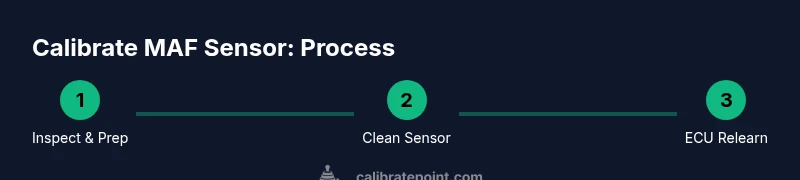
This overview provides a practical framework you can follow with the detailed steps in the next block. The process emphasizes safety, data verification, and adherence to manufacturer guidelines. You’ll inspect the sensor, clean it if needed, reset ECU learned values, reassemble, and validate results using live data. The goal is reliable readings across RPMs and temperatures, not a one-time fix. Calibrating the MAF sensor is a balance between mechanical inspection and ECU adaptation.
Post-Calibration Checks and Common Pitfalls
After calibration, perform a thorough check across typical driving scenarios: idle, acceleration, cruise, and full-throttle moments. Verify that short- and long-term fuel trims stay within expected ranges and that the engine runs smoothly without hesitation. Common pitfalls include not clearing ECU learned data, improper cleaning agents, contaminated wiring or connectors, and failing to perform a proper drive cycle. If readings remain unstable after calibration, consider sensor replacement, wiring inspection, or diagnosing related intake leaks. The goal is enduring stability, not a temporary improvement.
Tools & Materials
- Safety gear (gloves, eye protection)(Safety first; protect eyes from cleaners)
- OBD-II scanner with live data(Must display MAF sensor data (g/s) and fuel trims)
- MAF sensor cleaner spray(Use automotive-grade product; avoid carb or brake cleaners)
- Soft brush or lint-free cloth(Gentle cleaning; do not scratch the sensing element)
- Replacement MAF sensor(Only if sensor is visibly damaged or drift persists after cleaning)
- Screwdrivers or socket set(For sensor removal and access)
- Rags or microfiber towels(For wiping surfaces and catching cleaner residue)
- Torque wrench (if required by manual)(Use only when the service manual specifies torque values)
Steps
Estimated time: 60-90 minutes
- 1
Prepare safely and gather tools
Turn off the engine and disconnect the negative battery terminal to prevent ECU memory changes. Put on safety glasses and gloves, then collect all tools and materials from your list. Read the service manual for model-specific precautions and torque specs. Why: this reduces risk and ensures you can perform a consistent relearn when needed.
Tip: Disconnect the battery first, then wait 60 seconds to discharge capacitors. - 2
Inspect the MAF sensor wiring and housing
Visually inspect the sensor, wiring, and connector for oil contamination, cracks, corrosion, or loose pins. If the connector has oil buildup, clean the exterior and check seals. Why: poor connections or contamination can mimic sensor drift and mislead the calibration process.
Tip: Use a bright light and magnifier to spot hairline cracks in the plastic housing. - 3
Remove and clean the MAF sensor
Carefully remove the MAF sensor from its housing per the service manual. Spray the sensing element with automotive MAF cleaner from a safe distance and wipe away residue with a lint-free cloth or soft brush. Why: buildup on the element alters readings and can prevent proper calibration.
Tip: Do not touch the hot-film element with bare fingers or abrasive tools. - 4
Reset ECU adaptations and clear learned fuel trims
If your vehicle’s procedure requires it, reset ECU adaptations by disconnecting power or using the OBD menu to clear learned fuel trims. Reconnect the battery and allow the ECU to relearn during the next drive cycle. Why: the ECU must recalibrate its fuel mappings using fresh, accurate data.
Tip: Some models require a specific relearn sequence; follow the manual rather than guessing. - 5
Reinstall, reconnect, and perform a drive cycle
Reinstall the MAF sensor, reconnect all connectors, and start the engine. Perform a defined drive cycle that includes idle, light acceleration, and steady cruising to allow the ECU to relearn. Why: real-world driving conditions provide the data needed for stable operation.
Tip: Keep RPMs within normal ranges during the relearn drive cycle. - 6
Verify results with live data and log trends
Review live sensor data and short/long-term fuel trims after the drive cycle. Look for readings that stay within manufacturer specs and for stable idle. If drift returns, inspect for leaks or consider sensor replacement.
Tip: Document baseline readings and any variation to track improvements over time.
Questions & Answers
Do I always need to calibrate the MAF sensor after cleaning?
Not every cleaning requires a formal calibration. Many vehicles only need the ECU to relearn after cleaning. If readings remain unstable, a formal calibration or sensor replacement may be necessary.
In most cases, cleaning plus an ECU relearn suffices, but persistent drift may require a sensor replacement.
How can I test if my MAF sensor is working correctly?
Check live data with an OBD-II scanner for stable readings (g/s) across RPM ranges and compare fuel trims at idle and under load. If readings are erratic or out of spec, investigate for contamination or a faulty sensor.
Use live data to confirm readings are steady, then drive to see how trims respond.
Can I calibrate a MAF sensor without a scanner?
A scanner makes the process reliable; some vehicles ID ECU relearn with drive cycles, but a dedicated scanner helps confirm sensor data. Without a scan tool, you risk guessing and missing subtle drift.
A scanner helps you verify data; you can attempt ECU relearn via drive cycle, but a tool makes it safer.
What’s the typical wait time during ECU relearn after cleaning?
Most ECUs relearn quickly during normal driving, often within a completed drive cycle. Some vehicles may require longer cycles or repeated drives to stabilize readings.
Relating to the drive cycle, most cars relearn as you drive normally for a while.
What are signs the MAF sensor needs replacement?
Persistent rough idle, multiple misfires, failing to stabilize fuel trims, or readings that don’t respond to cleaning indicate a likely sensor failure.
If cleaning doesn’t help and readings stay off, replacement is likely needed.
Watch Video
Key Takeaways
- Collaborate with live data to verify sensor health
- ECU relearn is essential after cleaning or sensor replacement
- Follow manufacturer steps to avoid calibration errors
- Inspect wiring to prevent false drift readings
- A properly calibrated MAF improves idle stability and fuel economy