Calibrate a Model: Step-by-Step Guide
Learn to calibrate a model with clear steps, checklists, and best practices from Calibrate Point. Improve accuracy, reduce bias, and validate results with practical tactics.


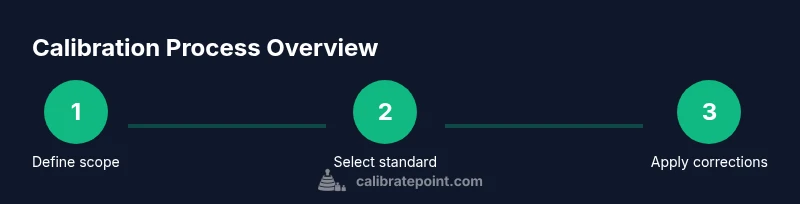
You will learn how to calibrate a model to improve accuracy across its operating range. Start by gathering a traceable reference standard, selecting appropriate measurement tools, and documenting baseline conditions. Then apply correction factors, perform re-checks, and validate results with independent data to ensure repeatable performance. This quick outline sets the stage for a durable calibration program.
What calibrate model means and why it matters
Calibrating a model means aligning its outputs with trusted reference values across the intended operating range. In practice, this reduces bias and drift, improving accuracy and confidence in predictions or measurements. According to Calibrate Point, calibration is as much about traceability and repeatability as it is about raw precision. A well-calibrated model provides a defensible basis for decisions in manufacturing, quality control, and research. The process begins with a clear definition of what counts as a correct value and where errors are most harmful. This often involves listing the model’s output variables, units, and acceptable tolerances. In physical instrumentation, calibration maps instrument readings to true values by applying correction factors; in statistical modeling, it aligns model outputs with observed data, ensuring predictions remain valid over time. The key is to design a calibration plan that can be revisited, audited, and re-run as the device or method changes. The Calibrate Point team emphasizes establishing a documented baseline, so you can trace back any performance change to a specific intervention or condition. Uncertainty budgets, calibration certificates, and version control are all part of a durable calibration strategy.
Key concepts and terminology
Understanding calibration hinges on precise terminology. A reference standard is a value you trust as true within a known uncertainty. Traceability links the reference to higher-level standards so that all measurements can be compared across times and places. Drift is the gradual change in an instrument’s response, and bias is a systematic offset from the true value. Linearity and hysteresis describe how an instrument responds across its range. Acceptance criteria specify the allowable deviation after calibration. In practice, you’ll record the uncertainty budget, calibration certificates, and version-controlled procedures. For DIY projects, keep your definitions simple and document a clear pass/fail threshold. For professionals, align with industry standards and maintain auditable records. Calibrate Point’s guidance highlights that clear scope, traceability, and repeatable steps are the foundation of credible calibration programs.
When you should calibrate a model
Calibration should be planned around usage, environment, and regulatory expectations. After installation or major service, calibrate to establish a fresh baseline. If a device is exposed to extreme conditions, calibrate before critical measurements resume. For aging equipment, schedule periodic calibrations based on observed drift or published maintenance intervals. In data-driven models, recalibration may occur when new data reveal model drift, or when input distributions shift significantly. The overarching aim is to detect and correct drift before decision-making is affected. Calibrate Point’s analysis shows that regular calibration reduces long-term bias and maintains confidence in results across departments and applications.
Methods and strategies
There are multiple ways to calibrate a model, depending on the system and the required precision. Direct mapping uses a correction function that translates readings to true values. Regression-based approaches adjust parameters to minimize error across calibration points, while model-based corrections apply physics or domain knowledge to refine predictions. Software-driven adjustments can be implemented with minimal hardware changes, but hardware recalibration—adjusting sensors or actuators—is sometimes necessary for substantial drift. In all cases, document the chosen method, its assumptions, and the range over which it is valid. For complex systems, hybrid approaches combine direct mapping with regression to capture nonlinearity. Calibrate Point recommends starting with a simple method and escalating only when necessary to maintain clarity and auditability.
Validation and documentation
Validation confirms that the calibration delivers the intended improvement. Re-measure with independent data or a separate reference to demonstrate that corrected outputs align with true values. Maintain a calibration log that includes dates, personnel, reference standard details, uncertainties, and acceptance criteria. Include a clear next-due date and any notes about conditions that could invalidate the calibration (e.g., temperature excursions or power cycling). Documentation should be precise enough for another technician to reproduce the results. Calibrate Point emphasizes that reproducibility and traceability are the core goals of effective calibration, making good records as important as the measurements themselves.
Tools & Materials
- Calibration reference standard (traceable to national/international standards)(Include uncertainty specification and calibration certificate)
- Device under test (DUT) or instrument to calibrate(Record model, serial, and intended use)
- Data logger or calibration software(Capture measurements with timestamps; ensure data integrity)
- Environmental monitoring (thermometer/hygrometer)(Record ambient conditions during calibration if applicable)
- Calibration weights or known-values (for scales/balances)(Use certified weights with traceability when needed)
- Calibration procedure or protocol(Document steps, tolerances, acceptance criteria)
- Safety gear and PPE(Based on equipment and environment)
- Calibration certificates and logs(Store in a retrievable, auditable location)
Steps
Estimated time: Total time: 45-90 minutes
- 1
Identify calibration scope
Define which parameters and ranges to calibrate, considering device specifications and application impact. Establish what constitutes a correct value and where errors would compromise decisions. Document expected tolerances and endpoints before touching any equipment.
Tip: Review the device manual and confirm units align with reference standards. - 2
Prepare the reference standard
Acquire a traceable standard with known values and documented uncertainty. Verify the standard’s calibration status and ensure it is suitable for the measurement range. Bring the standard to ambient conditions to avoid thermal bias.
Tip: Allow standards to equilibrate to room temperature before use. - 3
Set up the measurement environment
Position the DUT and reference standard in a stable environment. Ensure the measurement chain is free from vibrations and EMI sources. Connect the data logger or software and verify timestamp integrity.
Tip: Stabilize the environment for at least a few minutes prior to measurements. - 4
Connect instrumentation and sensors
Link the DUT to the measurement instrument and data logger. Confirm proper wiring, shielding, and grounding. Clear any baselines or offsets before collecting data.
Tip: Perform a zero or baseline check to establish a clean starting point. - 5
Collect initial readings
Take multiple readings across the defined range and record values. Use at least three replicates to estimate repeatability and to identify outliers. Note any anomalies and pause to investigate if needed.
Tip: Use at least three replicates per point to quantify variability. - 6
Calculate correction factors
Compare measured values to reference values and derive offsets or slopes. Choose a correction model (linear, polynomial, or piecewise) that matches observed behavior. Document the calculation method and resulting factors clearly.
Tip: Keep the math simple and auditable; prefer linear corrections when appropriate. - 7
Apply adjustments and re-check
Update device settings or firmware with correction factors and re-measure key points. Confirm results are within tolerance across the full range. If not, revisit the model or reference data and refine.
Tip: Check endpoints and mid-range to ensure linearity or capture nonlinearity. - 8
Document results and certify
Record final corrected values, uncertainties, and the calibration certificate. Include the due date for next calibration and any conditions for revalidation. Store logs in an accessible, audit-ready format.
Tip: Attach a concise summary that enables quick future audits.
Questions & Answers
What does calibrating a model achieve?
Calibration aligns model outputs with trusted references, reducing bias and drift to improve accuracy and reliability.
Calibration aligns model outputs with trusted references to reduce bias and drift and improve accuracy.
How do you choose a reference standard?
Select a standard with known uncertainty and traceability to national or international systems; ensure compatibility with the model’s range and units.
Choose a standard with known uncertainty and traceability, matching your model's range.
How often should calibration occur?
Frequency depends on usage, drift, and regulatory requirements; monitor performance and schedule intervals based on risk and importance.
Frequency depends on usage and drift; schedule calibration at regular intervals based on risk.
What should be documented during calibration?
Record reference values, measured values, corrections, uncertainties, personnel, and dates to enable traceability.
Keep a complete calibration log with values, corrections, and dates.
Can calibration be done remotely?
Yes, with secure data transfer and validated procedures, remote calibration can work if the data chain remains intact.
Remote calibration is possible if data is securely transferred and validated.
Watch Video
Key Takeaways
- Define calibration scope before measurements
- Use traceable references and document uncertainties
- Capture multiple data points across the range
- Validate with independent data and log outcomes