Calibrate Test: A Practical Step-by-Step Calibration Guide
This Calibrate Test guide teaches how to verify device accuracy against reference standards, covering prerequisites, environmental controls, step-by-step procedures, data handling, and traceability.


Learn how to perform a reliable calibrate test across common measuring devices. This guide covers prerequisites, reference standards, stable environment, validation procedures, the exact steps to execute, and how to document results for traceability and future re-testing.
What calibrate test really means\n\nThe phrase calibrate test describes a structured process to verify that a measurement device or sensor delivers results within defined tolerances compared to a trusted reference. In practice, a well-executed calibrate test ensures traceability, repeatability, and confidence in data used for decisions. In this guide, you will learn how to plan, perform, record, and act on calibration results for a range of instruments—thermometers, scales, torque wrenches, and more—so you can maintain measurement integrity with every measurement.\n
Prerequisites and definitions\n\nBefore starting a calibrate test, define the scope, terms, and acceptance criteria. Key terms include reference standard, traceability, tolerance, and repeatability. You will need a stable reference, an environmental baseline, and a documented procedure. Clear definitions prevent ambiguity during data interpretation and ensure everyone follows the same protocol.\n
Reference standards and traceability\n\nReference standards anchor your calibrate test to objective measurements. A trustworthy reference is traceable to national standards (for example, NIST in the United States). Always document the calibration certificate of the reference standard, its uncertainty, and the date of last adjustment. This section explains how to select an appropriate standard, how to verify its status, and how to record its serial number and uncertainty for audit trails. Traceability means your results can be traced back to an accepted standard, which is essential for quality control and compliance.\n
Environment and stability considerations\n\nEnvironmental conditions strongly influence measurement accuracy. Temperature, humidity, vibration, and electromagnetic interference can shift readings. A calibrate test should occur in a controlled environment or with compensations built into the procedure. This section outlines practical steps to establish a stable baseline, including placement of devices, warm-up periods, and how to monitor environmental variables. By reducing external influences, you improve repeatability and confidence in the results.\n
Calibration plan: scope, intervals, and acceptance criteria\n\nA robust calibration plan defines what to calibrate, how often, and what constitutes an acceptable result. You will set the instrument’s range, specify the reference points, determine the number of calibration points, and define decision rules for when to reject measurements. This section demonstrates how to tailor the plan to the device type, usage frequency, and criticality of measurements. Clear acceptance criteria prevent subjective judgments and support consistent decisions.\n
Tools, equipment, and safety\n\nGather the tools necessary for a successful calibrate test, including reference standards, measurement instruments, data-logging capabilities, and safety equipment when needed. This section lists essential items, how to inspect them before use, and how to handle delicate references to avoid damage. Safety reminders apply mainly to electrical, high-temperature, or mechanical testing scenarios. Proper tools reduce variances and protect you and the device under test.\n
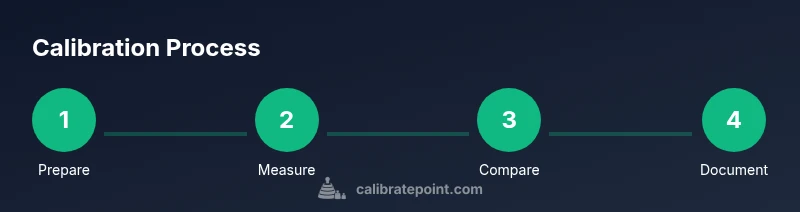
Step-by-step workflow overview\n\nA high-level workflow helps organize the process: prepare the device, establish the reference, perform measurements, compare results, document findings, and close the loop with corrective actions if needed. While the detailed steps are provided in the STEP-BY-STEP block, this overview shows how the pieces fit together and where decision points occur. Following the workflow consistently drives reliable outcomes and audit trails.\n
Data collection and measurement strategies\n\nEffective data collection emphasizes consistent timing, stable sampling rates, and correct measurement units. Whether you're logging temperature data from a probe or load readings on a torque wrench, precise data capture is critical. This section covers data formatting, uncertainty estimation basics, and how to structure data sheets to facilitate analysis and review by peers or auditors.\n
Interpreting results: what the numbers mean\n\nInterpreting calibration data involves comparing measured values to the reference, evaluating the residuals, and applying acceptance criteria. You’ll learn how to read uncertainty budgets, determine whether to accept or adjust readings, and decide when a device requires service or replacement. Proper interpretation prevents overcorrection and ensures you act only when necessary.\n
Common pitfalls and how to avoid them\n\nCommon mistakes include skipping warm-up time, neglecting environmental control, or failing to document the reference standard properly. This section highlights practical strategies to avoid these issues, such as standardizing start-up routines, keeping a single source of truth for procedures, and conducting periodic peer reviews of calibration data.\n
Documentation and record-keeping\n\nThe final phase of a calibrate test is producing a certificate or report that captures method, results, uncertainties, and acceptance decisions. This documentation supports traceability, enables future audits, and provides a reference for re-testing. The best practice is to store digital copies in a centralized calibration management system with version history and secure access.\n
Real-world devices: examples and constraints\n\nFrom kitchen thermometers to precision torque tools, calibration needs vary by device class. This section discusses common devices, typical reference standards, and practical constraints you may encounter in a workshop or lab. Real-world considerations—such as cost, availability of standards, and required turnaround—shape how you implement the calibrate test without compromising reliability.\n
Authority sources\n\n- NIST weights and measures: https://www.nist.gov/pml/weights-and-measures\n- NIST Special Publication 811 on measurement: https://nvlpubs.nist.gov/nistpubs/SpecialPublications/NIST.SP.811.pdf\n- ISO/IEC standards on calibration and quality management: https://www.iso.org/standard/66912.html\n
Tools & Materials
- Reference standard (calibration standard)(Traceable to national standards; record uncertainty)
- Device under test (DUT)(Ensure clean, ready for testing)
- Calibration certificates/logs(Include serial, date, uncertainty)
- Measurement instruments (calipers, multimeters, etc.)(Calibrated instruments with current certificates)
- Environmental monitor (thermo-hygrometer)(Use if environment affects results)
- Data-logging device or software(Time-stamped records)
- Personal protective equipment (PPE)(Safety first if required by device)
Steps
Estimated time: 1.5-3 hours
- 1
Prepare the DUT and reference
Power the device, allow warm-up, and verify the reference standard is within its own tolerance window.
Tip: Document the exact start time to establish a baseline. - 2
Warm up and stabilize
Let the DUT and reference run for the recommended warm-up period to minimize drift.
Tip: Avoid touching test surfaces during warm-up. - 3
Record baseline measurements
Take initial readings from both DUT and reference at zero or baseline point.
Tip: Use the same operator and measurement mode for consistency. - 4
Apply test points
Apply the predefined test points or ranges per the calibration plan.
Tip: Ensure points cover the full useful range of the DUT. - 5
Compare and compute residuals
Calculate the difference between DUT readings and reference at each point.
Tip: Capture at least three readings per point to assess repeatability. - 6
Decision and documentation
Decide if results meet acceptance criteria; document findings and any corrective actions.
Tip: If out of tolerance, escalate per your procedure.
Questions & Answers
What is a calibrate test and why is it important?
A calibrate test verifies that a device's measurements align with a reference within defined tolerances, establishing accuracy and traceability for reliable data.
A calibrate test checks that a device's measurements match a trusted standard within set tolerances, ensuring accuracy and traceability.
Who should perform a calibrate test?
Qualified technicians or technicians with calibration training should perform it, following a documented procedure and using traceable reference standards.
Qualified technicians should perform calibrations using documented procedures and traceable standards.
How often should calibrations be performed?
Calibration frequency depends on device usage, criticality, and stability; follow the plan defined in the calibration procedure and adjust based on data trends.
Follow the defined plan, and adjust frequency based on device use and data trends.
What should be included in a calibration certificate?
A calibration certificate should include the reference standard details, the DUT, test points, results, uncertainties, acceptance decisions, and the analyst's signature.
The certificate lists reference standards, device tested, results, uncertainties, and who conducted the test.
What if a calibration fails?
If results fail acceptance criteria, follow the corrective action plan, document root cause, and schedule a re-test after adjustments or service.
If failing, follow the corrective action plan and re-test after adjustments.
Watch Video
Key Takeaways
- Define scope and acceptance criteria before testing
- Use traceable reference standards for credibility
- Control environment to reduce drift and variance
- Document all data for auditability
- Follow a tested STEP-BY-STEP workflow