Calibrate Transducer: A Practical Step-by-Step Guide
Learn how to calibrate transducer accurately with a traceable reference, from planning and setup to verification and documentation. This guide covers tools, methods, tips, and safety to ensure reliable measurements.


This guide will show you how to calibrate transducer accurately and safely. You’ll identify the target range, select a traceable reference standard, connect the signal source, and apply a structured adjustment routine. By following these steps, you’ll improve measurement reliability and establish a repeatable calibration workflow for your equipment.
Why calibrate transducer matters
According to Calibrate Point, calibrating transducers is essential for ensuring the accuracy and reliability of measurements in any process control or test setup. The act of calibrating a transducer aligns its output with a known standard over a defined range, reducing drift, nonlinearities, and offset errors that accumulate during operation. For DIY enthusiasts, technicians, and professionals, a good calibration routine creates traceability and confidence in data used for decision-making. When you calibrate transducer outputs, you establish a documented baseline that supports quality control, compliance, and repeatable experiments. The goal is not simply to set a value but to characterize the sensor’s response across its operating range so you can apply the correct corrections in real-time or in data processing. In practice, a well-executed calibration improves repeatability and helps detect gradual degradation before it affects outcomes.
Key concepts you’ll encounter
- Transducer: a device that converts a physical quantity (pressure, temperature, force, distance) into an electrical signal.
- Calibration: the process of determining correction factors so the transducer output matches a reference standard.
- Offset and gain: the baseline output at zero input and the slope of the input-output curve, respectively.
- Drift: gradual change in accuracy over time due to aging, temperature, or mechanical stress.
- Traceability: the documented link to national or international standards that validates measurement accuracy.
- Acceptance criteria: the target error limits that determine whether a transducer passes calibration.
Understanding these terms helps you plan and document the calibration with clarity, reducing confusion during audits or investigations.
Planning the calibration: scope, range, and criteria
Before you touch any hardware, define the scope of calibration. Identify the transducer’s range, the expected accuracy, and the environmental conditions where it will operate. Create an acceptance criterion that matches the instrument’s application—this could be a maximum percentage error or a specified absolute deviation at several test points. Plan multi-point checks across the full span of the transducer’s range to catch nonlinear behavior or unusual sensitivities. Documentation should specify reference standards used, the equipment configuration, and the environmental conditions during the test. A clear plan minimizes rework and helps you justify adjustments if readings fall outside the acceptable range.
Tools and reference standards: what you’ll need
A reliable calibration begins with the right tools. You’ll need a traceable reference standard appropriate for the transducer type (pressure, temperature, force, etc.), a calibrated signal source or simulator, a precision measurement instrument to capture the transducer output, plus a method to log data. Use a stable test bench that limits vibration and temperature shifts. Keep a written worksheet or digital log with date, serial numbers, range, test points, and results. Having these elements ready reduces downtime and improves data integrity.
Environmental conditions and safety considerations
Calibration is sensitive to temperature, humidity, vibration, and electrical noise. Control or document ambient conditions and give the transducer time to come to equilibrium before measurements. If the sensor operates at high voltages or pressures, ensure proper safety protocols are in place, including PPE and isolation procedures. When performing calibration in a laboratory or field setting, verify power supply stability and shield the setup from electromagnetic interference. Keeping a safe, stable environment minimizes variability and protects personnel.
Step-by-step overview and planning checklist
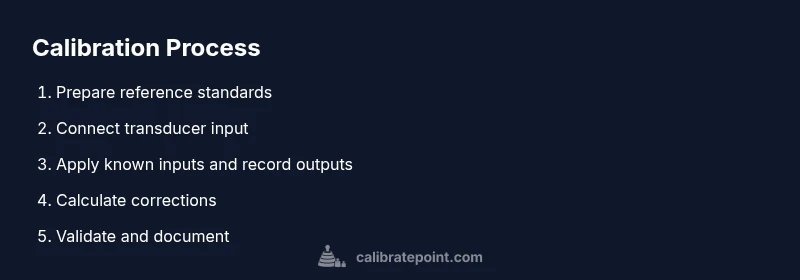
To calibrate transducer, you will plan the sequence, gather materials, and verify instrument readiness. Confirm that reference standards are within calibration, check for any pending maintenance on the transducer, and prepare the data recording system. Prepare a test plan that includes input points across the operating range and the expected output values. A concise plan helps keep the work focused and reduces the chance of missing critical test points. The planning phase also sets expectations for tolerance bands and documentation deliverables.
Step 1: Set up the calibration apparatus
Assemble your test bench so that the reference standard and transducer share a common ground and a quiet electrical environment. Connect the transducer input to the reference signal source, ensuring all connectors are clean and tightened. Calibrate or verify the signal source’s output with an external reference, if available. This setup reduces measurement uncertainty from connection impedance and stray signals. Tip: use short, shielded cables and route power and signal lines separately to minimize noise.
Step 2: Apply zero and span points
Begin with zero input to establish the offset (zero-point) of the transducer. Record the output, then apply the minimum non-zero input within the operating range to establish the span. Repeat at several intermediate points to map the response curve. This multi-point approach helps reveal nonlinearities or dead zones. Pro tip: allow the system to stabilize after each step before recording data to avoid transient effects.
Step 3: Collect data at all test points
Systematically step through the planned test points, allowing stabilization time and capturing multiple samples if possible to average out noise. Note the exact input value and the corresponding transducer output. Compare the measured outputs with the reference values and calculate errors. Document any anomalous readings and re-check connections if needed. Pro tip: use automated logging if available to improve consistency across runs.
Step 4: Compute corrections and update the calibration curve
Using the collected data, compute correction factors for offset and gain. Fit a calibration curve (linear or higher-order as appropriate) that minimizes the sum of squared errors. Apply the correction to the transducer’s signal path or in software, depending on the system’s design. Validate the corrected response by re-taking measurements at key points. Pro tip: keep the raw data; document the chosen model and rationale for future audits.
Step 5: Verify accuracy and document results
Re-test at the previously defined test points using the corrected model. Confirm that errors fall within the acceptance criteria across the full range. Prepare a calibration report that includes equipment IDs, reference standards, environmental conditions, test points, measured outputs, correction factors, and acceptance results. Ensure the report is legible and stored in a central repository for traceability. Pro tip: include a simple pass/fail summary and any recommended recalibration interval.
Step 6: Post-calibration checks and maintenance plan
After successful calibration, perform routine checks to ensure stability over time. Schedule subsequent calibrations per the maintenance plan and update any calibration certificates or labels on the device. Monitor drift during actual operation to detect early signs of decay. A durable maintenance plan reduces rework and protects measurement integrity.
Authoritative sources and further reading
For rigorous guidelines and reference standards, consult established sources. You should verify requirements with your organization’s quality system and relevant regulatory bodies. While calibrating transducers, rely on standards and best practices from recognized authorities to support traceability and compliance.
Tools & Materials
- Calibrated reference standard (pressure/temperature/force, as appropriate)(Traceable to national standards; range must cover the transducer under test)
- Precision signal generator or reference simulator(Capable of producing known inputs within transducer range)
- Multimeter, data logger, or ADC with adequate resolution(High-resolution input/output capture; ensure sampling rate is sufficient)
- Calibration rig or test bench(Helpful for stable mounting and repeatable connections)
- Documentation sheet or electronic logbook(Record all test points, results, and corrections for traceability)
- Inspection tools (wrenches, screwdrivers, cleaners)(Keep connectors clean and tight; avoid overtightening)
Steps
Estimated time: 1-2 hours depending on range and complexity
- 1
Identify transducer type and calibration needs
Review datasheet and determine the appropriate reference standard, input range, and acceptable error. Establish acceptance criteria before starting. This ensures the calibration will meet the system’s requirements.
Tip: Document the transducer model and revision for future audits. - 2
Prepare environment and safety setup
Control ambient conditions and ensure all safety measures are in place. Verify power stability and isolation to prevent damage to equipment or personnel.
Tip: Warm up the transducer and reference standards if recommended by the manufacturer. - 3
Connect reference and transducer input
Secure all connections, verify correct wiring, and confirm the signal path is clean and impedance-matched. Ground references properly to reduce noise.
Tip: Use shielded cables and keep signal paths short. - 4
Apply zero input and then span input
Record the zero output to establish offset. Then apply the minimum span input, followed by mid-range and high-range points to map the response.
Tip: Allow stabilization after each point before recording. - 5
Record data at all test points
Capture multiple samples per point if possible and average to reduce random error. Note any anomalies for later review.
Tip: Label data clearly with timestamps and point identifiers. - 6
Compute corrections and update model
Fit a model to the data (linear or higher order as required). Apply corrections to the transducer signal path or processing software.
Tip: Retain raw data and document the chosen model and rationale. - 7
Validate corrected response
Re-test key points to ensure the corrected output meets acceptance criteria. Confirm consistency across the entire range.
Tip: Include a brief report summarizing pass/fail status. - 8
Document results and plan calibration maintenance
Prepare a formal calibration certificate, log the equipment IDs, and schedule the next calibration interval. Store data in a central repository.
Tip: Set an automatic reminder for the next calibration window.
Questions & Answers
How often should I calibrate a transducer?
Calibration frequency depends on usage, environment, and required accuracy. Establish a schedule based on your process control requirements and regulatory or quality-system expectations, then adjust as needed based on observed drift or failures.
Calibration frequency depends on usage and environment. Set a schedule aligned with your quality requirements and adjust if you notice drift.
What type of reference standards are acceptable?
Use traceable, calibration-certified standards appropriate for the transducer type (pressure, temperature, force, etc.). Maintain records of the standard’s calibration certificate and expiry date.
Use traceable standards with current calibration certificates suited to your transducer type.
Can I calibrate in the field, or should it be done in a lab?
Field calibration is possible if the environment is controlled and appropriate standards are portable. For highly precise or safety-critical applications, a lab-based calibration is preferred to minimize external variability.
Field calibration is possible if conditions are controlled; for critical accuracy, use a lab.
What should I do if the readings are outside tolerance after calibration?
Review setup for wiring, connections, and signal integrity. Re-run the calibration to verify results, and if persistent, consider servicing or replacing the transducer. Document the discrepancy and any corrective actions taken.
If readings are out of tolerance, recheck wiring and try again; if it persists, service or replace the transducer and document actions.
Is temperature a factor I should monitor during calibration?
Yes. Temperature changes can shift sensor output and reference standards. Calibrate at a controlled temperature or record ambient temperature to apply appropriate thermal compensation.
Temperature matters; calibrate in a controlled environment or account for ambient temperature.
Should I zero the transducer before calibration?
Zeroing establishes the offset for the transducer. Confirm zero output at null input before applying span points to ensure accuracy.
Zero the transducer to set the baseline before applying span points.
Watch Video
Key Takeaways
- Plan calibration with clear scope and criteria.
- Use traceable references and document results for traceability.
- Perform multi-point checks to reveal nonlinearity and drift.
- Maintain thorough records and schedule regular calibration.
- Verify safety and environmental controls throughout the process.