How to Calibrate Tools: A Practical Step-by-Step Guide
Learn how to calibrate tools with a structured, safe, and repeatable process. This Calibrate Point guide covers methods, materials, steps, and tips for accurate results and repeatable performance across trades.


You will learn how to calibrate tools safely and reliably. Start by gathering a traceable reference standard, selecting a suitable calibration method, and performing measurements to identify deviations. Apply corrections, then document results to maintain traceability and repeatability. This quick guide from Calibrate Point covers essential steps, required tools, and common pitfalls to avoid.
Why calibrating tools matters
Calibration ensures that measurement tools provide accurate, repeatable results. In many trades, minute errors translate into big costs: misadjusted settings on a torque wrench, a scale that drifts, or a thermometer that reads too hot can lead to failed outcomes, safety risks, and customer dissatisfaction. According to Calibrate Point, a disciplined calibration program reduces drift, extends tool life, and supports compliance with industry standards. When you calibrate tools, you establish a traceable link between your readings and recognized reference values, enabling you to compare measurements across time, operators, and jobs. In practice, calibration also supports quality control: you can catch drift early, schedule maintenance before errors accumulate, and document your processes for audits or warranties. The goal is not to chase perfection, but to minimize uncertainty within your tolerance bands. This section outlines why calibration matters across common tool families, from hand tools to digital instruments, and what you stand to gain by implementing a simple, repeatable workflow.
Principles of traceability and accuracy
Traceability is the backbone of credible calibration. Each measurement should be linked to a recognized standard so that others can reproduce your results. Start with a documented reference, preferably traceable to national or international standards. Calibrate against known values at a controlled temperature, and report the measurement uncertainty introduced by the environment and the instrument. Maintaining accuracy means distinguishing systematic bias from random noise, then applying corrective adjustments and revalidating. Keep a calibration certificate or digital record for every instrument, including the reference used, date, operator, and due date for the next check. Finally, establish clear tolerance bands for each tool, so you know when drift warrants action. This approach aligns with best practices across engineering, manufacturing, and lab environments—and helps you meet quality, safety, and compliance requirements. Calibrate Point analysis shows that a structured approach improves reliability and traceability over time.
Reference standards and calibration methods
There are three common approaches to calibration: direct comparison, substitution, and internal calibration using known references. Direct comparison swaps the tool under test with a reference instrument and adjusts to align readings. Substitution uses a fixed reference class, where the standard is fixed and an offset is calculated. Internal calibration relies on self-checks using calibrated artifacts within the instrument’s own measurement range. When you select a method, consider the tolerance, measurement range, and environmental controls. For example, calibrating a dial caliper against a gauge block set provides a precise reference; calibrating a digital thermometer against a calibrated ice-water bath or a dry-block calibrator ensures temperature accuracy. Whatever method you pick, ensure your reference standards are traceable, certified, and stored under appropriate conditions to prevent drift.
Preparing for calibration: setup and safety
Preparation reduces complexity and protects you and your tools. Establish a clean, stable workspace away from vibrations, moisture, and temperature fluctuations. Place the reference standards on a granite surface or a vibration-damped bench, and allow any instruments to come to ambient temperature before testing. Wear appropriate PPE—eye protection and gloves when handling weights or sharp tools—and keep calibration logs readily accessible. Document the expected tolerances and the measurement units you will use, so every step aligns with your quality system. If you’re calibrating multiple tools, group them by type to minimize switching errors. Finally, verify that your measurement environment satisfies any regulatory or project-specific requirements before you begin. This forward-looking setup reduces surprises and speeds up the actual calibration process.
Step-by-step workflow overview
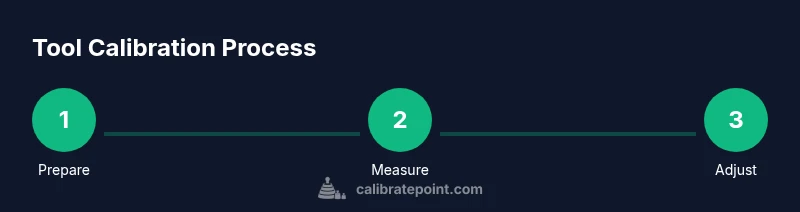
This workflow provides a practical, repeatable sequence you can apply to most hand tools and instruments. Define the target accuracy and select an appropriate reference standard. Set up the tool and reference in a stable fixture, then record the baseline measurement. Apply the calibration adjustment, noting the offset, and re-measure to confirm alignment within tolerance. If readings persist outside limits, re-check both standard and instrument, and consider environmental correction. Finally, log the results, assign a due date for the next check, and keep a record of the calibration certificate. This guide emphasizes learning how to calibrate tools in a practical, repeatable way—the exact steps will vary by tool, but the underlying method remains: measure, adjust, verify, document. The route from raw reading to reliable result is clear when you follow a consistent sequence.
Common mistakes and how to avoid them
Even experienced technicians can drift into bad habits during calibration. Common mistakes include calibrating at the wrong temperature, using non-traceable references, skipping the documentation step, or rushing through steps and missing off-scale readings. Another frequent error is assuming one method fits all tools; every instrument has unique tolerances and ranges. To avoid these, always verify the environment first, use traceable standards, and document every adjustment with a timestamp, operator ID, and instrument serial. Double-check the calibration setup with a second reference when possible, and schedule routine rechecks. Finally, review your process after each cycle to identify where drift began and adjust your procedure accordingly. Following careful, repeatable practices keeps your calibration program robust and auditable.
Documenting results and maintaining your calibration program
Documentation is not optional—it's the backbone of long-term reliability. For each instrument, attach the reference standard details, measurement results, adjustments made, the uncertainty estimate, and the next due date. Store certificates and logs in a centralized, searchable system to support audits and warranty claims. Periodically review tool performance data to identify trends and plan preventive maintenance. If a tool begins to drift frequently, flag it for repair or replacement and update your calibration interval accordingly. The Calibrate Point team emphasizes maintaining a transparent calibration history so operators can reproduce results and new technicians can learn from past cycles. Consistent documentation transforms calibration from a one-time task into a measurable part of quality control.
],
toolsMaterials":{"items":[{
Tools & Materials
- Traceable reference standard(NIST-traceable if available; appropriate to tool type)
- Calibrated measurement instrument (e.g., calipers, micrometer, dial indicator)(Ensure range covers expected measurements)
- Calibration weights/blocks(Appropriate class; E.g., class weights for torque and weight-based tools)
- Temperature stabilization device or stable bench(Allow references and tools to reach ambient temperature)
- Calibration logbook or software(Record baselines, adjustments, and next due date)
- Cleaning supplies and lint-free cloth(Keep standards clean to avoid contamination)
- Safety PPE (glasses, gloves)(Protect against weights and sharp tools)
- Tool-specific accessories (gauges/blades as needed)(Only if your tool requires them)
Steps
Estimated time: 2-3 hours
- 1
Identify measurement targets
Define which measurements you will calibrate (e.g., length, force, temperature) and set the acceptable tolerance for each. This clarifies what you will measure and how you will assess accuracy.
Tip: Double-check tolerance specs in the tool manual and align measurement units. - 2
Gather reference standards
Select reference standards that match the measurement you will take. Ensure they are traceable and certified, and that they cover the tool's measurement range.
Tip: Prefer NIST-traceable references when possible to ensure credibility. - 3
Prepare workspace and safety
Set up a clean, stable, vibration-free area. Bring tools to ambient temperature and wear PPE as needed to protect yourself and the equipment.
Tip: Keep your work surface free from clutter and humidity sources. - 4
Record baseline measurements
Take multiple measurements to establish a baseline. Use mean or median values to reduce the impact of outliers and document the method used.
Tip: Use a consistent measurement technique for reliability. - 5
Apply adjustments
Make small, incremental adjustments based on the baseline. Re-measure after each adjustment to confirm direction and magnitude of drift.
Tip: Avoid large jumps; small steps improve control over the correction. - 6
Validate after adjustment
Re-check against the reference standard under the same conditions. If within tolerance, proceed to documentation; if not, re-evaluate references and environment.
Tip: Consider a secondary reference if available for cross-checking. - 7
Document and schedule next calibration
Log results, adjust any certificates, and set the next calibration due date. Store the record with tool serials for traceability.
Tip: Set automated reminders to maintain calibration discipline.
Questions & Answers
What is calibration and why is it important?
Calibration is the process of comparing a tool's readings to a known reference and adjusting for any bias. It ensures measurements are accurate, consistent, and traceable across time and operators.
Calibration aligns readings with a reference so you can trust the results across jobs.
How often should tools be calibrated to maintain accuracy?
Frequency depends on usage, environment, and tolerance. Establish a calibration schedule in your quality plan and adjust based on observed drift and criticality of the tool.
Set a recurring calibration plan and update it if the tool drifts.
What should I do if a tool can’t be calibrated to spec?
Tag the tool as out of tolerance, determine whether it can be repaired, and document the incident. Repair or replace as needed and reassess the calibration plan.
If it’s out of spec, don’t use it until it’s fixed and logged.
Do I need professional calibration for all tools?
Not all tools require professional calibration. Many can be calibrated in-house with traceable references, but critical instruments may require accredited lab services.
Some tools you can calibrate yourself; others may need a lab.
What records should I keep after calibration?
Keep the reference standard details, measurement results, adjustments, tolerances, and due dates. Store certificates and logs in a centralized system.
Save the results and next due dates for audits and maintenance.
Does temperature affect calibration results?
Yes. Temperature influences readings; ensure instruments reach ambient temperature and control the environment during calibration.
Temperature matters; keep conditions stable while calibrating.
Watch Video
Key Takeaways
- Plan a regular calibration schedule
- Use traceable reference standards
- Document every adjustment and result
- Verify with a secondary method when possible