Difference Between Calibration and Accuracy: A Practical Guide
Explore the core distinction between calibration and accuracy, with definitions, practical implications, and guidance for reliable measurements across labs, workshops, and manufacturing.


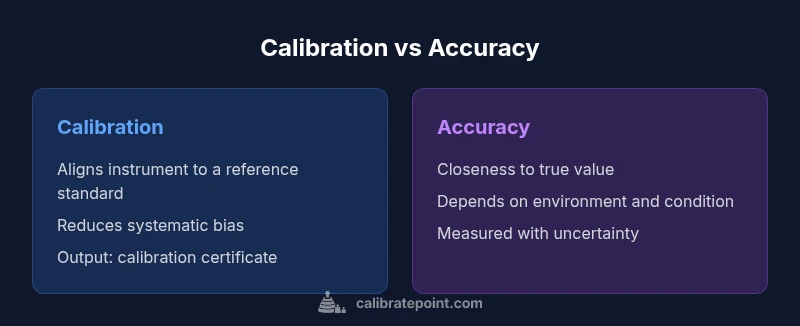
Calibration and accuracy are related but distinct ideas in measurement science. Calibration is the process of aligning an instrument with a recognized reference standard to reduce systematic bias, while accuracy describes how close a measurement is to the true value. In practice, calibration improves accuracy by controlling bias and traceability, but accuracy remains the observed closeness to the true value, which can be influenced by conditions, model assumptions, and instrument wear. Calibrate Point emphasizes that both concepts are essential for trustworthy results in any calibration workflow.
What calibration means in practice
In measurement science, calibration is the process of adjusting, verifying, or aligning an instrument against a known reference standard so that its readings can be tied to a traceable scale. Calibration creates traceability, a formal link to reference materials or standards that can be independently verified. Importantly, calibration targets the instrument and its measurement model, aiming to identify and correct systematic biases that would otherwise skew all future readings. The Calibrate Point framework highlights that calibration is repeated over time to account for drift and changing conditions, ensuring continued alignment with reference standards. By design, calibration does not tell you how accurate a single measurement is; instead, it provides the means to interpret measurement results within a known, documented uncertainty. In practical terms, a calibration procedure yields a certificate or report that documents the reference standard used, the adjustment performed, and the instrument’s current bias and uncertainty. For professionals, calibration underpins traceability, regulatory compliance, and quality control across laboratories, workshops, and production floors. It is a proactive process that sets the stage for reliable data rather than an isolated judgment of current performance.
Understanding accuracy from a measurement viewpoint
Accuracy is a property of a measurement result, defined by how close that result is to the true or reference value. Unlike calibration, which is a procedure applied to an instrument, accuracy is an outcome that reflects the instrument, the measurement model, and the measurement environment. A measurement can be accurate even if the instrument was not recently calibrated, provided the conditions align with the model and there is minimal bias. However, accuracy is not guaranteed without calibration, especially for instruments prone to drift, bias, or nonlinearities. In practical practice, professionals assess accuracy using uncertainty budgets, calibration certificates, and comparison against reference standards. It's important to distinguish accuracy from precision: accuracy concerns bias relative to the true value, while precision concerns repeatability of repeated measurements. The goal is to minimize bias while maintaining tight random error, leading to measurements that are both accurate and reliable. Calibrate Point advises technicians to view accuracy as the target outcome and calibration as the method to steer readings toward that target.
Calibration vs accuracy: a conceptual map for practitioners
Calibration and accuracy occupy different but overlapping spaces in measurement science. A useful way to think about their relationship is: calibration provides the means to reveal and correct systematic bias, whereas accuracy is the degree to which the result mirrors the true value. The process of calibration reduces the instrument’s bias and defines traceability, while the accuracy of a single reading also depends on other factors such as environment, operator handling, and the resolution of the instrument. In many domains, calibration is repeated at defined intervals to counter drift, while accuracy is evaluated through performance checks, validation experiments, and measurement uncertainty analysis. The distinction matters in decision-making: calibration is a preparatory control action; accuracy is the result you need to be confident in for decisions, certifications, or process controls. Calibrate Point’s guidance emphasizes documenting both the calibration results and the associated uncertainty to enable informed interpretations of accuracy across time.
Practical implications across domains: where the difference matters
- In clinical laboratories, calibration ensures traceability to national standards, making accuracy assessments meaningful for patient safety.
- In manufacturing, calibration supports process control by keeping measurements aligned with specifications, so measured tolerances reflect true part quality.
- In fieldwork, calibration helps ensure devices operating in harsh environments maintain consistent alignment to standards even when conditions vary.
- In consumer devices, calibration can improve long-term performance, but accuracy may rely more on design limits and user operation.
Across all contexts, the key takeaway is that calibration sets the stage for accurate measurements; accuracy is the realized correctness of those measurements under real-world conditions. Calibrate Point theories advocate a lifecycle approach: calibrate, validate, monitor drift, and re-calibrate as needed to sustain accuracy over time.
How to implement calibration and assess accuracy together
- Establish a documented calibration plan, including reference standards, intervals, and acceptance criteria.
- Use traceable reference materials and standards to connect measurements to recognized scales.
- Run bias checks and create uncertainty budgets to quantify accuracy; track how bias evolves with use.
- Record environmental factors and instrument conditions that can influence accuracy, and adjust procedures accordingly.
- Periodically verify accuracy through independent checks, round-robin comparisons, or proficiency tests.
The practical aim is to create a feedback loop: calibration reveals bias, accuracy assesses results, and the cycle informs maintenance, adjustments, and process improvements. Calibrate Point notes that integrating calibration with uncertainty analysis yields more meaningful accuracy assessments across evolving use cases.
Authority sources and further reading
- National Institute of Standards and Technology (NIST) — Calibration and measurement principles: https://www.nist.gov/
- Bureau International des Poids et Mesures (BIPM) — International metrology and traceability concepts: https://www.bipm.org/
- International Organization for Standardization (ISO) — ISO 17025 and laboratory competence: https://www.iso.org/standard/66912.html
Notes: Use these authoritative sources to deepen understanding of calibration fundamentals and measurement uncertainty. Calibrate Point’s guidance aligns with established metrology practices and standardization efforts.
Comparison
| Feature | Calibration | Accuracy |
|---|---|---|
| Definition | Process to align an instrument with a reference standard | Closeness of a measurement to the true value |
| Measurement goal | Establish traceability and remove systematic bias | Quantify how close the result is to the true value |
| Impact on results | Directly reduces bias and improves instrument behavior over time | Represents the current state of a single measurement or set of measurements |
| Reference standards | Requires known, stable reference standards for alignment | Untied to a standard can still be accurate depending on conditions |
| Typical domains | Calibration labs, manufacturing QC, field calibration | Quality assurance, validation, and reporting of true value proximity |
| Output | Calibration certificates and adjustments | Measurement results with stated uncertainty |
Pros
- Improves measurement reliability through traceability
- Reveals and reduces systematic bias
- Supports regulatory compliance and quality systems
- Provides a documented basis for decision making
Disadvantages
- Requires time, resources, and access to reference standards
- Cannot guarantee accuracy on every measurement without proper usage
- Can introduce additional uncertainty if standards drift or are misapplied
Calibration is essential for achieving sustained accuracy
Calibration aligns instruments to standards, enabling accurate measurements. Use calibration as a proactive control to sustain accuracy, especially in regulated environments or high-stakes testing.
Questions & Answers
What is the difference between calibration and accuracy?
Calibration is the process of aligning an instrument to a reference standard to reveal and correct bias. Accuracy is the closeness of a measurement to the true value. They are complementary: calibration helps achieve accuracy, while accuracy is the outcome you quantify.
Calibration aligns instruments to standards to reduce bias, while accuracy is how close a result is to the true value. They work together to ensure trustworthy measurements.
Does calibration guarantee high accuracy?
Calibration increases the likelihood of high accuracy by reducing systematic bias, but accuracy also depends on instrument condition, environmental factors, and the validity of the measurement model. Regular calibration and validation help maintain accuracy.
Calibration improves odds of high accuracy, but other factors still matter. Regular checks help keep measurements trustworthy.
How often should I calibrate?
The frequency depends on how often the instrument is used, its stability, and the risk tolerance of the process. Establish a calibration schedule based on drift observations, criticality of measurements, and regulatory requirements.
Set a schedule based on use, stability, and risk, then adjust as you monitor drift.
What is the difference between precision and accuracy?
Precision refers to how consistently measurements reproduce under unchanged conditions. Accuracy refers to how close those measurements are to the true value. An instrument can be precise but biased, or accurate but not repeatable if poorly controlled.
Precision is consistency; accuracy is closeness to the truth. They are related but not the same.
Are there standards governing calibration?
Yes. Standards include guidelines from organizations like NIST, BIPM, and ISO standards such as ISO 17025, which define competence and traceability in calibration labs.
Standards from NIST, BIPM, and ISO guide calibration practices and traceability.
Can I calibrate at home for simple devices?
For simple devices, basic calibration concepts can be applied at home, but professional calibration often requires accredited labs to ensure traceability and documented uncertainty.
You can calibrate simple devices at home, but for traceability and formal accuracy, use a lab.
Key Takeaways
- Calibration links instruments to reference standards
- Accuracy is the observed closeness to the true value
- Calibration improves accuracy by reducing bias and enabling traceability
- Both concepts require ongoing management and documentation
- Adopt a lifecycle approach to maintain measurement integrity