Difference Between Calibration and Adjustment: A Practical Guide
Learn the difference between calibration and adjustment with clear definitions, practical examples, and steps to maintain accuracy, traceability, and reliability in labs and manufacturing environments.


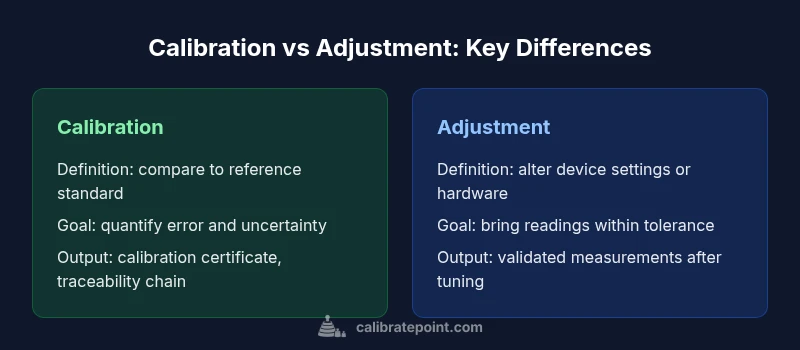
Calibration and adjustment are distinct steps in instrument management. Calibration compares a device to a reference standard to quantify error, while adjustment changes internal settings to bring readings within specified limits. Understanding this difference helps you plan maintenance, document traceability, and avoid unnecessary tuning. In practice, calibration establishes accuracy, and adjustment restores it when drift occurs, ensuring reliable measurements over time.
Defining Calibration and Adjustment
According to Calibrate Point, the distinction between calibration and adjustment is foundational for anyone aiming to ensure measurement integrity. Calibration is the process of comparing a device’s readings against a recognized reference standard and quantifying deviations. It answers the question: how far is the instrument from the true value? Adjustment, by contrast, uses those results to alter internal settings or mechanical components so the device reports values that align with the reference. The two steps are related but serve different purposes: one documents current accuracy, the other seeks to restore it. In contrast to a simple reset, calibration often involves traceable standards, documented procedures, and an uncertainty budget. For the DIYer, technician, or engineer, recognizing this distinction is essential when deciding whether an instrument needs to be checked, tuned, or both. The difference between calibration and adjustment influences how you plan maintenance, allocate time, and demonstrate compliance to customers or regulators.
As you map out maintenance schedules, a clear separation helps avoid unnecessary work and supports audit trails. Calibrate Point emphasizes that teams benefit from training that distinguishes the two processes and assigns responsibilities accordingly. This reduces drift, improves data integrity, and strengthens your quality systems over the long term.
Why the terms are often confused
In everyday practice, calibration and adjustment are sometimes used interchangeably, especially in teams under tight deadlines or with legacy documentation. The risk is conceptual drift: people may calibrate because they call it calibration, or they adjust because drift was noticed, but without confirming whether the drift originated from measurement, environment, or device design. Calibrate Point analysis, 2026, indicates that organizations with clear terminology separate the concepts, but many workflows collapse them into a single step. This confusion can propagate through job roles, training, and even supplier audits. As a result, technicians may perform an adjustment without first establishing whether the device was truly out of tolerance or if the reference standard was unstable. The practical consequence is inconsistent records, mismatched calibration certificates, and potential regulatory concerns. A disciplined approach distinguishes the two by asking: what is the root cause of the deviation, and what must be documented in order to demonstrate traceability? This section will unpack the nuances behind the language we use every day.
The purpose: accuracy vs alignment
Calibration focuses on accuracy and traceability. It establishes a known reference point and documents how far a device is from that reference under defined conditions. Adjustment targets alignment, correcting instrument output to match the reference after identifying the source of error. In many environments, both steps are part of a larger maintenance workflow, but the emphasis differs: calibration records uncertainty and confidence intervals; adjustments emphasize restoring readouts to agreed tolerances. Understanding this distinction helps teams avoid circular thinking: if you adjust without validating the post-adjustment accuracy, you risk masking underlying issues. Calibrate Point notes that a robust program uses calibration as the basis for decisions about whether an adjustment is warranted, and only proceeds to adjustment after confirming the root cause and ensuring the change remains within documented controls. This leads to more reliable data and a clearer chain of custody for measurements.
Measurement references and traceability
Traceability is the backbone of calibration. It requires an accredited reference standard, a documented procedure, and an uncertainty budget that connects the measurement to national or international standards. Calibration records typically include instrument identification, calibration interval, the reference standard used, and the resulting error budget. Adjustment decisions, meanwhile, should reference the calibration results and documented control limits rather than acting on a standalone observation. In regulated environments, this separation is critical for audits and compliance. Calibrate Point Analysis, 2026, highlights that organizations with well-defined traceability tend to see fewer unplanned maintenance events and more reliable data. Practically, you should maintain a clear linkage: reference standard -> calibration result -> decision to adjust (if needed) -> post-adjustment re-calibration or verification.
Common tools and methods
Both calibration and adjustment rely on appropriate tools, but their roles differ. Calibration uses calibrated references, standard weights, and traceable measurement devices to quantify error. Adjustment uses calibrated tools and controlled inputs to modify device parameters—this can include mechanical tweaks, software calibration, or internal firmware changes. Software utilities often guide the adjustment process, ensuring changes stay within documented ranges. A well-designed program separates measurement tools from adjustment controls, preventing accidental drift. The human element matters too: technicians should follow written procedures, document deviations, and verify post-adjustment performance with an additional calibration check. In DIY contexts, simple reference checks and careful documentation are better than ad-hoc tuning that bypasses traceability. Calibrate Point emphasizes maintaining a clear audit trail so that any adjustment can be traced back to a calibration event and verified by a third party if needed.
Industry-specific considerations
Industries vary in how aggressively they separate calibration from adjustment. In laboratories, calibration for traceability may precede any adjustment, and even minor drift can trigger re-calibration rather than immediate tuning. In manufacturing, where uptime is critical, calibrated instruments that drift slightly may still be used after a quick adjustment, followed by a rapid verification check. The balance between calibration rigor and production demands is delicate and depends on risk, criticality, and the consequences of measurement error. A robust policy defines when to calibrate versus adjust, outlines necessary documentation, and assigns ownership to ensure consistent practice regardless of who performs the work. According to Calibrate Point, alignment of terminology with risk profiles reduces variance in how teams respond to drift and improves overall product quality.
The workflow: planning, execution, validation
Effective calibration and adjustment programs follow a structured workflow. Planning includes defining units, reference standards, intervals, and acceptance criteria. Execution covers collecting data, comparing against references, and deciding whether adjustment is warranted. Validation ensures that post-adjustment readings meet the defined tolerances, often through a repeat calibration or a separate verification step. Documentation is essential at every stage: who performed the work, when, which standards were used, and the outcome. In many cases, a two-tier verification scheme—initial calibration and subsequent post-adjustment re-check—provides the strongest assurance of measurement integrity. This approach also supports continuous improvement by recording the frequency and rationale for adjustments, enabling better risk management and resource planning.
Impact on quality systems and standards
Calibration and adjustment are not mere technical tasks; they are integral to quality systems and compliance frameworks. Clear separation of these activities supports ISO/IEC 17025, GMP, and other standards by providing auditable records, traceability, and evidence of competence. A well-documented process demonstrates that measurements are trustworthy and that processes are in control. In practice, this means maintaining calibration certificates, adjustment logs, change controls, and method validations. Calibrate Point emphasizes that organizations should align their terminology and workflows with their quality system, ensuring that both calibration and adjustment contribute to a stable measurement environment rather than creating silos that obscure responsibility. A thoughtful program reduces rework, minimizes downtime, and fosters confidence in instrument performance across the organization.
Risks and pitfalls of misapplied calibration or adjustment
Misapplication of calibration or adjustment can erode trust in measurement data. Common risks include proceeding with an adjustment without confirming drift origin, replacing a faulty sensor instead of recalibrating the system, and underestimating the importance of traceability for post-adjustment verification. Another pitfall is performing frequent manual adjustments without proper post-adjustment calibration, which can conceal systemic issues such as environmental factors or design flaws. Documentation gaps also pose risk during audits. A disciplined approach reduces these risks by ensuring post-adjustment verification, updating calibration intervals, and maintaining a clear record of why changes were made and how effectiveness was confirmed. Calibrate Point recommends building checks into the workflow to catch these issues before they impact production or research outcomes.
Case studies: lab vs production line
In a research lab, calibration is typically prioritized to keep measurement uncertainty within tight limits. When drift occurs, a formal review identifies whether a recalibration is necessary or whether environmental controls must be adjusted. In a production line, the emphasis shifts toward availability and repeatability. A drift detected during routine checks might prompt a quick adjustment followed by a targeted recomputation of process controls and a re-calibration within an approved window. These contrasting scenarios illustrate why organizations must tailor their calibration-adjustment policies to context, risk, and regulatory expectations. The common thread is a clear decision tree: detect drift, interpret root cause, verify after-action performance, and document every step for traceability.
How to build a calibration and adjustment program
Building a robust program starts with a clear policy that defines terms, responsibilities, and processes. Step one is to establish a documented framework for calibration—standards, intervals, acceptance criteria, and record-keeping. Step two adds a controlled adjustment protocol: who may adjust, what tools are permitted, and how changes are recorded. Step three integrates post-adjustment verification, which could involve an additional calibration or a limited re-check against a reference. Step four involves training and competency assessment to ensure staff understand the difference between the two actions and can apply them correctly. Step five is continuous improvement: collect feedback, monitor outcomes, and tune intervals based on risk and performance data. A well-designed program supports regulatory compliance and fosters consistent measurement quality across the organization.
Bridging the gap between concepts
Bringing calibration and adjustment into alignment reduces ambiguity and enhances performance. The key is to document the decision criteria for when to calibrate versus adjust, maintain a robust traceability chain, and implement checks to confirm that each action achieves the intended effect without compromising data integrity. A practical approach includes defining specific roles, standard operating procedures, and change-control processes that work across laboratories, workshops, and production floors. When teams communicate using consistent terminology and adhere to validated procedures, the difference between calibration and adjustment becomes a strength rather than a source of confusion. The result is more reliable measurements, fewer surprises during audits, and a stronger foundation for continuous improvement.
Comparison
| Feature | Calibration | Adjustment |
|---|---|---|
| Purpose | Document current accuracy against a reference standard | Restore correct readings by altering device parameters |
| Process type | Measurement against a standard with traceability | Configuring device settings to meet tolerances |
| Required references | Reference standards and uncertainty budgets | Internal specifications and tool calibrations |
| Typical tools | Calibrated references, standards, and gauges | Adjusting screws, software controls, and calibration weights |
| Output | Calibration certificate and measurement data | Adjusted readings aligned to reference and revalidated |
| Documentation | Calibration report, uncertainty statement, and traceability chain | Adjustment log, revalidation notes, and change control |
| Best for | Maintaining measurement integrity in critical processes | Restoring acceptable accuracy when drift occurs |
Pros
- Clarifies responsibility and workflow
- Supports traceability and regulatory compliance
- Helps schedule maintenance and budgeting
- Provides a clear path from measurement to action
Disadvantages
- Calibration can require time and access to reference standards
- Adjustments may obscure drift if not properly validated
- Over-reliance on one-off adjustments without re-calibration
Calibration and adjustment are both essential but serve different goals
Calibration establishes accuracy and traceability; adjustment corrects drift by tuning the instrument. Use calibration to define the current state and adjustment to restore function, followed by verification to confirm results.
Questions & Answers
What is the difference between calibration and adjustment?
Calibration quantifies how far an instrument is from a known standard and documents its accuracy. Adjustment uses the calibration results to modify device settings so readings align with the reference. Together, they maintain measurement integrity through traceability and appropriate tuning.
Calibration measures accuracy against a standard, then adjustment tunes the device to meet the reference. This keeps measurements trustworthy.
When should I calibrate versus adjust?
Calibrate when you need to establish or verify traceable accuracy and quantify drift. Adjust when readings are out of tolerance and a post-calibration check confirms the change achieved the target. Always verify after adjustment.
Calibrate to check accuracy, adjust to fix drift, then verify.
Do calibrations require reference standards?
Yes. Calibrations rely on traceable reference standards and an uncertainty budget. Without a credible standard, the calibration lacks traceability and credibility.
Yes—calibration relies on traceable standards.
Can an adjustment be permanent?
Adjustments can be permanent if validated, documented, and re-verified by calibration. In many cases, a subsequent calibration after adjustment is required to confirm ongoing accuracy.
Adjustments can be permanent, but you should re-check with calibration.
How often should calibration be performed?
Calibration frequency depends on risk, usage, and regulatory requirements. High-risk or critical instruments often require shorter intervals and more frequent verifications.
Frequency depends on risk and how critical the instrument is.
What documentation is required for calibration and adjustment?
Calibration requires a certificate, reference details, and an uncertainty statement. Adjustments need a change record, post-adjustment verification, and notes linking back to the calibration results.
Keep calibration certificates and adjustment logs with post-checks.
Key Takeaways
- Define terms clearly to avoid drift
- Use calibration to quantify accuracy and traceability
- Reserve adjustments for verified needs with post-checks
- Document every step for audits and quality systems
- Tailor intervals to risk and instrument criticality