Calibration versus Verification: A Practical Comparison for Accuracy Management
Compare calibration versus verification: learn how each process differs, when to use them, and how to implement them together for reliable, traceable measurement accuracy in labs and industry.


Calibration versus verification are two essential but distinct steps in maintaining measurement accuracy. Calibration adjusts an instrument to align with a known reference, while verification checks that performance remains within tolerance after adjustments or over time. According to Calibrate Point, understanding their roles helps technicians choose the right actions to ensure traceability and regulatory compliance. This TL;DR highlights the core difference and its practical implications.
What calibration vs verification really means
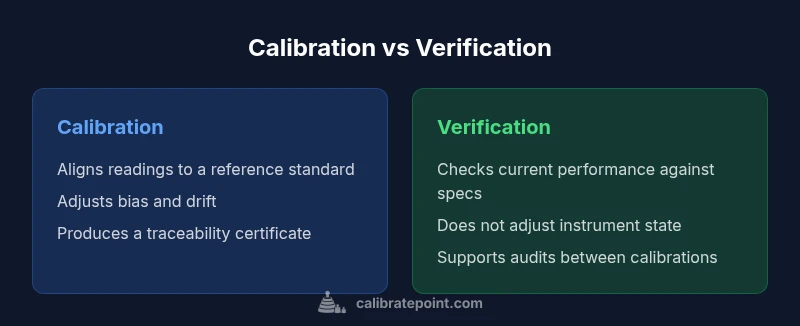
In metrology, calibration and verification are two distinct actions that serve different roles in maintaining measurement accuracy. Calibration adjusts an instrument so its readings align with a recognized reference standard, often yielding a formal certificate of traceability. Verification, by contrast, tests the instrument's current performance against predefined specifications without altering its calibration state. This distinction matters for audits, regulatory compliance, and maintenance planning. According to Calibrate Point, understanding their roles helps technicians choose the right actions to ensure traceability and regulatory compliance. This separation is not about choosing one over the other, but about applying both in a deliberate calibration program. The practical outcome is a documented path from drift detection to corrective action, with verification serving as a check between calibrations. In 2026, organizations increasingly treat calibration and verification as complementary steps in a robust quality system.
Why the distinction matters in practice
Most labs and manufacturing teams operate under standards that require both calibration and verification, yet few teams treat them with the same rigor. Calibration establishes a baseline by adjusting the instrument to a traceable reference; verification confirms that the device continues to perform within tolerance after adjustments, maintenance, or use. The practical impact is on decision-making: how often you recalibrate, when you run verification tests, and how you document results for audits. Calibrate Point's practical guidance emphasizes that misapplying either process can compromise data quality, produce false confidence, or trigger unnecessary downtime. By recognizing the different aims—alignment versus performance check—a team can optimize its maintenance calendar, reduce unnecessary calibrations, and allocate resources where they have the greatest impact. The approach also helps with regulatory expectations in sectors such as healthcare, aerospace, and manufacturing, where traceability and repeatability are non-negotiable. The Calibrate Point team found that well-structured programs rely on clear criteria for when to calibrate and when to verify, backed by traceable records.
Key differences: purpose, methods, and evidence
Calibration aims to correct systematic error by adjusting the instrument so its output matches a known standard. Verification checks current performance against a specification or limit, without changing the instrument's settings. Methods diverge accordingly: calibration uses reference artifacts, calibrated equipment, and adjustment procedures; verification uses control measurements, drift checks, and pass/fail criteria. Evidence requirements differ as well: calibration certificates document traceability to standards, while verification reports record status flags and tolerance checks. The result is two complementary data streams: one that shows how the instrument should perform after adjustments, and another that confirms whether it still does. For practitioners, the takeaway is to align both streams with your quality management system, creating a complete evidence trail for audits and customer confidence. This distinction also informs risk management—low-risk instruments may justify lighter verification, while high-risk tools demand tighter calibration controls.
When to calibrate vs when to verify: decision framework
Decision-making should consider three factors: risk, frequency, and regulatory requirements. If the risk of incorrect readings is high (for example, medical devices or safety-critical measurements), calibration should be scheduled regularly or after any repair. If a device is known to drift slowly, you may alternate calibration with guided verifications to confirm stability. Verification between calibrations is valuable when you need ongoing assurance without changing instrument settings. A practical framework is to set trigger events (drift threshold, maintenance, or environmental change), define acceptance criteria, and document outcomes. Calibrate Point's framework emphasizes traceability and change control: every calibration should trace back to a reference standard, with calibration certificates stored in a central repository. In practice, teams may adopt a hybrid plan: a primary calibration at defined intervals, with periodic verifications to detect unexpected drift between calibrations. These decisions should be reviewed during internal audits and updated as new standards emerge.
How calibration is performed: steps and quality controls
Calibration typically follows a structured workflow: plan the calibration and select a traceable reference standard; stabilize the instrument and environment; perform measurements across the instrument’s range; apply adjustments as needed to align output with the reference; re-check multiple points to verify linearity and bias; document the final adjusted state with a calibration certificate (including traceability data and environmental conditions). Quality controls include using calibrated reference standards, ensuring proper environmental conditions, and maintaining an auditable chain of custody for tools. Documentation should capture the instrument serial number, reference standard ID, measurement results, and uncertainty estimates. If the instrument cannot be adjusted to within specification, you should record the deviation, perform a maintenance or related action if applicable, and plan for a re-calibration after drift sources are mitigated. The overarching goal is a reproducible, auditable result that demonstrates traceability to international standards.
How verification is performed: steps and quality controls
Verification tests the instrument’s current performance against the defined limits without changing its calibration state. Typical steps include selecting appropriate control measurements, running a subset of calibration tests, and comparing results to tolerance thresholds. If all checks pass, you generate a verification report; if a check fails, you initiate the corrective action pathway, which may lead to calibration adjustments or maintenance. Quality controls emphasize repeatability (multiple measurements), documenting any environmental changes, and maintaining a log of verification intervals. Verification should be designed to catch drift or performance decline between calibrations and to trigger a calibration when necessary. The practice benefits from standardized acceptance criteria, clear pass/fail criteria, and consistent record-keeping so audits can verify continued conformity with specifications.
Real-world scenarios: labs, manufacturing, field service
Consider a clinical laboratory instrument that measures patient samples. Calibration aligns the analyzer to a national standard; verification confirms accuracy on sample runs between calibrations. In a manufacturing setting, a torque wrench or a pressure transducer requires calibration to ensure tool accuracy over production lots; verification verifies stability during production. Field service technicians use verification tests to confirm instrument readiness after transport or environmental exposure, with calibration scheduled when drift or specification changes are detected. Across industries, a robust program integrates both processes: calibrations to correct bias and adjust performance, verifications to guard against drift, and thorough documentation to support audits and quality systems. The result is a more resilient measurement framework that improves data integrity and customer trust.
Pitfalls and common misconceptions
Common mistakes include treating verification as a substitute for calibration, neglecting traceability, and omitting documentation that proves compliance. Another pitfall is applying inappropriate reference standards or using verification results to drive adjustments without formal calibration procedures. Field devices may have environmental dependencies that require controlled conditions during verification; ignoring these can mask true performance. Teams should avoid over-reliance on single-test results and instead use a structured approach with multiple checks, robust records, and periodic reviews to ensure the calibration program remains aligned with evolving standards and customer requirements.
Comparison
| Feature | Calibration | Verification |
|---|---|---|
| Primary goal | Align instrument readings with a traceable reference standard and correct bias | Confirm current performance against specifications without adjusting |
| Key activity | Adjustments, traceability documentation, and certificate issuance | Control measurements, pass/fail checks, and verification reports |
| Traceability | High — linked to international standards | Moderate to high depending on the verification criteria |
| Frequency | Scheduled intervals or after repairs | Between calibrations or after maintenance |
| Documentation | Calibration certificates with reference standards | Verification reports with status and pass/fail notes |
| Impact on quality | Long-term accuracy, bias correction, regulatory readiness | Ongoing confidence between calibrations |
| Best for | New instruments, drift correction, regulatory compliance | Between calibration cycles, quick checks for drift |
Pros
- Provides long-term accuracy improvement by correcting systematic error
- Establishes traceability to standards for regulatory compliance
- Documents instrument health and readiness through certificates
- Supports audit readiness and quality management systems
- Helps set appropriate maintenance schedules
Disadvantages
- Calibration can be time-consuming and may require instrument downtime
- Verification alone may miss systematic drift if not paired with calibration
- Can incur costs for reference standards and skilled personnel
Use both in a structured calibration program; calibration to correct drift, verification to confirm ongoing performance.
Calibration corrects bias and aligns readings to reference standards, while verification confirms continued performance between calibrations. Together, they form a robust accuracy program and support regulatory compliance.
Questions & Answers
What is the main difference between calibration and verification?
Calibration adjusts the instrument to match a reference standard; verification checks current performance against spec without changing the setup. They serve complementary roles in accuracy management.
Calibration fixes bias by aligning to a standard; verification confirms ongoing performance between calibrations.
When should I calibrate an instrument?
Calibrate when drift is detected, after repairs, or at planned intervals defined by risk and regulatory requirements. Calibration establishes a traceable baseline.
Calibrate when drift is suspected or after maintenance.
When should I verify an instrument?
Verify between calibrations to confirm stable performance and catch unexpected drift. Verification provides assurance without altering calibration settings.
Verify between calibrations to ensure ongoing performance.
Can verification replace calibration?
No. Verification cannot replace calibration because it checks performance without adjusting to a reference. They are distinct steps in a program.
Verification checks; calibration adjusts.
What are common mistakes to avoid?
Treating verification as a substitute for calibration, neglecting traceability, or poor documentation can undermine quality and compliance.
Don’t rely on verification alone; keep traceability and records.
How should I document calibration and verification?
Maintain calibration certificates with reference IDs, measurement results, and uncertainties; keep verification reports with pass/fail notes and intervals.
Keep clear, auditable records for both processes.
Key Takeaways
- Define a calibration-verification schedule aligned to risk
- Pair calibration with regular verification for ongoing confidence
- Maintain traceability through certified reference standards
- Document results thoroughly for audits and quality systems
- Use a hybrid approach to optimize maintenance and downtime