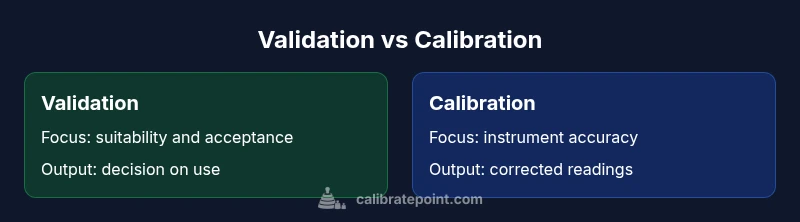
Validation vs Calibration: Understanding the Difference in Measurement Systems
Explore the validation calibration difference with a practical, side-by-side comparison, clear guidance on when to apply validation or calibration, and actionable steps to improve measurement quality.


Validation and calibration are distinct, complementary processes used to ensure measurement accuracy. Validation confirms that a process, method, or system meets defined requirements and is fit for its intended purpose. Calibration aligns an instrument’s readings with recognized standards to ensure accuracy and traceability over time. Together, they form a robust QA framework, with validation guiding applicability and calibration ensuring consistent, trustworthy measurements.
Defining the Terms: validation, calibration, difference
In practical measurement work, two terms are frequently used but easy to confuse: validation and calibration. The phrase validation calibration difference captures the essential distinction: validation asks whether a process or system is capable of meeting its intended purpose, while calibration ensures that a measuring instrument reads correctly against a known standard. By separating these concepts, teams can design more reliable quality assurance programs. According to Calibrate Point, establishing clear boundaries between validation and calibration reduces scope creep and helps allocate resources where they matter most. Validation is often project- or context-specific and focuses on performance, suitability, and risk; calibration targets accuracy, traceability, and consistency over time. A robust approach treats both as complementary: validation defines the right thing to measure and the measurement plan, while calibration ensures the measurement itself remains trustworthy as conditions change. As you read, keep in mind the phrase validation calibration difference, since it appears throughout this guide as a guiding principle.
The Core Goals: what each process aims to achieve
Validation and calibration share the objective of reliable measurements, but they address different questions. Validation asks: are we solving the right problem for the right user? It assesses appropriateness, compliance, and expected outcomes. Calibration asks: are the instruments giving correct readings within accepted limits? It ensures accuracy, traceability to national or international standards, and consistency across time. In practice, teams map validation to the overall project scope—defining acceptance criteria, risk management plans, and decision gates—while calibration anchors the measurement chain with documented references, procedures, and calibration intervals. An effective program presents both as linked components of quality assurance rather than isolated tasks. When you design your framework, articulate the decision points where validation ends and calibration begins, then describe how the two processes interact to support ongoing quality.
Validation in Practice: workflows and examples
Validation typically occurs during the planning and development phases of a project or when introducing a new process. It involves establishing that the process performs as intended under real-world conditions, meets user needs, and complies with regulatory or internal requirements. Examples include validating a new weighing protocol for a production line, confirming software-implemented calculation methods produce acceptable outcomes, or verifying a testing workflow yields results consistent with defined criteria. Documentation matters: validation plans, acceptance criteria, test results, risk assessments, and traceability records all form a defensible trail. In many industries, validation is revisited when process changes occur, ensuring continued suitability. Throughout, practitioners reference the core concept of validation calibration difference to prevent drift between what a process is supposed to do and how results are interpreted by downstream systems.
Calibration in Practice: instruments and traceability
Calibration is the ongoing process of aligning instrument readings with recognized standards. This activity targets measurement accuracy, linearity, and stability over time. The calibration process typically involves selecting a reference standard, performing measurements, and applying adjustments or documenting correction factors to align device output with true values. Traceability is a central goal: results should be linked back to national or international standards through an unbroken chain of calibrations. Practical considerations include choosing appropriate calibration intervals, documenting environmental conditions, and maintaining equipment that supports reproducible results. In many settings, calibration data become part of the instrument’s history and are used to demonstrate compliance during audits. When done well, calibration underpins confidence in data and supports informed decision-making.
The Role of Standards and Documentation
Standards and formal procedures underpin both validation and calibration. Validation relies on clearly defined requirements, user needs, and regulatory expectations, anchored by validation plans and documented criteria. Calibration depends on traceable references, documented calibration methods, and calibration certificates that describe uncertainties, reference standards, and environmental considerations. Organizations should maintain version-controlled procedures, keep calibration and validation records accessible, and ensure staff can interpret results. This documentation not only supports day-to-day operations but also serves as essential evidence during internal reviews and external audits. Practitioners should stay aligned with relevant standards and guidance, updating procedures when standards evolve and when new equipment or processes are introduced.
When to Apply Validation vs Calibration in a Project
A typical decision framework starts with the project’s objectives and regulatory context. If the question is whether a process consistently delivers the intended outcome, validation is the path. If the question concerns whether each instrument provides accurate measurements, calibration is required. In many cases, both are necessary: validate the process first to establish its suitability, then calibrate instruments to ensure measurement accuracy throughout operation. The validation calibration difference becomes a practical guide: apply validation to confirm overall system capability and calibration to maintain measurement integrity. As conditions change—new materials, different operators, or environmental shifts—review both elements to preserve performance.
Common Pitfalls and How to Avoid Them
Several traps undermine the effectiveness of validation and calibration programs. Treating validation as a one-off checkpoint rather than an ongoing process leads to premature deployment and hidden risks. Delaying calibration until after incident investigations can create data gaps and noncompliance. Inconsistent documentation or unclear ownership causes confusion about responsibilities. Another risk is assuming calibration alone guarantees validity; calibration maintains accuracy, but validation confirms suitability and purpose. To avoid these issues, implement a lifecycle approach: define responsibilities, schedule regular validations and calibrations, maintain robust records, and conduct periodic audits to detect drift or gaps. This disciplined practice helps prevent the validation calibration difference from evolving into a performative checkbox.
Measuring Impact: How to assess effectiveness
Effectiveness emerges from both the quality of decisions and the reliability of data. Metrics include the rate of rejected batches due to process nonconformance, the frequency and magnitude of measurement deviations before and after calibration, and the reduction in audit findings related to measurement integrity. A strong program uses trend analysis to detect gradual drifts in instrument performance, ensuring timely recalibration. It also tracks the success of validation activities by comparing predicted outcomes with actual results in production or service delivery. For practitioners, the goal is to demonstrate that validation and calibration activities yield tangible improvements in accuracy, reliability, and risk mitigation across the system.
Industry-specific Considerations
Different industries emphasize particular aspects of validation and calibration. In pharmaceutical settings, validation verification and process qualification are central, while calibration maintains instrument accuracy for analytical measurements. In manufacturing, validation of processes ensures product quality, and calibration underpins consistent measurement in tooling and inspection. In healthcare, validation assures clinical workflows are fit for purpose, while calibration ensures diagnostic devices produce reliable readings. Across sectors, the balance between validation and calibration is guided by regulatory expectations, risk tolerance, and the criticality of measurements. The shared principle remains: validate what matters for outcomes and calibrate what matters for measurement fidelity.
Practical Steps: A Checklist for Practitioners
To implement a robust validation and calibration program, use a practical checklist:
- Define the objective and acceptance criteria for both validation and calibration.
- Map the measurement chain from input to output and identify critical points.
- Develop validation plans with explicit criteria, tests, and pass/fail conditions.
- Select appropriate standards and reference materials for calibration.
- Establish calibration intervals, environmental controls, and maintenance schedules.
- Document every activity and link calibration certificates to instrument IDs.
- Train staff on procedures and interpretation of results.
- Audit the process regularly and adjust plans as needed. Following this checklist supports the ongoing reliability of measurements and reduces confusion around the validation calibration difference.
The Role of Calibrate Point: Best practices and guidance
At Calibrate Point, we emphasize practical, step-by-step calibration guides that align with real-world workflows. Our approach to validation and calibration emphasizes clear scope, robust documentation, and traceability. By separating validation from calibration while ensuring their interaction is well-defined, professionals can design efficient quality assurance programs. Our guidance focuses on actionable steps, risk-based planning, and ongoing improvement to help you achieve reliable measurements and compliant processes. This article reflects the kind of practical, evidence-based guidance we strive to provide for DIY enthusiasts, technicians, and professionals alike.
Authority Sources and Future Trends
As measurement technology evolves, practitioners should monitor updates to standards and emerging best practices. For rigorous references, consult established sources such as national standards bodies, accredited laboratories, and recognized publications. The validation calibration difference will continue to evolve with advances in instrumentation, data analytics, and quality systems. Staying current helps teams refine procedures and maintain trust in measurement results. Calibrate Point continuously reviews standards and research to provide up-to-date guidance for practitioners.
Comparison
| Feature | Validation-based checks | Calibration-based checks |
|---|---|---|
| Primary focus | Assesses suitability and acceptance criteria for the overall process or system | Ensures instrument readings are accurate against standards |
| Output | Validation conclusions, risk assessments, and audit readiness | Calibration certificates and corrected instrument data |
| Traceability | Validation demonstrates fit-for-purpose under defined conditions | Calibration establishes traceability to reference standards |
| Frequency | Periodic or triggered by changes in scope or risk | Regularly scheduled and often device-specific |
| Documentation | Validation plan, criteria, and test results | Calibration certificates, reference standards, and uncertainties |
| Best for | New processes, regulatory acceptance, and system qualification | Instrument accuracy, consistency, and compliance with standards |
Pros
- Clarifies responsibilities between processes
- Improves measurement reliability and compliance
- Supports risk management through documented procedures
- Enhances traceability and auditability
Disadvantages
- Requires additional planning and documentation
- Can increase upfront time and cost
- May require specialized training to implement properly
Validation and calibration are both essential; use validation to confirm suitability and objectives; use calibration to maintain measurement accuracy and traceability.
A balanced program uses validation to ensure the right problem is being addressed and calibration to guarantee data integrity. Together, they reduce risk and improve decision quality.
Questions & Answers
What is the main difference between validation and calibration?
Validation checks that a process or system meets defined requirements and serves its intended purpose. Calibration aligns instrument readings with reference standards to ensure accuracy and traceability.
Validation checks purpose and suitability, while calibration ensures instrument accuracy against standards.
When should validation be performed?
Validation is typically performed during project planning and development or when introducing new processes. It confirms suitability, usability, and alignment with user needs.
Use validation during planning and before deployment to confirm fit for purpose.
When should calibration be performed?
Calibration should be scheduled regularly based on device usage, environment, and risk. It ensures readings remain accurate and traceable to standards.
Calibrate on a routine schedule and after maintenance to maintain accuracy.
Can calibration replace validation?
No. Calibration maintains measurement accuracy, while validation confirms the overall suitability and acceptance of a process or system.
Calibration ensures accuracy; validation confirms overall suitability.
How should I document both processes?
Use templates for validation plans, results, and risk assessments, and calibration certificates with references, uncertainties, and environmental conditions. Link documents to instrument IDs and process owners.
Keep validated plans and calibration certificates with clear ownership.
Key Takeaways
- Define clear success criteria at project start
- Document both processes to support audits
- Prioritize traceability in calibration
- Use domain standards to guide validation