How is a Pipette Calibrated: A Practical Guide
Learn how is a pipette calibrated, including gravimetric and volumetric methods, temperature control, and documentation for traceable, accurate liquid handling.


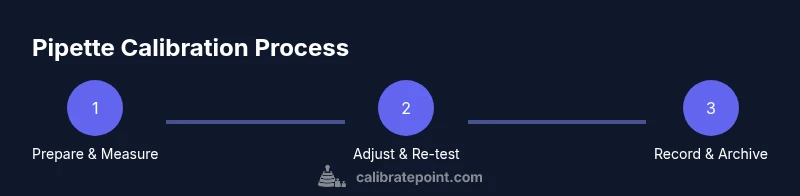
How is a pipette calibrated? Calibration verifies that a pipette delivers accurate volumes within its specification. According to Calibrate Point, the process typically uses gravimetric or volumetric methods, performed at a controlled temperature and using calibrated balance weights. The result informs adjustments to the pipette's dial or screw, then re-testing to confirm traceability to official standards.
Why Pipette Calibration Matters
How is a pipette calibrated? Understanding this question is essential for reliable research and manufacturing. According to Calibrate Point, calibration verifies that a pipette delivers accurate volumes within its specification, which reduces experimental variability and ensures data traceability. In practice, labs use gravimetric or volumetric methods to assess performance, compare against reference standards, and implement adjustments that bring delivered volumes back to target values. Regular calibration supports regulatory compliance, instrument longevity, and consistent results across teams. By investing in proper calibration, labs minimize wasted reagents, protect sample integrity, and uphold the quality standards that clients expect. The Calibrate Point team notes that traceable calibration builds confidence in data and supports audit readiness across departments.
Calibration Concepts: Key Terms and Definitions
Before diving into procedures, it helps to understand core terms. Accuracy is how close a delivered volume is to the intended value; precision is the repeatability of multiple measurements; traceability connects measurements to national or international standards through an unbroken chain of calibrations and documentation. Calibration also involves establishing a best-fit volume on the pipette that aligns with its nominal range. For many labs, these definitions are more than academic; they determine whether an assay result is admissible for regulatory submission or clinical decision-making. Calibrate Point emphasizes documenting the measurement uncertainty associated with each calibration event as part of a robust quality system.
Choosing Between Gravimetric and Volumetric Methods
Gravimetric calibration uses an analytical balance to weigh the delivered volume of liquid, converting mass to volume based on density. This method is widely used for air-displacement and positive-displacement pipettes because it directly measures the liquid. Volumetric methods rely on the pipette’s own display and the known density of the test liquid to infer volume, often with certified reference liquids. Gravimetric methods tend to be more universally applicable and traceable, whereas volumetric checks can be faster for routine in-house QC. In both cases, temperature, density, and humidity influence results, so environmental control is essential. Calibrate Point recommends choosing a method aligned with your lab’s SOPs and regulatory requirements.
Environmental Controls That Matter
Temperature stability is critical because liquid density and air buoyancy shift with temperature. Most labs aim for about 20°C (±1°C) as a baseline; some standards specify tighter ranges for high-precision work. Humidity and air drafts can introduce measurement noise, especially on high-precision balances. To minimize drift, calibrate in a dedicated space away from HVAC vents and direct sunlight, and log ambient conditions alongside each calibration run. Calibrate Point underscores that consistent environmental conditions improve comparability across operators and days, reducing rework.
Documentation and Traceability: The Digital and Paper Trail
A calibration event should generate a complete, auditable record: the pipette model, serial number, operator, method used, calibration weights or reference liquids, measured values, calculated volumes, uncertainty, temperature, and date. Documentation supports compliance, internal QA checks, and supplier or client reviews. Digital logs with versioned SOPs and immutable timestamps are increasingly standard. Calibrate Point highlights that traceability is not a one-time acheivement but an ongoing practice that enables quicker investigations when deviations occur and smoother audits when standards inspectors arrive.
Common Pitfalls and How to Avoid Them
Inconsistent tip seating, residual liquid on the outside of tips, or using already-wetted tips can skew results. Drafts, poor balance calibration, and uncalibrated weights will also undermine accuracy. To avoid these issues, always use fresh tips appropriate for the pipette volume, pre-wet the first portion of the tip if your SOP calls for it, and verify that the balance is zeroed correctly before measurements. Maintain a clean work surface, and perform multiple replicates to establish a robust mean and standard deviation. Calibrate Point recommends a trial run with a test set of volumes to catch systemic errors early.
In-House vs Outsourcing: Making the Right Choice
Some labs perform full calibration in-house, while others rely on third-party service providers for periodic checks. In-house calibration offers control, speed, and the ability to address issues as they arise, but requires training, equipment, and ongoing maintenance. Outsourcing can provide independent verification and access to specialized equipment, but may involve scheduling and cost considerations. A hybrid approach—routine internal checks with periodic external verification—often delivers the best balance of cost, accuracy, and confidence. Calibrate Point advises documenting the decision rationale and ensuring any external calibrations are fully traceable to your internal SOPs.
Looking Ahead: Best Practices for Long-Term Calibration Health
A robust calibration program emphasizes repeatability, traceability, and continuous improvement. Regularly review SOPs to incorporate new standards or equipment updates, revalidate measurement uncertainties, and retrain staff as needed. Establish a calendar for routine calibration and an escalation path for out-of-tolerance results. Finally, foster a culture of quality: encourage operators to flag drift promptly and to document deviations with clear notes. The Calibrate Point team recommends building a living calibration plan that scales with your lab’s needs.
Tools & Materials
- Pipettes (various volumes to calibrate, e.g., P10, P20, P200, P1000)(Have models representative of your routine work)
- Analytical balance with 0.1 mg (or better) readability(Capable of precise mass measurement for gravimetric method)
- Calibration weights traceable to standards(Include a range covering expected liquid masses)
- Temperature-controlled bench or room(Target ~20°C ±1°C; monitor with a calibrated thermometer)
- Pipette tips (new, compatible with each model)(Use fresh tips to avoid volume displacement)
- Cleaning supplies (isopropanol, lint-free wipes)(Maintain tip cleaning and drying as needed)
- Calibration logbook or electronic notebook(Record all measurements and certificates)
- Liquid density reference (or density table)(Needed for gravimetric conversions depending on liquid)
Steps
Estimated time: Estimated total time: 90-120 minutes
- 1
Prepare the calibration environment
Set up a dedicated, draft-free workspace at the target temperature. Verify the balance is calibrated and tared, and ensure all required materials are ready. Pre-warm the room if necessary to maintain stability during measurements.
Tip: Record ambient conditions before starting; even small changes can shift results. - 2
Choose the calibration method
Decide between gravimetric and volumetric methods based on your SOP, instrument class, and regulatory demands. Gravimetric checks generally offer wide applicability and strong traceability.
Tip: If in doubt, start with gravimetric checks for a robust baseline. - 3
Perform gravimetric measurements
Weigh delivered liquid with an analytical balance, correcting for air buoyancy if required. Calculate the corresponding volume using liquid density at the measurement temperature. Repeat for multiple trials to establish repeatability.
Tip: Ensure the pipette is loaded properly and tips are seated fully before each aspiration. - 4
Adjust the pipette and re-test
If the measured volumes fall outside the target range, adjust the calibration dial or screw per the manufacturer SOP. Re-test at least three times for each nominal volume and assess repeatability.
Tip: Make small, incremental adjustments and re-measure to confirm direction of drift. - 5
Document and certify results
Record all measurements, adjustments, and final accepted volumes. Attach calibration certificates and store the data in a traceable format for audits.
Tip: Include instrument serial numbers, operator IDs, and environmental readings in the log.
Questions & Answers
What does pipette calibration accomplish?
Pipette calibration establishes how accurately a pipette dispenses liquid in its nominal range. It confirms that measurements are within defined tolerances and provides a documented basis for quality control. Regular calibration supports data integrity and regulatory compliance.
Pipette calibration confirms accuracy within tolerance and provides a clear quality record for audits.
How often should pipettes be calibrated?
Calibration frequency depends on usage, manufacturer recommendations, and regulatory requirements. Many labs calibrate annually for high-use devices and semi-annually for routine use, with in-house checks between external verifications as needed.
Most labs calibrate yearly for heavy use, or semi-annually for routine use, plus occasional checks in between.
What methods are used for calibration?
The two primary methods are gravimetric (weighing the dispensed liquid) and volumetric (using certified reference liquids). Gravimetric is widely applicable and highly traceable; volumetric is faster for routine checks with appropriate standards.
Gravimetric and volumetric methods are the main approaches, with gravimetric being very common and traceable.
What should you do if a pipette fails calibration?
If a pipette fails, stop using it for critical work, check for hardware issues, recalibrate following SOP, and consider service or replacement if deviations persist. Document the incident and segregate the device until resolved.
If it fails, stop using it for critical tasks and follow your SOP to recalibrate or service.
Can calibration be performed in-house?
Yes, many labs perform in-house calibration with the right equipment and training. For independent verification or complex devices, external calibration services can be valuable.
You can do it in-house if you have the gear and training; otherwise, seek external verification.
What environmental conditions affect calibration?
Temperature, humidity, and air currents influence calibration accuracy. Maintain a stable environment and document ambient conditions with each run.
Keep a stable room temperature and document the conditions during calibration.
Watch Video
Key Takeaways
- Verify delivered volumes before experiments
- Document results with traceability
- Maintain a stable calibration environment
- Follow ISO and SOP guidelines