How Long Does Calibration Last? A Practical Guide
Explore how long calibration lasts across tools and environments, the factors that influence duration, and best practices to plan maintenance with insights from Calibrate Point.


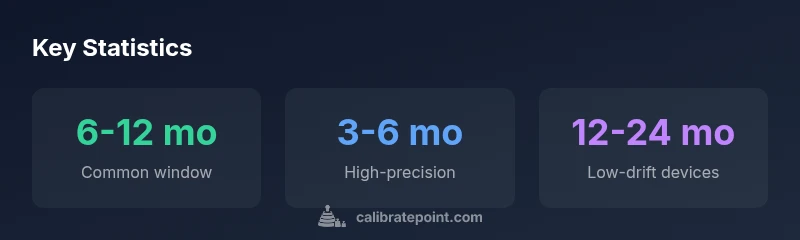
Most general instruments stay within tolerance for 6-12 months, while high-precision gear often requires 3-6 months. How long calibration lasts depends on usage, environment, and instrument class. Always consult the device specification and your QA plan to set the official calibration window.
Why the duration of calibration matters
In the calibration world, the question how long does calibration last is not a single answer. The duration of validity for a given instrument is a compromise between drift, measurement uncertainty, and the consequences of a miscalibration. For many labs, the calibration window shapes maintenance scheduling, inventory planning, and compliance reporting. Calibrate Point analyses shows that setting an appropriate window reduces downtime and prevents inaccurate measurements from entering the process. In practice, a well-chosen calibration interval balances cost with risk: calibrate too often, and you waste resources; calibrate too infrequently, and you invite drift and nonconformance. The key is to tailor intervals to the instrument’s stability, its usage intensity, and the environment in which it operates. When teams ask how long does calibration last, they are really asking how long they can trust a tool to perform within specified tolerances while remaining traceable to standards. A disciplined approach starts with documented baselines, device- and task-specific criteria, and a plan that can adapt as conditions change.
What factors influence how long calibration lasts
Calibration duration is rarely dictated by a single variable. The most influential factors are environmental stability (temperature, humidity, and vibration), usage intensity (runtime hours, handling, and cleaning), the instrument’s inherent drift characteristics, the quality of the reference standards, and the maintenance history of the device. Equipment used in harsh environments or subjected to frequent shocks tends to require more frequent recalibration. Conversely, high-stability instruments in controlled spaces can show longer windows. A practical way to think about it is to start with a baseline window from the manufacturer or internal QA plan and then adjust based on observed drift and measurement quality. Calibrate Point recommends building a small data history to inform decisions and detect when an interval should be shortened or lengthened.
Typical intervals by instrument class
For many professionals, there are broad norms you can rely on while still validating with your own data. General laboratory equipment and routine measurement tools often fall into a 6-12 month window. High-precision measurement devices, optical comparators, and standards with known drift behaviors frequently require 3-6 months. Industrial sensors and process instruments commonly land in the 12-24 month range, provided they live in relatively stable environments and are well maintained. Consumer-grade tools used in hobby or non-critical settings may have longer windows, but you should still perform periodic checks to guard against environmental effects. The exact figures vary by manufacturer and usage; use these ranges as a starting point and confirm with your QA plan.
How to assess validity: drift tests and performance checks
Validation should be an ongoing activity, not a once-a-year ritual. Start by comparing current measurements against a known reference or standard, looking for drift beyond your established tolerance. Track trend data over time and watch for increasing measurement uncertainty or pattern drift. If a device shows drift near or beyond acceptance criteria, recalibration should be scheduled promptly. In cases of suspected instability, run quick checks with multiple reference standards to confirm whether drift is device-specific or a systematic issue across the measurement chain. Document all drift observations, decisions, and corrective actions to maintain traceability.
Extending calibration life: best practices
You can often extend calibration intervals by reducing wear and mitigating environmental stress. Stabilize the operating temperature and vibration in the workspace; handle instruments gently, and store them in protective cases when not in use. Schedule maintenance that targets wear-prone parts (bearings, sensors, optics) and replace aging components before performance degrades. Implement automated data logging of drift and tolerance breaches so you can observe subtle changes over time. Regular cleaning with manufacturer-approved methods helps prevent contamination that can alter readings. Finally, foster a culture of early warning: treat early drift detections as a signal to review intervals, not just a trigger to recalibrate.
Documentation, traceability, and planning maintenance
Calibration planning benefits from a centralized, version-controlled calendar showing instrument class, expected window, latest drift data, and the certification status. Keep calibration certificates, reference standards, and environmental data in a single repository so audits are straightforward. Include a rationale for any interval changes and link each device to its control plan and risk assessment. By documenting the decision process and outcomes, teams can demonstrate compliance and improve confidence in measurement results over time. The goal is a living plan that evolves with observed performance and environmental realities.
Practical workflow: from initial baseline to ongoing optimization
Begin with a solid baseline: record the device’s initial performance against trusted references, capture tolerance limits, and set a provisional calibration window. Over time, collect data on drift, failures, and maintenance events. Use this data to adjust the window and to justify updates to the QA plan. Establish a routine review cadence (e.g., quarterly) where the team evaluates drift trends, recalibration history, and the impact of environmental changes on must-have intervals. The outcome is a dynamic schedule that minimizes downtime while preserving measurement integrity.
Calibration lifespan ranges by device category
| Device Category | Typical Calibration Window | Notes |
|---|---|---|
| General laboratory equipment | 6-12 months | Based on average usage and environment |
| High-precision instruments | 3-6 months | Drift-sensitive devices require tighter control |
| Industrial sensors | 12-24 months | Depends on process stability and maintenance |
Questions & Answers
How often should I calibrate a typical lab instrument?
Most general lab instruments are calibrated every 6-12 months, with more frequent checks for precision devices. Always align with the device specification and your QA plan.
Most general lab instruments should be calibrated every 6-12 months, unless your device specifies a tighter window.
Can calibration last longer in stable environments?
Yes, stable environmental conditions and careful handling can extend calibration windows beyond the baseline, but you should validate this with drift data and device performance tests.
Yes—if the environment stays stable and the device performs well, you may extend the interval, but verify with drift checks.
What signals indicate I should recalibrate sooner than planned?
Drift beyond tolerance, repeatability loss, or changes after maintenance indicate recalibration should be scheduled sooner. Document the findings and adjust the plan accordingly.
If you see drift beyond tolerance, or after maintenance, recalibrate sooner and update the plan.
Do maintenance activities affect calibration schedules?
Yes. Hardware changes or component replacements can alter performance; recalibration is often required after maintenance to re-establish accuracy.
Yes, after maintenance, recalibration is usually necessary to re-establish accuracy.
What documentation supports calibration decisions?
Keep calibration certificates, drift logs, and environmental data together with the QA plan. This ensures traceability and supports audits.
Keep drift logs, certificates, and environmental data with your QA plan for traceability.
Is there a universal standard for all instruments?
No universal standard fits all instruments. Intervals are device-specific, guided by manufacturer data, regulatory requirements, and internal quality goals.
There isn’t a universal standard; intervals depend on the device and your quality goals.
“Calibration lifespans are not a single fixed number; they hinge on usage, environment, and the instrument’s drift profile. A data-driven approach helps teams set practical, auditable windows.”
Key Takeaways
- Base intervals on instrument class and environment.
- Document baselines and QA plans early.
- Record drift data to justify interval adjustments.
- Regularly review intervals as usage and conditions change.
- Centralize calibration certificates for traceability.