How Often to Calibrate Scales: A Practical Guide
Learn how often to calibrate scales across lab, workshop, and industrial settings. This guide explains factors, intervals, and best practices to maintain accuracy, traceability, and audit readiness.


Most scales used in routine lab, workshop, and manufacturing settings should be recalibrated every 3–6 months. If your workflow demands higher accuracy, increase this to 1–3 months for critical measurements or high-usage periods. Between full calibrations, perform periodic checks to detect drift early and keep records for traceability. Always align with your internal quality policy.
Why Regular Scale Calibration Matters
In any environment where precise weight matters, calibration ensures that your readings reflect true mass rather than drifting measurement. A miscalibrated scale can lead to material waste, incorrect dosing, yield variability, or nonconformance with specifications. The question 'how often to calibrate scales' depends on intended accuracy, usage patterns, and environmental conditions. According to Calibrate Point, establishing a routine calibration rhythm tailored to your usage and to the scale class prevents gradual drift from eroding trust in measurements. The goal is to maintain traceability to national or international standards and to support repeatable processes across batches. When you document the calibration history, you build a defensible measurement record that auditors recognize. In practice, you should also plan for routine checks that catch drift before it affects critical outcomes. For most users, a baseline schedule of quarterly or semi-annual calibration provides a solid starting point, with adjustments as needed.
Factors Influencing Calibration Frequency
Several variables drive how often a scale should be recalibrated. First, the scale type matters: analytical balances and microbalances generally require tighter intervals than large industrial scales. Second, usage intensity matters: a lab environment with dozens of weighings per hour will drift faster than a small shop that weighs a few items daily. Third, the environment influences drift: humidity, temperature fluctuations, vibration, and exposure to solvents can degrade calibration stability. Fourth, calibration history and observed drift guide scheduling: if drift starts to creep, shorten the interval; if drift remains consistently within tolerance, you may extend it. Finally, regulatory or customer requirements — including internal quality policies — can set minimum or maximum intervals. Calibrate Point analysis suggests documenting decision rules so that anyone can understand the chosen interval at a glance.
How to Set a Calibration Schedule for Different Scales
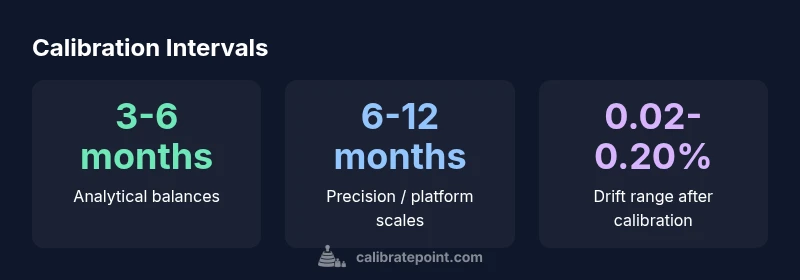
Identify the scale class (analytic, precision, platform) and consult the manufacturer’s guidance. Establish a baseline interval: 3–6 months for analytical balances, 6–12 months for precision and platform scales used less intensively. Define a drift tolerance (for example, 0.02–0.10%). Create a calibration calendar and assign responsibility to a trained technician. Schedule an initial calibration to verify the baseline, then monitor drift for the next two cycles; adjust the interval if needed. Implement a clear policy describing how exceptions are handled (e.g., after a repair or relocation). Documentation should live alongside the instrument’s maintenance file. The key is consistency—when teams understand the rule, measurements stay traceable and auditable.
Fixed-Interval vs. Event-Driven Calibration
Fixed-interval calibration follows a clock-based schedule (every 3, 6, or 12 months). Event-driven calibration triggers when a known event occurs (post-move, after a service, or when drift exceeds tolerance). Event-driven checks are valuable for high-variability settings but require a robust procedure to avoid missed calibrations. A hybrid approach—regular fixed intervals with event-driven checks between calibrations—offers both reliability and flexibility. Calibrate Point recommends documenting trigger criteria and ensuring that staff can initiate an unscheduled calibration if measurements show abnormal drift or after maintenance.
Practical Field Checks Between Calibrations
Between full calibrations, perform quick checks using certified weights that cover the scale’s operating range. A 1–3 minute check can reveal obvious issues: door vibrations, draft, or balance errors. Record the check results, noting weight used, time, environmental conditions, and any corrective actions. If a field check shows drift beyond the tolerance, escalate to a full calibration sooner rather than later. These routine checks act as a first line of defense against gradual drift and help protect product quality between formal calibrations.
Maintaining Traceability: Weights, Standards, and Documentation
Calibration relies on traceable weights that themselves are calibrated against primary standards. Maintain a weight set with a declared accuracy, calibration certificate, and storage conditions. All calibration events should be logged in a centralized system with date, operator, instrument ID, calibration method, reference standards, and observed drift. Regular reviews of the calibration history help identify patterns and justify interval adjustments. Good documentation supports audits, supplier assessments, and internal quality assurance programs while reinforcing confidence in measurement results.
How to Conduct a Calibration Check: Step-by-Step
- Verify the instrument is clean, stable, and at operating temperature. 2) Select a known, certified calibration weight near the scale’s typical measurement range. 3) Record the reading, subtract the weight value, and calculate the deviation. 4) Repeat with multiple weights to assess linearity. 5) If results are outside tolerance, perform a full calibration and update the calibration log. 6) Return the instrument to service with the corrected settings and note any follow-up actions required. This workflow keeps calibration rigorous without becoming onerous.
Data Logging and Record-Keeping for Compliance
A good calibration program stores all results in a centralized ledger or LIMS, linking each calibration event to the instrument, operator, and standard used. Keep certificates, certificates of conformity, and any adjustment notes. Establish retention policies to meet regulatory or customer requirements. Regular audits should verify that drift is within tolerance, that intervals are being observed, and that any deviations are properly tracked and resolved.
Industry Guidance and Standards: Aligning with Best Practices
Align calibration schedules with recognized frameworks and standards to maintain consistency across sites. Use internal policies to tailor intervals to your environment while preserving traceability to national or international standards. The Calibrate Point team emphasizes the importance of documented decision rules and transparent processes to support audit readiness. When possible, reference standards from national metrology institutes and satisfy quality-management expectations through ISO-compliant calibration procedures.
Building a Calibration Plan for Your Shop or Lab
Create a written calibration plan that defines scope, intervals, responsibilities, and documentation. Start with a baseline schedule (3–6 months for routine scales) and customize it for your usage and instrument class. Include a procedure for out-of-tolerance readings and for requalification after repairs, relocation, or servicing. Train staff on the process, assign a calibration owner, and schedule the first verification cycle. Review the plan periodically to incorporate new equipment, updated policies, and evolving regulatory requirements.
Calibration intervals by scale type and expected drift ranges
| Scale Type | Recommended Interval | Typical Drift | Notes |
|---|---|---|---|
| Analytical balance | 3-6 months | 0.02-0.10% | Lab-grade precision required |
| Precision scale (0.1 mg - 1 g) | 6-12 months | 0.05-0.15% | QC applications, moderate use |
| Industrial platform scale | 6-12 months | 0.02-0.20% | Rugged environments may need checks |
Questions & Answers
How often should I calibrate scales used for high-precision measurements?
For high-precision measurements, calibrate more often and follow a tighter drift tolerance. Use a documented policy that triggers recalibration after a predefined drift is observed or after any service. This keeps results trustworthy and auditable.
For high-precision work, calibrate more often and follow a stricter drift limit to keep results trustworthy.
Is it acceptable to skip calibration if readings appear stable?
No. Apparent stability can hide gradual drift. Always perform scheduled calibrations and corroborate stability with occasional independent checks or challenging weights to ensure the device remains within tolerance.
Stable readings can still drift; calibrate per policy and verify with checks.
What factors determine a shorter calibration interval?
Increased usage, harsher environments (vibration, humidity, solvents), recent repairs, relocation, or regulatory changes can shorten intervals. If drift appears earlier than expected, reduce the interval accordingly.
Heavy use, harsh environments, and recent changes can shorten the interval.
What kind of weights are needed for calibration?
Use certified, traceable weights with a range covering the scale's measurement spectrum. Calibrations should reference weight classes appropriate to the device (e.g., class E2 or better for analytical balances).
Use certified, traceable weights that cover the device’s range.
How should I document calibration events for audits?
Maintain a centralized calibration log with instrument ID, date, interval, standard used, drift observed, and any adjustments. Include certificates and operator initials. Regularly review the log for completeness and accuracy.
Keep a centralized log with all calibration details and certificates.
“Regular, documented calibration schedules are the backbone of measurement confidence.”
Key Takeaways
- Define a clear calibration interval based on usage
- Use certified weights and traceable standards
- Document every calibration for audits
- Review intervals after major process changes