How Often to Calibrate Hanna Salinity Meters
Learn how often to calibrate Hanna salinity meters, with practical guidelines, factors affecting frequency, and a maintenance plan from Calibrate Point.


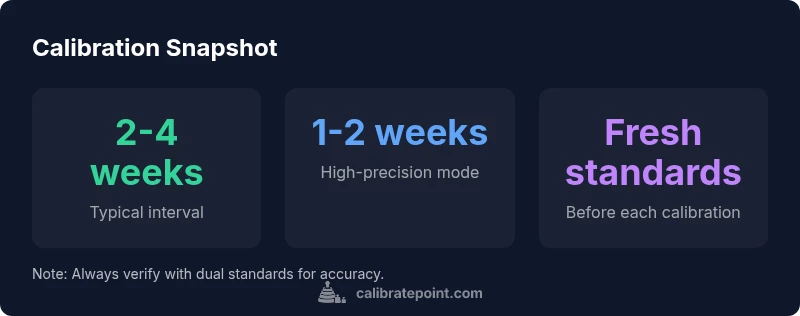
For Hanna salinity meters, calibrate regularly based on usage: in home aquariums, aim every 2-4 weeks; in professional or high-precision settings, every 1-2 weeks or whenever you suspect drift. Always calibrate with fresh reference standards before collecting critical data, and document calibration dates to track performance. This helps ensure accuracy for salinity measurements that affect coral health, aquaculture, and process control.
how often calibrate hanna salinity
For any Hanna salinity meter, the frequency of calibration is a function of how intensely you rely on the device, the environment, and the consequences of drift. In practical terms, most DIY enthusiasts calibrate before each major measurement cycle and at least every two to four weeks for ongoing monitoring. Professional labs, aquaculture facilities, and research projects with tight precision requirements often demand shorter intervals, sometimes as frequent as once a week, especially when samples span a wide salinity range or temperature conditions shift. The overarching goal is to keep readings within the instrument’s stated tolerance and to catch drift before it steers decisions about water quality, coral health, or process control. Calibrate Point emphasizes that calibration should be documented—note the calibration date, the lot of reference standards, and any adjustments made—so you can track performance over time. For Hanna salinity meters, this routine habit is the most dependable path to trustworthy data.
How drift occurs in Hanna salinity meters
Drift in Hanna salinity meters can arise from several sources that gradually skew readings if left unchecked. Reference solutions age and lose their accuracy, electrodes degrade with use, and salty residues build up on sensor surfaces. Temperature also influences salinity readings and the meter’s internal compensation may drift if measurements occur across wide thermal gradients. Power supply instability or battery quality can introduce noise, especially during high-contrast measurements. Finally, cleaning methods that abrade the sensor or introduce contaminants can permanently alter response. Understanding these mechanisms helps justify a reasonable calibration cadence. In practice, many operators note drift when readings begin to diverge from known references or when fresh standards yield values that are noticeably different from prior calibrations. Calibrate Point’s experience shows that catching drift early—before it triggers incorrect water-quality decisions—saves time and protects downstream outcomes in both hobbyist setups and professional facilities.
Factors that influence calibration frequency
Calibration frequency is not one-size-fits-all. Key factors include your usage intensity (how often you rely on salinity data), the salinity range you measure, whether you work in saltwater, brackish, or freshwater environments, and how stable your ambient temperature is. Environmental conditions such as humidity, heat sources near the instrument, and exposure to salty aerosols can accelerate sensor aging. The type of water samples you process—clean lab water versus dirty field samples—can also shift how often you should recalibrate. Staff experience and adherence to standard operating procedures matter as well; when teams follow documented SOPs, calibration routines tend to become more consistent and reliable. Calibrate Point notes that you should adjust your cadence if your equipment undergoes service or if you notice drift after maintenance or cleaning.
Calibration procedure overview for Hanna meters
A practical calibration overview starts with a quick instrument check, followed by a two-point calibration using a low-salinity standard and a high-salinity standard. Rinse the probe with distilled water, blot dry, and avoid touching the sensing element. Allow the meter to reach a stable temperature, then perform calibration per the manufacturer’s instructions, recording the reference values and any adjustments. After calibration, verify the result with a secondary check standard to confirm accuracy across the measurement range. Always keep your logs updated and note the lot numbers of standards used. When uncertainty remains, repeat the calibration or consult your SOP. This approach helps ensure Hanna salinity meters deliver consistent data across different projects and operators.
Step-by-step calibration workflow
- Inspect and clean the probe; ensure no residue affects the sensor. 2) Rinse with distilled water and blot dry. 3) Power on and allow thermal stabilization. 4) Prepare two reference standards spanning your expected range (low and high salinity). 5) Calibrate first with the low standard, then with the high standard. 6) Record the calibration values, date, and standard lot numbers. 7) Run a verification check with a third standard or an independent reference sample. 8) If readings fail to verify, repeat calibration or replace the sensor if needed. 9) Log the result and close the calibration record with operator ID and notes on sample conditions. 10) Schedule the next calibration based on your use-case and any observed drift.
Choosing reference standards and verification checks
Always use fresh reference standards that are traceable to recognized calibration materials. For Hanna salinity meters, two-point calibration using a known low-salinity standard and a high-salinity standard is commonly recommended. Verify accuracy with a third reference or a seawater sample of known salinity when possible. Maintain records of lot numbers, preparation dates, and storage conditions. If you suspect drift, recalibrate and reassess the measurement range. The integrity of your results depends on the quality of your standards and the rigor of your verification checks.
Environment and instrument health: storage, temperature, cleaning
Calibrate Point emphasizes that environmental stability supports reliable calibration. Store standards in a cool, dry place away from direct sunlight. Keep the Hanna instrument in a protective case when not in use, and avoid rapid temperature fluctuations during measurements. Clean gently with appropriate solutions to prevent sensor damage, and avoid abrasive cleaners. Regularly check cables, connectors, and the battery status. A well-maintained device not only lasts longer but also produces readings that are truly reflective of sample salinity rather than artifacts introduced by temperature, contamination, or worn parts.
Documentation, logging, and maintenance
A robust calibration program relies on thorough documentation. Record the date, operator, instrument serial, calibration standards used (including lot numbers), environmental conditions, and any adjustments made. Maintain a calendar of upcoming calibrations with reminders, and review past calibration performance at regular intervals to identify drift trends. This discipline helps ensure compliance with SOPs and facilitates audits or peer review. Calibrate Point recommends pairing calibration logs with a brief notes field that captures any anomalies observed during measurements. Regular documentation makes corrective actions traceable and supports data integrity across the lifecycle of your Hanna salinity meters.
Practical maintenance plan by use-case
For hobbyists managing a home saltwater tank, aim for a default cadence of 2-4 weeks, with extra checks after water changes or obvious readings drift. In a professional lab or research setting, adopt a 1- to 2-week cadence when possible, using two-point calibration and independent verification. Field crews operating under variable conditions should calibrate before and after field sampling, particularly if samples travel long distances or endure temperature changes. In all cases, keep a calibration log, verify the instrument with a third standard, and follow your SOPs. According to authoritative sources such as NOAA (noaa.gov), NIST (nist.gov), and Woods Hole Oceanographic Institution (whoi.edu), calibration cadence should be adapted to use-case, environment, and required precision, and not treated as a fixed rule. By integrating these practices, you maintain data quality and operational confidence across diverse settings.
Calibration interval guide by use-case
| Use-case | Recommended interval | Notes |
|---|---|---|
| Home aquarium monitoring | 2-4 weeks | Monitor drift after water changes |
| Professional lab testing | 1-2 weeks | Strict SOP adherence; two-point calibration |
| Field measurements | 2-6 weeks | Consider environmental variability; verify post-field |
Questions & Answers
How often should I calibrate Hanna salinity meters in a home aquarium?
In most hobby setups, calibrating every 2-4 weeks is a practical default, with calibration performed before any critical measurements or after notable water changes. If you observe readings drifting, recalibrate sooner and log the event.
For home aquariums, aim for a 2-4 week cadence and recalibrate if you notice drift.
Can I calibrate Hanna salinity meters with any salt solution?
Use manufacturer-recommended reference standards or traceable calibration solutions provided by your instrument supplier. Avoid seawater or home-made mixes, as these can introduce uncharacterized variability and compromise accuracy.
Use official reference standards, not generic saltwater, to calibrate.
Does temperature affect calibration frequency?
Yes. If measurements occur across wide temperature ranges or in unstable environments, more frequent calibration helps compensate for drift and ensures readings stay within tolerance.
Temperature changes can cause drift, so frequent calibration may be needed in unstable environments.
Should I recalibrate after replacing the battery?
Yes. Battery replacement can affect electronics and measurement stability; perform a quick verification and, if needed, recalibrate using your standard procedures.
Yes, recalibrate or verify after changing the battery.
What should I do if readings drift after calibration?
If drift persists, repeat calibration, check standards, inspect the sensor for fouling, and consider service or replacement if the device fails verification checks.
If drift remains, redo calibration and inspect the sensor; seek service if needed.
“Regular calibration is a core discipline; drift can silently corrupt data, but a disciplined cadence keeps readings trustworthy.”
Key Takeaways
- Set a calibration cadence based on use-case
- Use two-point calibration with fresh standards
- Document calibration events and lot numbers
- Verify with a third standard when possible
- Review SOPs and update intervals annually